
Appendix Settlement Family Life is where the family routes finally converge: partners, parents and private life applicants reach indefinite leave through it, on five- or ten-year qualifying periods that can — within rules — combine time across routes. This guide explains the appendix's architecture, which routes stack toward settlement, the suitability and residence requirements as they now stand, and how the £3,226 application actually runs.
On This Page

Where the Family Routes End Up
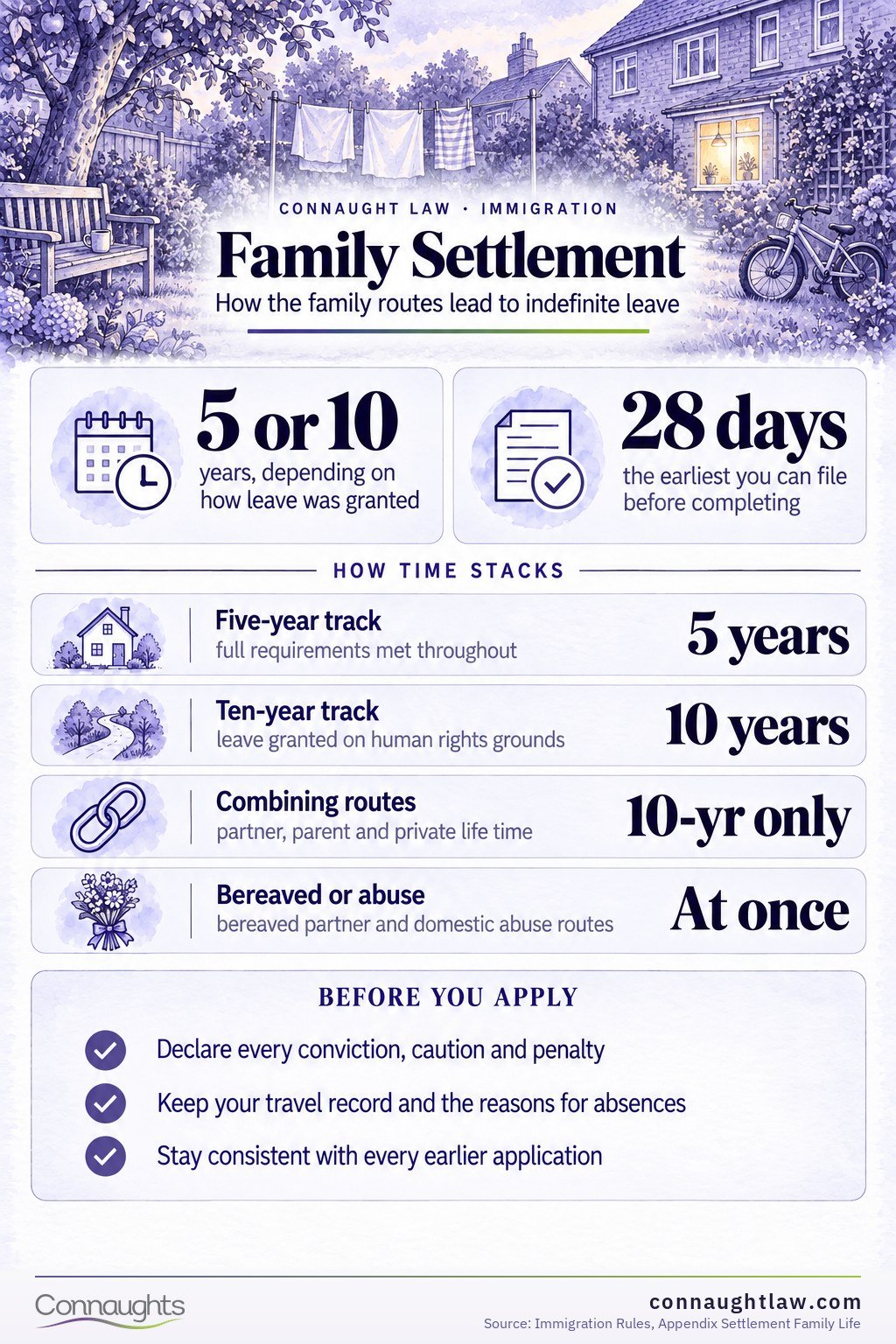
Appendix Settlement Family Life governs indefinite leave for partners, parents and private life applicants alike, and the qualifying period a family serves depends on the basis their leave was granted under: five years where the full requirements were met throughout, ten where leave rested on human rights grounds. Time across those routes combines on the ten-year clock but not the five. Suitability and genuine residence are then tested afresh at settlement.
The Appendix
Core Principles
Appendix Settlement Family Life governs settlement for people whose leave was granted on family and private life grounds — pulling requirements once scattered across Appendix FM and the private life rules into one framework. Its organising idea: the qualifying period you serve depends on the route your leave was granted under, and the settlement application tests that the basis of your leave still holds, your conduct qualifies, and your residence was real.
Qualifying Routes
Routes and Timelines
Five-year tracks serve partners and parents who met the full requirements — income, English, relationship — throughout; ten-year tracks serve those granted on human rights grounds where some requirement could not be met. Children, bereaved partners and victims of domestic abuse have their own accelerated provisions — the bereaved partner route settles immediately, as does the domestic abuse route, and children's tracks are mapped in our child ILR guide.
Key Changes
Suitability Tightening
Recent rule cycles have hardened the suitability thresholds settlement applications face — criminality assessed under the Part Suitability framework, with sentence-based bands replacing older discretionary formulas — and family settlement decisions now apply the same conviction arithmetic as the rest of the system. The direction matters for planning: conduct issues are better resolved before the settlement application than explained within it.
Combination Flexibility
The other modern development is flexibility between family routes: time accrued as a partner, a parent or on private life grounds can, in defined combinations, count toward the ten-year settlement clock rather than restarting it at each switch. For families whose circumstances shifted — a relationship ending, a child's status changing — the combination rules often shorten the road by years.
Route Combinations
Eligible Combinations
Which Routes Combine
- Ten-year clock: time on the partner, parent and private life routes combines where each grant was on the family/private life framework.
- Five-year clock: requires the full period on five-year-route terms — dropping to a ten-year route restarts the faster track.
- Moving up: switching from a ten-year to a five-year route is possible when requirements are later met, with the five-year period running from that grant.
- Outside time — visitor stays, work routes — does not join the family settlement clock.
Route Strategy
The strategic question for most ten-year-route families is whether to switch onto the five-year track mid-way — worth it when the financial and English requirements have become meetable, since five years from the switch frequently beats the ten-year balance. The comparison mechanics, and when each track wins, are worked through in our 5-year versus 10-year route guide.
Suitability
Criminal Conviction Framework
Custodial sentences of twelve months or more ground refusal; shorter sentences and persistent offending are assessed on defined criteria; and non-custodial matters feed the discretionary picture. Every conviction, caution and penalty must be declared — across a ten-year qualifying period many applicants accumulate something, and the disclosed minor matter is routinely survivable where the concealed one is fatal.
Other Suitability Grounds
Deception in any previous application, NHS debt above thresholds, and litigation-debt grounds complete the suitability picture. The settlement application re-opens the whole file — earlier applications' contents included — so consistency with everything previously submitted is part of preparation.
Residence Rules
The Family Residence Test
Family settlement's residence requirement differs from the work routes' 180-day arithmetic: the question is whether the UK remained your home through the qualifying period, with absences assessed for reason and pattern rather than against a single numeric cap. Long or repeated absences still endanger applications — particularly where they suggest family life was actually conducted elsewhere — so the travel record and its explanations belong in the evidence.
Route-Specific Considerations
Partners must also show the relationship subsisting and cohabitation across the period; parents must show continuing parental involvement; private life applicants continuity of the life the route protects. Each route's evidence accumulates best contemporaneously — tenancies, joint accounts, school letters — rather than being reconstructed at year five or ten.
Applying
The Decision Framework
Applications go through the SET(M), SET(F) or private-life settlement processes at £3,226 per applicant, with English at B1 and the Life in the UK test for adult applicants, and decide within the six-month settlement standard — super priority where offered compresses clean files. Caseworkers test three things in order: the qualifying period's arithmetic, the route requirements' continuity, and suitability.
Timeline and Practicalities
File within 28 days of completing the qualifying period at the earliest, with the evidence organised by requirement rather than by date. Where the family's history spans switches, curtailments or human rights grants, a professional audit of the period's arithmetic before filing prevents the expensive surprises — and the processing landscape for family and settlement casework is tracked in our family processing times guide.
Frequently askedQuestions about family settlement
What is Appendix Settlement Family Life?
The Immigration Rules appendix governing ILR for people on partner, parent and private life routes — setting the five- and ten-year qualifying periods, the combination rules between routes, and the suitability and residence requirements.
Can I combine different family routes toward settlement?
Yes, on the ten-year clock — partner, parent and private life time combines where each grant sat in the family framework. The five-year clock demands the whole period on five-year terms.
Is there a 180-day absence rule for family settlement?
Not the work-route version — family residence is assessed on whether the UK remained your home, with absences judged by reason and pattern. Long unexplained absences still refuse applications; keep the travel record and its reasons.
How much does family route ILR cost?
£3,226 per applicant, plus the £50 Life in the UK test and English certification where needed. Fee waivers do not apply to settlement applications, which makes the budgeting part of the ten-year planning.
Do convictions stop family settlement?
Custodial sentences of 12 months or more ground refusal; lesser matters are weighed on recency and pattern. Declare everything — across a decade most files contain something, and disclosure is what keeps minor matters minor.
Should I switch from the 10-year to the 5-year route?
Often — once income and English requirements are meetable, five years from the switch can beat the remaining ten-year balance. Run the arithmetic both ways before the next extension, not at settlement.
Send us every grant letter in date order. We'll compute the qualifying arithmetic, pick the faster track and file the settlement application when it first becomes winnable.
Get Expert Advice