
The Adult Dependent Relative route lets a British or settled person bring an elderly or disabled parent, grandparent, adult child or sibling to the UK — and it is the hardest family route in the Immigration Rules to satisfy. The applicant must need long-term personal care and must be unable to get that care where they live, even with the sponsor paying for it. Almost every refusal turns on that second test.
On This Page

The Route and Why It Is Hard
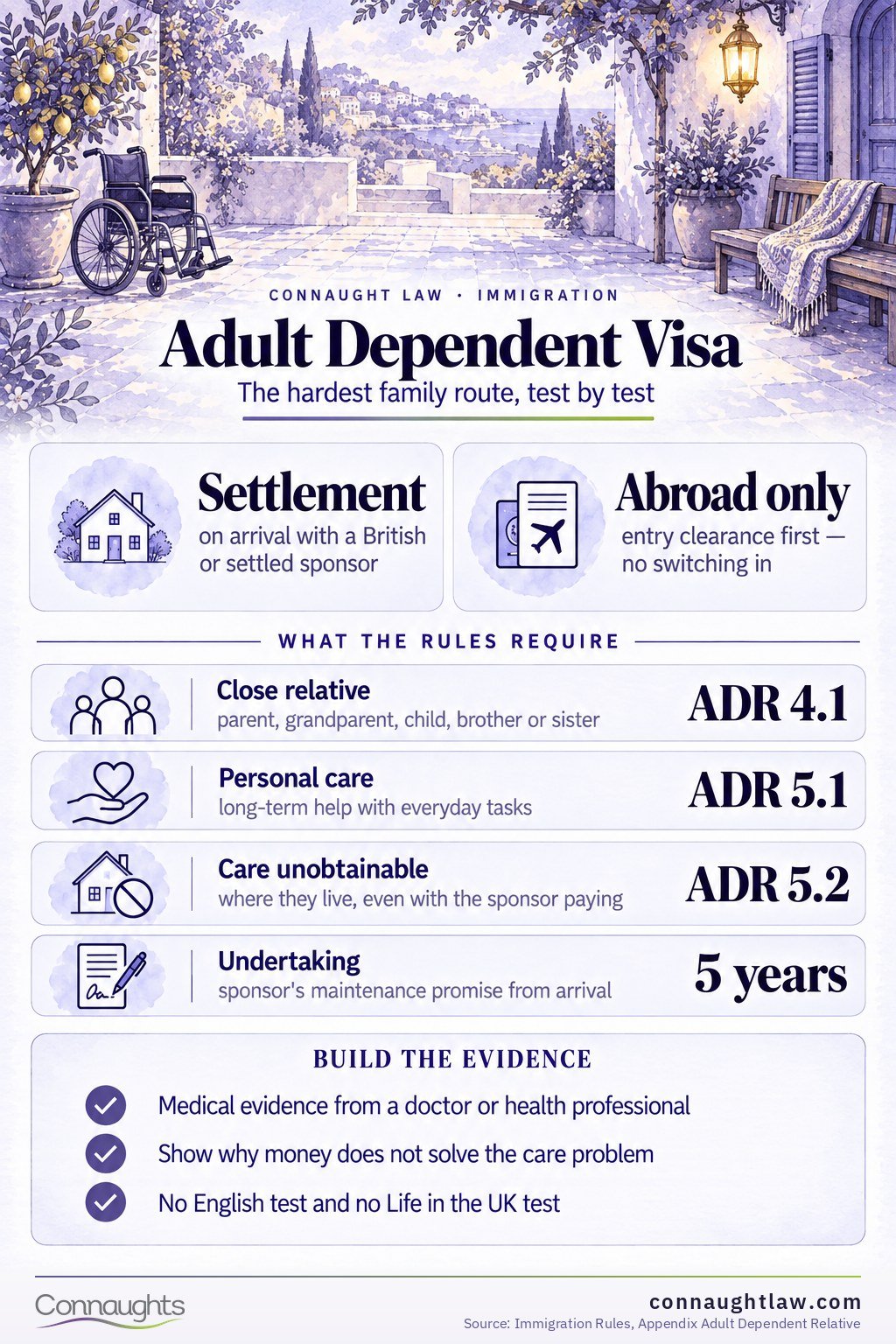
Appendix Adult Dependent Relative is a settlement route, not a visitor route. Where the sponsor is British or settled, a successful applicant is granted indefinite leave to enter on arrival under ADR 9.1 — not a temporary permission. That is why the requirements are set where they are: the Home Office is deciding, in one application, whether someone joins the UK permanently with access to the NHS.
It must be applied for from outside the UK. ADR 3.1 is explicit: a person seeking to come as an Adult Dependent Relative “must apply for and obtain entry clearance as an Adult Dependent Relative before they arrive in the UK”. There is no switching into this route from inside the country, whatever the relative’s circumstances once here, and an application made in-country is the commonest wasted fee on this route.
There is no English language requirement and no Life in the UK test in Appendix ADR. The difficulty is entirely in the care tests and the evidence behind them.
What the Rules Require
Every requirement below sits in Appendix Adult Dependent Relative. They are cumulative: failing any one of them ends the application, and the two care tests at ADR 5.1 and ADR 5.2 are where almost all refusals happen.
Every Requirement, Rule by Rule
| Rule | Requirement |
|---|---|
| ADR 3.1 | Entry clearance must be applied for and obtained before arrival. The route cannot be switched into from inside the UK |
| ADR 4.1 | The applicant must be the parent, grandparent, son, daughter, brother or sister of the sponsor |
| ADR 4.2 | The sponsor must be British, settled, in the UK with protection status, or an EEA national with leave under paragraph EU3 of Appendix EU meeting condition 1(a)(i) in EU14 |
| ADR 5.1 | The applicant must, as a result of age, illness or disability, require long-term personal care to perform everyday tasks |
| ADR 5.2 | They must be unable to obtain that care where they live, even with the sponsor’s financial help, because it is not available and no one there can reasonably provide it, or because it is not affordable |
| ADR 6.1 | The sponsor must be able to maintain, accommodate and care for the applicant in the UK without access to public funds |
| ADR 6.4 | A signed maintenance undertaking, for five years from arrival where settlement is granted |
| ADR 2.1 | The applicant must not fall for refusal under Part Suitability |
Two details are missed often enough to be worth naming. A parent or grandparent applying alone must not be in a subsisting relationship with a partner unless that partner applies at the same time (ADR 5.3A.1). And ADR 6.5 allows the government to recover public funds from the sponsor, which is what the undertaking at ADR 6.4 is for — it is an enforceable promise, not a formality. Our guide to adequate maintenance covers how the ADR 6.1 test is calculated.
Where the requirements are not met, ADR 7.1 provides an Article 8 fallback for cases where refusal would produce unjustifiably harsh consequences — though ADR 7.2 closes it off where SUI 2.1, 2.3, 3.1, 4.1 or 5.1 applies. It is a narrow door, not a second chance at the care tests.
The Success Rate, and Why There Isn’t One
This is the question everyone asks first, and the honest answer is that the Home Office does not publish it. Adult Dependent Relative applications are not counted separately in the published immigration statistics, so there is no current grant rate, no refusal rate and no release to cite. Any figure quoted as the ADR success rate — including figures you will find widely repeated — is not coming from an official source.
The only official outcome data that exists is a review the Home Office published on 8 December 2016, which compiled figures by hand from four manual case reviews. It says so itself, and it labels the numbers provisional management information subject to change. That review is now nearly a decade old and covers a period ending in 2015. It is the best evidence available and it is not good evidence.
Official Figures, 2012 to 2015
| Period | Applications | Granted at initial decision |
|---|---|---|
| 9 July to 31 December 2012 | 637 | 71 |
| 2013 | 970 | 37 |
| 2014 | 723 | 37 |
| 2015 | 452 | 22 |
Two cautions about reading that table. Initial decisions are not the whole story: grants also came through entry clearance manager review and on appeal, which is why the Home Office’s own summary figure for 2013 and 2014 is that around 19% of applications were granted once those routes are included — a materially different number from the initial-decision column. And the drop in applications after 2012 reflects the rules changing that July, not a change in need.
What the data does support is the only conclusion worth drawing: this route refuses far more applications than it grants, and it has done since 2012. That is a reason to prepare the evidence properly, not a reason to quote a percentage nobody can stand behind.
Evidence That Decides It
The caseworker guidance, version 7.0 of 11 November 2025, sets out what each limb needs. Medical evidence of the care requirement must come from a doctor or other health professional. Evidence that care is unavailable should come from a central or local health authority, a local authority, or a doctor or health professional in the country in question — not from the family.
- Records of what has actually been paid. Not an estimate of what care would cost, but what the family has been paying and to whom.
- An explanation of why those payments cannot continue. The rule asks whether care is affordable, and the sponsor’s ability to keep funding it is part of the answer.
- Why the sponsor’s support cannot continue or is no longer sufficient. The guidance names this directly, and it is the point most applications leave unaddressed.
- Country evidence about the specific place the relative lives, not about the country in general.
The trap in ADR 5.2 is that it asks whether care can be obtained even with the sponsor’s financial help. A sponsor who demonstrates they can comfortably fund care abroad has, without meaning to, answered the question against themselves. The application has to show why money does not solve the problem — because no suitable care exists, or because the cost is beyond what can be sustained.
Under paragraphs 36 to 39 of the Immigration Rules the entry clearance officer may also refer the applicant for a medical examination, so the medical evidence filed should be capable of standing up to an independent look.
Fees and the Maintenance Undertaking
The entry clearance fee is £3,635 from 8 April 2026, on the “route to settlement — other dependant relative” line, and £452 where the sponsor holds protection status. Each applicant pays separately, so a couple applying together pays twice.
The immigration health surcharge is the point most cost estimates get wrong. It is not payable by someone applying for indefinite leave to enter, and under ADR 9.1 an applicant with a British or settled sponsor is granted settlement on arrival. Where permission rather than settlement is granted — ADR 9.2 and 9.3 — the surcharge applies at the usual rate, and ADR 9.4 imposes a no recourse to public funds condition, with work permitted and study subject to ATAS.
Then there is the undertaking. ADR 6.4 requires the sponsor to sign for five years from the relative’s arrival where settlement is granted, and ADR 6.5 lets the government recover any public funds paid out during it. That is a real financial exposure and it should be understood before the application is filed, not after.
How the Rules Got This Strict
Before 9 July 2012 the test was materially easier, and the volume of applications reflects it: 637 in under six months of 2012, then 970 across the whole of 2013 once the new rules had bedded in. The change introduced the requirement that care be unobtainable in the country of residence even with the sponsor’s money, which is the test that closed the route to most families.
It was challenged and upheld. The Court of Appeal dismissed the challenge to the current rules, so the strictness is settled law rather than a policy that might be read down. Applications are decided on the rules as written, and arguments that the test is unfair belong to Parliament rather than to a caseworker.
The rules were later restructured into Appendix Adult Dependent Relative in its current form, and in November 2025 the suitability provisions were brought under Part Suitability with the rest of the family routes. The substance of the care tests has not moved since 2012.
What Has Changed, and What Has Not
Two things changed recently and both are administrative rather than substantive. Statement of Changes HC 259 substituted ADR 2.2, aligning the immigration-breach provisions with the overstayer exceptions used across the family routes. And the caseworker guidance was reissued at version 7.0 on 11 November 2025, its change note recording only that Part 9 references were removed in favour of Part Suitability.
What has not changed is more important. ADR 5.1 and ADR 5.2 are in the same terms they have been since 2012. No consultation proposes relaxing them, no Statement of Changes has been laid to do so, and the Commons Library briefing on post-white-paper changes does not list this route among those under review. Anyone waiting for the test to soften before applying is waiting on nothing that has been announced.
The practical reading is that this route rewards preparation and punishes optimism. Where the care tests genuinely cannot be met, the honest options are a visit visa, or an Article 8 case built on its own facts — and our family visa team can tell you which of those you are actually in.
Frequently askedQuestions about the adult dependent relative visa
What is the adult dependent relative visa success rate?
The Home Office does not publish one. ADR applications are not counted separately in the immigration statistics. The only official data is a review of 8 December 2016 covering 2012 to 2015, which gives around 19% granted in 2013 and 2014 once reviews and appeals are counted.
Who can apply?
A parent, grandparent, son, daughter, brother or sister of a British citizen, a settled person, someone with protection status, or a qualifying EEA national with status under Appendix EU. The applicant and sponsor must both be 18 or over at the date of application.
Can I apply from inside the UK?
No. ADR 3.1 requires entry clearance to be obtained before arrival, and there is no switching into the route from within the UK. A relative already here as a visitor cannot use it.
What does long-term personal care mean?
Needing help to perform everyday tasks as a result of age, illness or disability. It is not about companionship or a wish to live near family, and evidence must come from a doctor or other health professional.
Why are so many applications refused?
Because of ADR 5.2. Care must be unobtainable where the relative lives even with the sponsor paying for it. Showing that the family can afford care abroad tends to defeat the application rather than support it.
How much does it cost?
£3,635 for entry clearance from 8 April 2026, per applicant, or £452 where the sponsor has protection status. The health surcharge is not payable where settlement is granted on arrival.
Do they get settlement straight away?
Yes, where the sponsor is British or settled — ADR 9.1 grants indefinite leave to enter. Where the sponsor holds another status, permission is granted in line with theirs, with no recourse to public funds.
Is there an English or Life in the UK requirement?
No. Appendix Adult Dependent Relative contains neither. The difficulty in this route is entirely in the care tests and the evidence supporting them.
Tell us what care they need, who provides it now and what is available where they live. We'll tell you whether this route is realistic on those facts, and what else may be open to you.
Get Expert Advice