
Insurmountable obstacles is the test at the heart of EX.1(b) Appendix FM: very significant difficulties in continuing family life with your partner outside the UK, which either cannot be overcome or would cause very serious hardship. It is deliberately stringent — harder than reasonableness, easier than impossibility — and it is decided on objective evidence, not preference. This guide explains the meaning, the leading case and the line between what qualifies and what fails.
On This Page

A Stringent Test, Practically Applied
Under paragraph EX.2 of Appendix FM, insurmountable obstacles means "very significant difficulties which would be faced by the applicant or their partner in continuing their family life together outside the UK and which could not be overcome or would entail very serious hardship for the applicant or their partner." Where the test is met on the ten-year partner route, the immigration status, financial and English requirements fall away.
The phrase misleads by sounding absolute. The Supreme Court in Agyarko [2017] UKSC 11 described the test as stringent but to be applied in a practical and realistic sense — nobody has to prove that relocation is literally impossible. What they do have to prove is difficulty of a wholly different order from the disruption every international couple faces.
The Legal Definition and Its Two Limbs
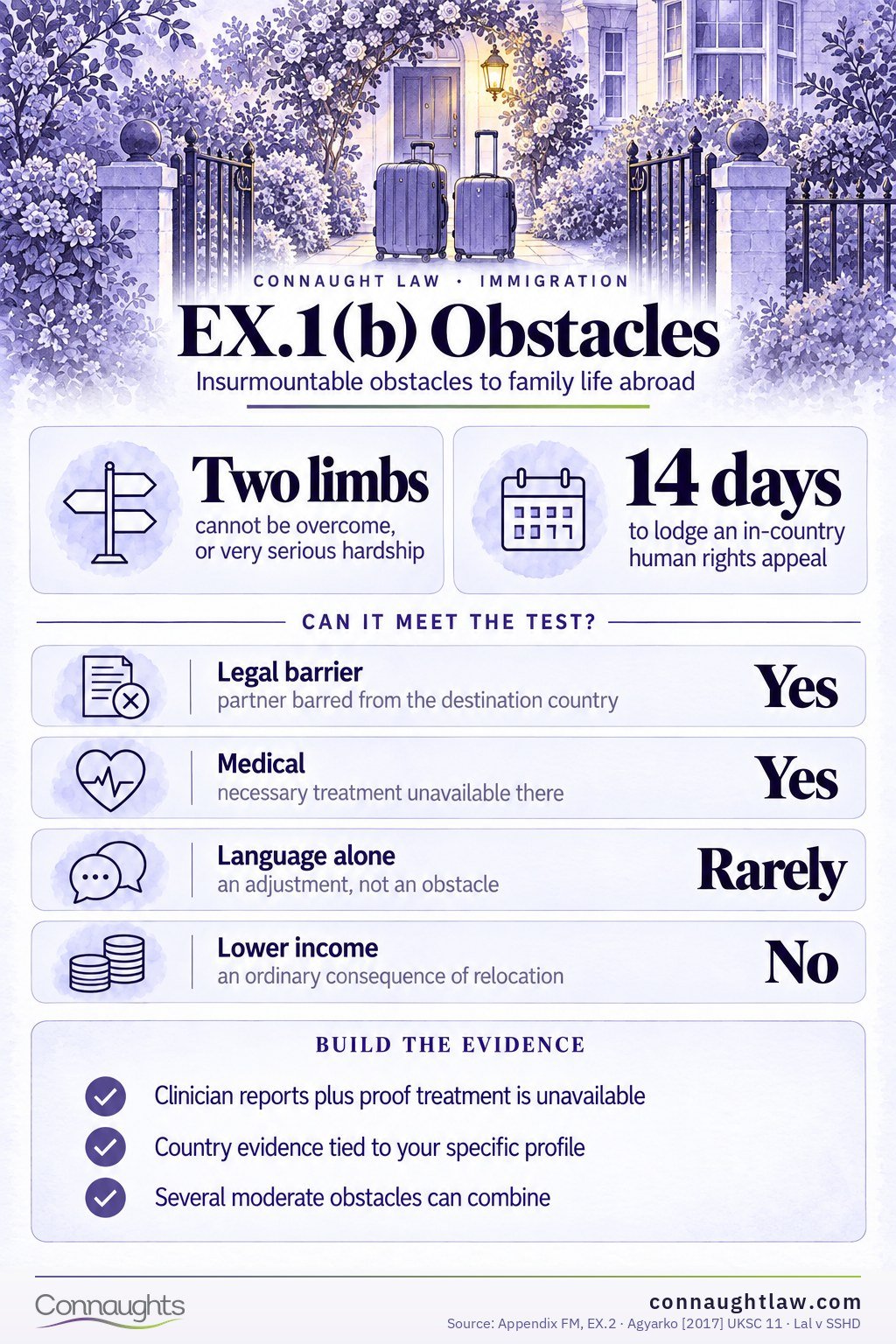
EX.2 gives the test two limbs. Obstacles that could not be overcome — a partner legally barred from the destination country, for instance. And obstacles that could technically be overcome, but only at the cost of very serious hardship — a treatable condition whose treatment does not exist there, or a couple whose relationship is criminalised where they would have to live. Either limb suffices; most strong cases stack elements of both.
Not a Reasonableness Test
The question is not whether staying in the UK is preferable, or whether relocation is unreasonable — it is whether the identified difficulties reach the EX.2 threshold. That framing matters in practice: applications drafted as lists of reasons the UK is better lose, while applications that name specific obstacles, evidence them and connect them to the destination country win the argument the rule actually sets.
Insurmountable or Surmountable
| Category | Can meet the test | Usually will not |
|---|---|---|
| Legal barriers | The partner is refused entry or legally prohibited from the destination | Slow or complicated visa processes |
| Medical | Serious conditions whose necessary treatment is unavailable there | Conditions manageable with treatment available abroad |
| Safety and rights | Criminalisation of the relationship, persecution, honour-based risk | Generalised crime rates or economic instability |
| Living conditions | Documented severe risk that cannot be mitigated | Climate, comfort and lifestyle preferences |
Lal v SSHD — the Leading Case
In Lal v SSHD [2019] EWCA Civ 1925 the Court of Appeal examined the test through a couple where the British partner, in his seventies, said he could not relocate to India — heat sensitivity among the reasons. The court's contribution was method, not sympathy: it confirmed the assessment is objective, asking what difficulties would actually be faced and how serious they would actually be, on evidence.
The Objective Assessment
Objective does not mean impersonal. The couple's individual circumstances — age, health, finances, ties — are exactly what gets assessed; what the court rejected is assertion standing in for proof. A claimed inability to tolerate a climate, live safely somewhere or access treatment must be substantiated by evidence a stranger could test: medical reports, country material, documentation. The subjective strength of the couple's wish to stay carries no weight at this stage.
Practical Lessons from Lal
Lal is best read as an instruction to applicants: every claimed obstacle needs its evidential partner. Age needs medical context, health needs clinical reports, risk needs country evidence, financial impossibility needs figures. Cases lose not because judges doubt the couple's sincerity but because the file gives the objective assessment nothing to hold onto.
What Qualifies and What Fails
Circumstances That Can Qualify
The recurring winners share one feature: they attach to this couple and this destination. Serious medical conditions with no realistic treatment route there; relationships criminalised or persecuted in the destination country; a partner facing honour-based violence or targeted discrimination; genuine legal barriers to the partner's entry or residence. Several moderate obstacles can also combine — the assessment is cumulative, and the second limb's "very serious hardship" is often reached by accumulation rather than a single dramatic fact.
Arguments That Usually Fail
What Usually Qualifies
| Raised in applications | How it is usually treated |
|---|---|
| Language barriers alone | An adjustment, not an obstacle — unless tied to safety or essential services |
| Lower income or career damage | An ordinary consequence of relocation |
| Separation from extended family | Emotional cost, not EX.2 hardship, absent real dependency |
| Cultural difference and lifestyle | Preference, which the test deliberately excludes |
| Caring for a dependent relative with critical needs | Can qualify — dependency and necessity are the distinction |
Cases Are Built, Not Found
Evidence Strategy
- Medical evidence from treating clinicians, paired with evidence about treatment availability in the destination country.
- Country evidence — official reports and current material — tied to the couple's specific profile, not generic hardship.
- Documentation of any legal barrier: refusals, rules, or expert confirmation the partner cannot lawfully settle there.
- Where obstacles stack, a clear narrative showing how they combine into very serious hardship rather than a scattered list.
Fitting EX.1(b) Into the Wider Application
EX.1(b) rarely stands alone. The same facts usually ground a GEN.3.2 exceptional-circumstances argument — the wider framework is mapped in our Appendix FM exceptions guide — and behind both sits Article 8 itself, covered in our family and private life guide. A well-built application runs the arguments in the right order: the rule first, the exception second, the Convention as the frame around both.
Strategy Before Submission
Planning the Argument
Before anything is filed, name each obstacle, assign it a limb, and list the evidence that will prove it — gaps found at this stage cost weeks; gaps found by a caseworker cost the application. Honest triage matters too: where the obstacles are real but modest, the better route may be meeting the ordinary rules or arguing GEN.3.2, and our family visa team makes exactly that call with clients before committing.
Timing and Outcomes, Honestly Stated
Applications relying on EX.1(b) sit in the in-country human-rights caseload, which currently takes around 12 months to decide, per gov.uk on the day of writing. Refusals carry a human-rights appeal — 14 days to lodge in-country — where the tribunal re-hears the evidence, which is why files built properly at the start keep their value even when the first decision goes wrong. No official statistics break out success rates for this test specifically; be sceptical of any article that claims them. Where protection issues overlap, our human rights and asylum team handles the combined case.
Frequently askedQuestions about insurmountable obstacles
What does insurmountable obstacles actually mean?
Very significant difficulties in continuing family life with your partner outside the UK, which either cannot be overcome or would cause very serious hardship — the EX.2 definition. It does not require impossibility; it does require far more than inconvenience, expense or preference.
What counts as very serious hardship?
Consequences of a different order from ordinary relocation: necessary medical treatment that does not exist in the destination, a relationship that is criminalised or persecuted there, targeted violence risks, or genuine legal barriers to the partner living there. Several moderate difficulties can combine to reach the threshold.
How did Lal v SSHD change the test?
It confirmed the assessment is objective: the couple's individual circumstances count, but every claimed obstacle must be substantiated with evidence that can be tested — medical reports, country material, documentation. Sincere assertion, standing alone, cannot establish the threshold.
Do language barriers count?
Rarely on their own — the case law treats language as an adjustment burden. It can contribute where it connects to something weightier, such as an inability to access essential medical care safely, or as one strand in a cumulative hardship argument.
Can medical conditions qualify?
Yes, where the evidence shows the condition is serious and the necessary treatment or support is genuinely unavailable or inaccessible in the destination country — not merely less convenient. Clinical evidence plus treatment-availability evidence is the pairing that carries these cases.
How is this different from exceptional circumstances?
EX.1(b) is a defined rule about obstacles to family life abroad on the ten-year partner route. Exceptional circumstances under GEN.3.2 is the broader Article 8 safety valve where refusal would be unjustifiably harsh. Strong cases usually argue both, in that order.
Tell us where your partner would have to go, what makes returning together difficult and what evidence you have of it. We'll tell you whether that meets the insurmountable obstacles test or needs a different argument.
Get Expert Advice