
A Part 25 application asks the family court for permission to rely on expert evidence — a business valuer, a pension actuary, a psychologist, a drug-testing laboratory. Under Part 25 of the Family Procedure Rules no expert evidence comes in without the court's leave, and the test is necessity, not usefulness. This guide explains the framework, the experts courts allow, the application itself, its costs, and what makes a Part 25 application succeed.
On This Page

Permission First: How Expert Evidence Enters Family Cases
Family courts control expert evidence tightly: no party may instruct an expert or put expert evidence before the court without permission, and permission is granted only where the evidence is necessary to resolve the proceedings justly. That gatekeeping — stricter still in children cases — keeps cases proportionate and is the entire reason the Part 25 application exists.
You apply under Part 25 FPR, usually at a case management hearing, identifying the expert, their field, the questions they will answer and the cost. The court grants permission only if the evidence is necessary — not merely helpful — and the default is a single joint expert instructed by both sides rather than duelling experts.
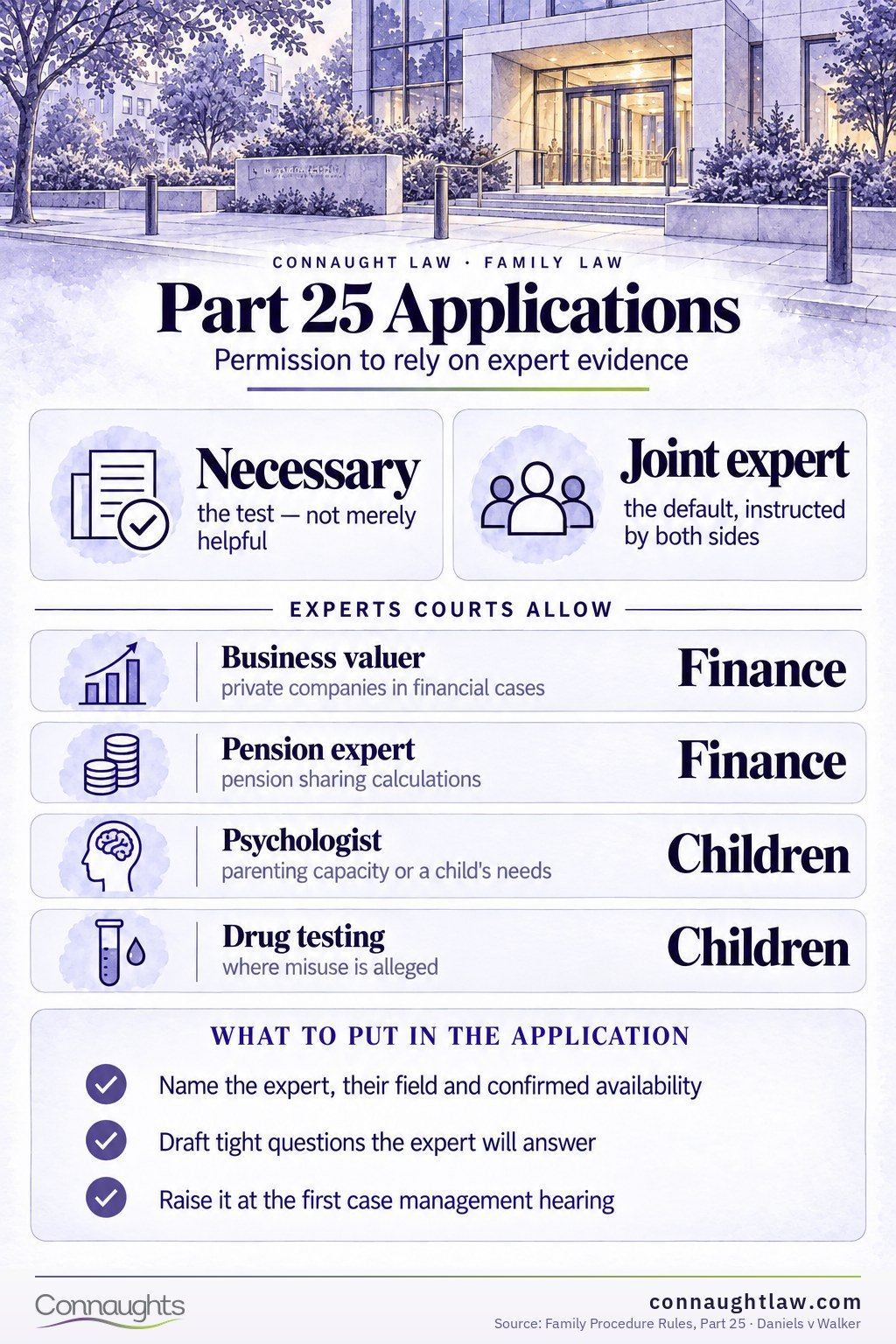
What a Part 25 Application Is
The Gate and Its Keeper
Part 25 of the Family Procedure Rules governs experts in every family proceeding — financial remedy, private and public children cases alike. The expert's duty runs to the court, not to the party paying; reports answer defined questions within defined expertise; and in children proceedings the statutory bar is higher still, with control over any assessment of the child.
How the Framework Operates
Practice Directions and the Joint Expert Default
The supporting practice directions set the machinery: what an application must contain, the expert's duties and qualifications, the form of the report, and the presumption of a single joint expert in financial cases. Where a party is dissatisfied with a joint expert's report, the route to a second opinion runs through the Daniels v Walker principles — covered in our Daniels v Walker guide — and needs its own justification, not mere disappointment.
The Experts Courts Allow
Financial Remedy Cases
The recurring financial experts: business valuers for private companies, pension-on-divorce experts for sharing calculations, chartered surveyors where property value is disputed, and tax specialists where a settlement's structure has tax consequences. Each is granted against the necessity test — a modest pension or an agreed property value needs no expert at all. Our valuation guide shows where these reports change outcomes.
Children Cases
In children proceedings the threshold is necessity within an already cautious framework: psychologists and psychiatrists for parenting capacity or a child's needs, drug and alcohol testing where misuse is alleged, and medical experts in harm cases. Routine welfare assessment belongs to Cafcass, not instructed experts, and courts police the boundary.
Making the Application
What You Must Put Before the Court
- The expert's discipline, identity or shortlist, and confirmed availability
- The specific questions the expert will answer, drafted tightly
- Why the evidence is necessary — what the court cannot fairly decide without it
- Cost estimate and how the fee will be shared
- The timetable impact, fitted to the existing directions
Forms and Timing
The Paperwork
In ongoing proceedings the application is made within the case — on Form C2 in children proceedings or Form D11 in financial remedy proceedings — ideally raised at the first case management hearing rather than by freestanding application later. Late applications must explain the lateness; the court's timetable, particularly the 26-week clock in public children cases, weighs against them.
What It Costs
Court Fees and Expert Fees
The application fee within proceedings is modest — the current figures sit in the EX50 family court fees list — but the real money is the expert's own fee, which varies with discipline and complexity: get quotes before the hearing, because the court will ask. Single joint expert fees are usually shared equally, with the order recording the split; legal aid, where held, treats approved expert fees as disbursements at prescribed rates.
What Makes the Court Say Yes
The Judicial Checklist
Judges test necessity against the issues actually in dispute, the other evidence available, the cost against the sums or welfare at stake, and the delay. Applications succeed when the questions are tight, the expert is identified and available, the cost is proportionate and the case genuinely cannot be decided fairly without the answer. They fail when the report would merely bolster a position, duplicate Cafcass, or fish for issues. Our family team drafts these applications to the checklist — which is, in the end, the whole art of Part 25.
Frequently askedQuestions about Part 25 applications
What is a Part 25 application in family law?
An application under Part 25 of the Family Procedure Rules for the court's permission to rely on expert evidence — a valuer, actuary, psychologist or tester. No expert evidence is admissible in family proceedings without it, and permission turns on whether the evidence is necessary.
What does "necessary" mean under Part 25?
More than helpful or reassuring: the court must be unable to resolve the proceedings justly without the evidence. If the issue can be decided on existing material — disclosure, Cafcass work, agreed figures — permission is refused however eminent the proposed expert.
What is a single joint expert?
One expert instructed jointly by both parties, answering agreed questions with a duty to the court alone — the default in financial remedy cases. A party unhappy with the report needs Daniels v Walker grounds to justify their own expert, not just a worse-than-hoped answer.
How much does a Part 25 application cost?
The in-proceedings application fee is small — see the EX50 fees list for current figures — but the expert's fee is the real cost and varies widely by discipline. Courts expect quotes with the application, and single joint expert fees are normally shared equally.
When should I raise expert evidence in my case?
At the first case management hearing, with the expert identified, questions drafted and a quote in hand. Late applications need to explain their lateness and fit the existing timetable — in children cases the 26-week clock makes courts especially resistant to delay.
Tell us the issue — valuation, pensions, testing, assessment — and where your case is in its timetable. We will frame the necessity argument and the questions so permission is the likely answer.
Get Expert Advice