Violence against women and girls covers a range of crimes and behaviours — from domestic abuse and sexual violence to stalking, coercive control and online abuse — that disproportionately affect women and girls. This guide sets out what the term means in UK law, the most recent official statistics, the legal protections available to those at risk, and where to find support. If you are in immediate danger, call 999.
Violence against women and girls (VAWG) is an umbrella term for crimes and behaviours that disproportionately affect women and girls, including domestic abuse, sexual violence, stalking, harassment, coercive control, so-called honour-based abuse and online abuse. UK law provides both criminal offences and civil protective orders — and protection does not require a criminal prosecution.
What Violence Against Women and Girls Means
VAWG is not a single offence but a term used in policy and policing to group together the forms of abuse that women and girls disproportionately experience. It draws on international definitions, including the United Nations framework, and covers physical, sexual, psychological and economic harm. Men and boys also experience many of these forms of abuse, and the law protects all victims; the VAWG label reflects the disproportionate pattern the evidence shows.
At the centre of the domestic side of VAWG is the statutory definition of domestic abuse in the Domestic Abuse Act 2021. It defines domestic abuse between people aged 16 or over who are personally connected, and expressly includes not only physical and sexual abuse but also threatening behaviour, controlling or coercive behaviour, economic abuse and psychological or emotional abuse. That definition matters because it shapes which protections and offences apply.
The Latest UK Statistics
The most recent official figures come from the Office for National Statistics. In the year ending March 2025, an estimated 3.8 million adults aged 16 and over (7.8%) experienced domestic abuse in England and Wales — around 2.2 million women (9.1%) and 1.5 million men (6.5%). Over a lifetime, approximately one in four people aged 16 and over (25.8%) have experienced domestic abuse since the age of 16.
Police recorded 816,493 domestic abuse-related crimes in the same year. These figures almost certainly understate the true scale, because a large proportion of abuse is never reported. Reflecting the concern behind the data, policing leaders described violence against women and girls as a national emergency in 2024. Current statistics should always be checked against the latest ONS crime and justice releases, which are updated regularly.
Recent Legal Developments and Strategy
The law in this area has developed significantly. The Domestic Abuse Act 2021 introduced the statutory definition, recognised children who see or hear abuse as victims in their own right, and created new Domestic Abuse Protection Notices and Orders, which began piloting in selected areas from late 2024. A specific offence of non-fatal strangulation is now in force, and controlling or coercive behaviour is a criminal offence in its own right.
Alongside these, the Stalking Protection Act 2019 created stalking protection orders, and the Online Safety Act 2023 introduced offences addressing cyberflashing and the sharing of intimate images. The Government has set an ambition to halve violence against women and girls within a decade, backed by a cross-government strategy. The direction of reform is towards earlier, stronger protection and treating abuse as a pattern of behaviour, not just isolated incidents.
The Types of Abuse Covered
VAWG spans a wide range of conduct. Domestic abuse includes physical violence but also coercive control — a pattern of intimidation, isolation and control that can be as damaging as physical harm. Sexual violence covers rape, sexual assault and abuse. Stalking and harassment, whether in person or online, are criminal offences with dedicated protective orders.
The term also covers so-called honour-based abuse, forced marriage and female genital mutilation, each of which has specific criminal offences and protective orders, and increasingly online forms of abuse such as the sharing of intimate images without consent. Recognising that these forms often overlap — coercive control alongside economic abuse, for example — is central to how the law now responds.
Note — Coercive Control Is a Crime
Controlling or coercive behaviour in an intimate or family relationship is a criminal offence in its own right, even where there is no physical violence. A pattern of control, isolation, monitoring or economic restriction can itself found both criminal charges and civil protective orders.
The Impact on Victims and Families
The effects of abuse reach beyond the immediate harm. Victims can face lasting physical and psychological consequences, disruption to housing and work, and economic hardship, particularly where economic abuse has been part of the pattern. Because the Domestic Abuse Act 2021 recognises children as victims in their own right, the law now acknowledges the serious harm caused to children who live with abuse, even when it is not directed at them.
These wider impacts are part of why the legal response emphasises protection and support, not only prosecution. Civil protective orders, housing remedies and access to specialist services are designed to help a person and their children reach safety, whether or not a criminal case is pursued.
Support and Legal Protection
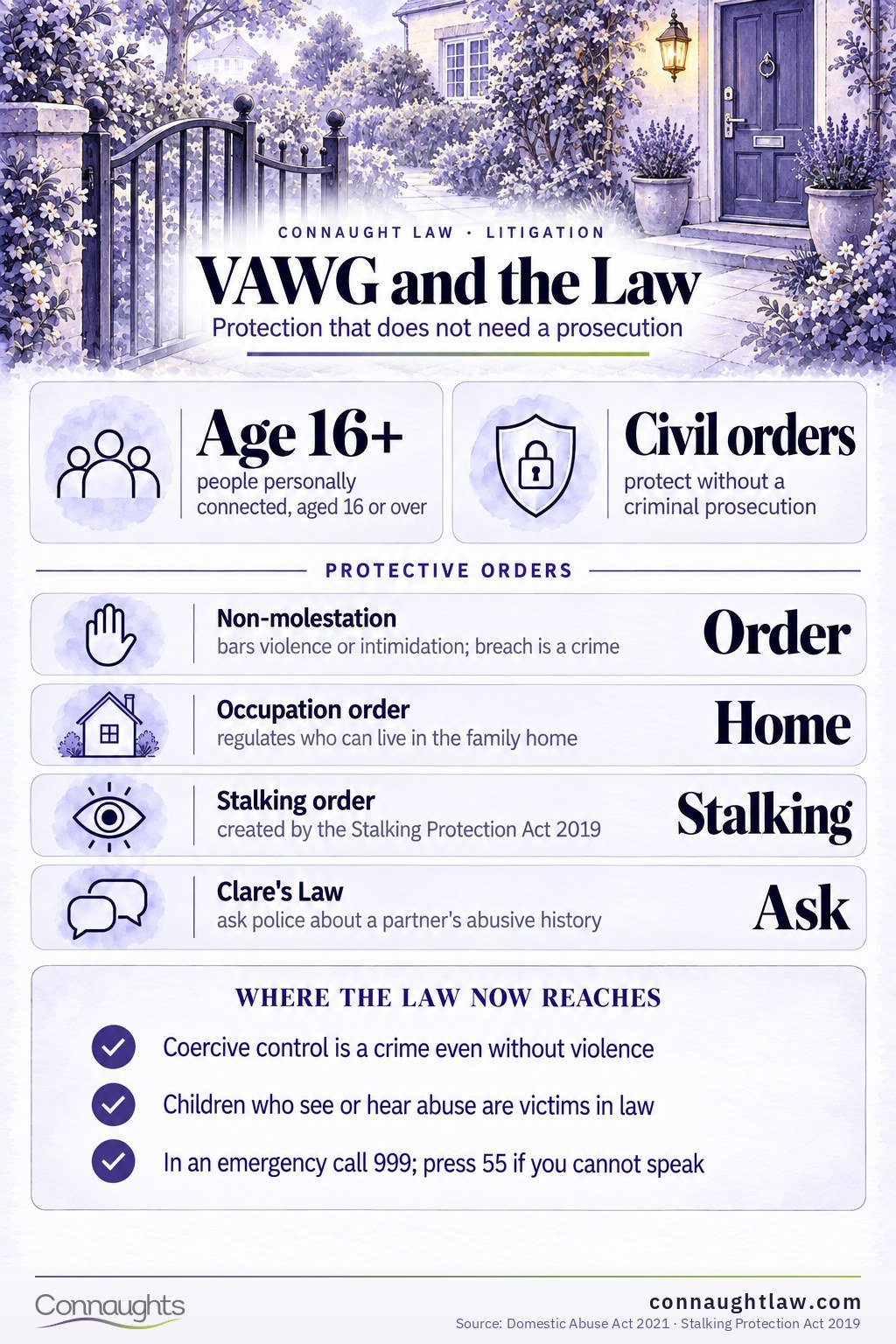
Strong civil protections are available, and they do not depend on a criminal prosecution. A non-molestation order prohibits an abuser from using or threatening violence, harassing or intimidating a person; breaching one is a criminal offence. An occupation order regulates who can live in the family home. Restraining orders, stalking protection orders and the new domestic abuse protection orders provide further routes. These can often be applied for urgently, and in some cases without the other person being told until the order is made. Our guide to non-molestation and occupation orders explains how they work, and legal aid for domestic abuse cases remains available for protective injunctions for those who qualify.
Support is also available outside the legal system. The Domestic Violence Disclosure Scheme, known as Clare's Law, lets a person ask the police whether a partner has an abusive history. Specialist charities offer confidential help: the 24-hour National Domestic Abuse Helpline, run by Refuge, can be reached on 0808 2000 247, and Women's Aid provides information and local services. In an emergency, always call 999 — and if you cannot speak, the Silent Solution allows you to press 55 once prompted to be connected to police.
Frequently Asked Questions
What does violence against women and girls (VAWG) mean in UK law?
VAWG is an umbrella term for crimes and behaviours that disproportionately affect women and girls, including domestic abuse, sexual violence, stalking, coercive control, so-called honour-based abuse and online abuse. The Domestic Abuse Act 2021 provides the statutory definition of domestic abuse that underpins much of the protection.
What counts as domestic abuse under the Domestic Abuse Act 2021?
The Act covers physical and sexual abuse, threatening behaviour, controlling or coercive behaviour, economic abuse, and psychological or emotional abuse, between people aged 16 or over who are personally connected. It also recognises children who see or hear abuse as victims in their own right.
How many people experience domestic abuse in the UK?
In the year ending March 2025, the ONS estimated that 3.8 million adults (7.8%) experienced domestic abuse in England and Wales — about 2.2 million women and 1.5 million men — and police recorded 816,493 domestic abuse-related crimes. The true figure is likely higher, as much abuse goes unreported.
Is coercive control a criminal offence?
Yes. Controlling or coercive behaviour in an intimate or family relationship is a criminal offence in its own right, even without physical violence. A documented pattern of control, monitoring, isolation or economic restriction can support both criminal charges and civil protective orders.
What new laws address violence against women and girls?
Recent measures include the Domestic Abuse Act 2021, new Domestic Abuse Protection Orders being piloted, a specific non-fatal strangulation offence, stalking protection orders, and Online Safety Act offences on intimate image abuse and cyberflashing, alongside a strategy to halve VAWG within a decade.
What legal protection is available for victims?
Civil protective orders — non-molestation orders, occupation orders, restraining orders, stalking protection orders and domestic abuse protection orders — can protect a person without a criminal prosecution. Many can be applied for urgently, and legal aid remains available for protective injunctions for those who qualify.
What is Clare's Law?
Clare's Law, the Domestic Violence Disclosure Scheme, allows a person to ask the police whether a current or former partner has a history of abuse. The police can disclose relevant information to help someone make an informed decision about their safety.
Where can I get help or support?
In an emergency call 999 (and press 55 if you cannot speak). The 24-hour National Domestic Abuse Helpline, run by Refuge, is 0808 2000 247, and Women's Aid offers information and local services. A family solicitor can advise on urgent protective orders and next steps.
Confidential Protective Order Support
Urgent Protection
We apply for non-molestation and occupation orders quickly, including without notice where safety requires it.
Clear Guidance
We explain your legal options in plain terms and help you decide the safest way forward for you and any children.
Legal Aid
We advise on legal aid for protective injunctions and help gather the evidence needed to support an application.
If you or someone you know needs protection from abuse, help is available and does not require a prosecution — the family team at Connaught Law can advise confidentially and act quickly to keep you safe.
The information in this blog is for general information purposes only and does not purport to be comprehensive or to provide legal advice. Whilst every effort is made to ensure the information and law is current as of the date of publication it should be stressed that, due to the passage of time, this does not necessarily reflect the present legal position. Connaught Law and authors accept no responsibility for loss that may arise from accessing or reliance on information contained in this blog. For formal advice on the current law please don't hesitate to contact Connaught Law. Legal advice is only provided pursuant to a written agreement, identified as such, and signed by the client and by or on behalf of Connaught Law.
Violence Against Women and Girls UK 2026: Current Statistics and Legal Framework
Violence against women and girls covers a range of crimes and behaviours — from domestic abuse and sexual violence to stalking, coercive control and online abuse — that disproportionately affect women and girls. This guide sets out what the term means in UK law, the most recent official statistics, the legal protections available to those at risk, and where to find support. If you are in immediate danger, call 999.
Understanding Violence Against Women and Girls
Violence against women and girls (VAWG) is an umbrella term for crimes and behaviours that disproportionately affect women and girls, including domestic abuse, sexual violence, stalking, harassment, coercive control, so-called honour-based abuse and online abuse. UK law provides both criminal offences and civil protective orders — and protection does not require a criminal prosecution.
What Violence Against Women and Girls Means
VAWG is not a single offence but a term used in policy and policing to group together the forms of abuse that women and girls disproportionately experience. It draws on international definitions, including the United Nations framework, and covers physical, sexual, psychological and economic harm. Men and boys also experience many of these forms of abuse, and the law protects all victims; the VAWG label reflects the disproportionate pattern the evidence shows.
At the centre of the domestic side of VAWG is the statutory definition of domestic abuse in the Domestic Abuse Act 2021. It defines domestic abuse between people aged 16 or over who are personally connected, and expressly includes not only physical and sexual abuse but also threatening behaviour, controlling or coercive behaviour, economic abuse and psychological or emotional abuse. That definition matters because it shapes which protections and offences apply.
The Latest UK Statistics
The most recent official figures come from the Office for National Statistics. In the year ending March 2025, an estimated 3.8 million adults aged 16 and over (7.8%) experienced domestic abuse in England and Wales — around 2.2 million women (9.1%) and 1.5 million men (6.5%). Over a lifetime, approximately one in four people aged 16 and over (25.8%) have experienced domestic abuse since the age of 16.
Police recorded 816,493 domestic abuse-related crimes in the same year. These figures almost certainly understate the true scale, because a large proportion of abuse is never reported. Reflecting the concern behind the data, policing leaders described violence against women and girls as a national emergency in 2024. Current statistics should always be checked against the latest ONS crime and justice releases, which are updated regularly.
Recent Legal Developments and Strategy
The law in this area has developed significantly. The Domestic Abuse Act 2021 introduced the statutory definition, recognised children who see or hear abuse as victims in their own right, and created new Domestic Abuse Protection Notices and Orders, which began piloting in selected areas from late 2024. A specific offence of non-fatal strangulation is now in force, and controlling or coercive behaviour is a criminal offence in its own right.
Alongside these, the Stalking Protection Act 2019 created stalking protection orders, and the Online Safety Act 2023 introduced offences addressing cyberflashing and the sharing of intimate images. The Government has set an ambition to halve violence against women and girls within a decade, backed by a cross-government strategy. The direction of reform is towards earlier, stronger protection and treating abuse as a pattern of behaviour, not just isolated incidents.
The Types of Abuse Covered
VAWG spans a wide range of conduct. Domestic abuse includes physical violence but also coercive control — a pattern of intimidation, isolation and control that can be as damaging as physical harm. Sexual violence covers rape, sexual assault and abuse. Stalking and harassment, whether in person or online, are criminal offences with dedicated protective orders.
The term also covers so-called honour-based abuse, forced marriage and female genital mutilation, each of which has specific criminal offences and protective orders, and increasingly online forms of abuse such as the sharing of intimate images without consent. Recognising that these forms often overlap — coercive control alongside economic abuse, for example — is central to how the law now responds.
Controlling or coercive behaviour in an intimate or family relationship is a criminal offence in its own right, even where there is no physical violence. A pattern of control, isolation, monitoring or economic restriction can itself found both criminal charges and civil protective orders.
The Impact on Victims and Families
The effects of abuse reach beyond the immediate harm. Victims can face lasting physical and psychological consequences, disruption to housing and work, and economic hardship, particularly where economic abuse has been part of the pattern. Because the Domestic Abuse Act 2021 recognises children as victims in their own right, the law now acknowledges the serious harm caused to children who live with abuse, even when it is not directed at them.
These wider impacts are part of why the legal response emphasises protection and support, not only prosecution. Civil protective orders, housing remedies and access to specialist services are designed to help a person and their children reach safety, whether or not a criminal case is pursued.
Support and Legal Protection
Strong civil protections are available, and they do not depend on a criminal prosecution. A non-molestation order prohibits an abuser from using or threatening violence, harassing or intimidating a person; breaching one is a criminal offence. An occupation order regulates who can live in the family home. Restraining orders, stalking protection orders and the new domestic abuse protection orders provide further routes. These can often be applied for urgently, and in some cases without the other person being told until the order is made. Our guide to non-molestation and occupation orders explains how they work, and legal aid for domestic abuse cases remains available for protective injunctions for those who qualify.
Support is also available outside the legal system. The Domestic Violence Disclosure Scheme, known as Clare's Law, lets a person ask the police whether a partner has an abusive history. Specialist charities offer confidential help: the 24-hour National Domestic Abuse Helpline, run by Refuge, can be reached on 0808 2000 247, and Women's Aid provides information and local services. In an emergency, always call 999 — and if you cannot speak, the Silent Solution allows you to press 55 once prompted to be connected to police.
Frequently Asked Questions
What does violence against women and girls (VAWG) mean in UK law?
VAWG is an umbrella term for crimes and behaviours that disproportionately affect women and girls, including domestic abuse, sexual violence, stalking, coercive control, so-called honour-based abuse and online abuse. The Domestic Abuse Act 2021 provides the statutory definition of domestic abuse that underpins much of the protection.
What counts as domestic abuse under the Domestic Abuse Act 2021?
The Act covers physical and sexual abuse, threatening behaviour, controlling or coercive behaviour, economic abuse, and psychological or emotional abuse, between people aged 16 or over who are personally connected. It also recognises children who see or hear abuse as victims in their own right.
How many people experience domestic abuse in the UK?
In the year ending March 2025, the ONS estimated that 3.8 million adults (7.8%) experienced domestic abuse in England and Wales — about 2.2 million women and 1.5 million men — and police recorded 816,493 domestic abuse-related crimes. The true figure is likely higher, as much abuse goes unreported.
Is coercive control a criminal offence?
Yes. Controlling or coercive behaviour in an intimate or family relationship is a criminal offence in its own right, even without physical violence. A documented pattern of control, monitoring, isolation or economic restriction can support both criminal charges and civil protective orders.
What new laws address violence against women and girls?
Recent measures include the Domestic Abuse Act 2021, new Domestic Abuse Protection Orders being piloted, a specific non-fatal strangulation offence, stalking protection orders, and Online Safety Act offences on intimate image abuse and cyberflashing, alongside a strategy to halve VAWG within a decade.
What legal protection is available for victims?
Civil protective orders — non-molestation orders, occupation orders, restraining orders, stalking protection orders and domestic abuse protection orders — can protect a person without a criminal prosecution. Many can be applied for urgently, and legal aid remains available for protective injunctions for those who qualify.
What is Clare's Law?
Clare's Law, the Domestic Violence Disclosure Scheme, allows a person to ask the police whether a current or former partner has a history of abuse. The police can disclose relevant information to help someone make an informed decision about their safety.
Where can I get help or support?
In an emergency call 999 (and press 55 if you cannot speak). The 24-hour National Domestic Abuse Helpline, run by Refuge, is 0808 2000 247, and Women's Aid offers information and local services. A family solicitor can advise on urgent protective orders and next steps.
We apply for non-molestation and occupation orders quickly, including without notice where safety requires it.
We explain your legal options in plain terms and help you decide the safest way forward for you and any children.
We advise on legal aid for protective injunctions and help gather the evidence needed to support an application.
If you or someone you know needs protection from abuse, help is available and does not require a prosecution — the family team at Connaught Law can advise confidentially and act quickly to keep you safe.
Speak to UsDisclaimer:
The information in this blog is for general information purposes only and does not purport to be comprehensive or to provide legal advice. Whilst every effort is made to ensure the information and law is current as of the date of publication it should be stressed that, due to the passage of time, this does not necessarily reflect the present legal position. Connaught Law and authors accept no responsibility for loss that may arise from accessing or reliance on information contained in this blog. For formal advice on the current law please don't hesitate to contact Connaught Law. Legal advice is only provided pursuant to a written agreement, identified as such, and signed by the client and by or on behalf of Connaught Law.