
There is no official average payout for a dog bite in the UK — awards are built from what the bite actually did: scarring, hand damage and psychological injury, each valued under the Judicial College Guidelines (18th edition, April 2026). Liability often needs no negligence at all, because the Animals Act 1971 can make a dog's keeper strictly liable. This guide sets out realistic dog bite compensation brackets, why online calculators mislead, how bite severity levels translate into claim value, and how the claim process works in 2026.
On This Page

Understanding Dog Bite Compensation UK 2026
Dog bite claims sit at an awkward junction of law, neighbourliness and insurance, and the insurance point deserves saying first: claims are met by household or pet liability cover far more often than by owners personally, which is why a claim over a neighbour's or relative's dog is usually a claim against a policy, not a friendship. Where no insurance exists, recovery depends on the owner's means — worth establishing before costs are incurred.
The injuries concentrate on hands and forearms in adults, who defend instinctively, and on faces in children, who meet dogs at muzzle height. That anatomy shapes valuation: scarring and its visibility, hand function and the psychological aftermath are where these claims carry their real value, each assessed like any other personal injury claim.
Average Payout for a Dog Bite in the UK
The average payout for a dog bite UK is the most searched question in this field, and the honest answer is that no official average exists. No court, government body or insurer publishes dog-bite settlement averages, and figures quoted on claims websites are marketing estimates rather than data. What can be said reliably comes from the Judicial College brackets: minor bites leaving modest marks typically resolve in the low thousands, significant permanent facial scarring reaches well into five figures, and the most severe attacks exceed £128,000 before financial losses are added.
There is no official average. Minor bites with modest scarring typically settle in the low thousands (trivial facial scarring £2,260–£4,670), significant facial scarring attracts £12,040–£39,750, and very severe cases range up to £128,590 — with lost earnings and treatment costs added on top.
The spread is wide because identical punctures produce different awards: a scar on a child's cheek outvalues the same mark on an adult's calf, and a diagnosed dog phobia can exceed the physical injury altogether. Averages flatten exactly the factors that decide these claims.
Dog Bite Compensation Amounts 2026
There is no dog-bite chapter in the Judicial College Guidelines; the injuries are valued by what they did. The table below shows the 18th edition brackets (April 2026) most dog bite claims draw on.
Dog Bite Injury Brackets
| Injury Consequence | JCG 18th Edition Bracket |
|---|---|
| Facial scarring — trivial | £2,260 – £4,670 |
| Facial scarring — less significant | £5,220 – £18,150 |
| Facial scarring — significant | £12,040 – £39,750 |
| Facial scarring — less severe | £23,730 – £63,970 |
| Facial scarring — very severe | £39,340 – £128,590 |
| Body scarring — one noticeable or several superficial scars | £3,130 – £10,350 |
| Body scarring — several noticeable or one disfiguring scar | £10,350 – £30,030 |
| Psychiatric injury — moderate | £7,740 – £25,190 |
One naming quirk needs decoding: in the facial scarring chapter, "less severe" sits above "significant" — the categories ascend trivial, less significant, significant, less severe, very severe. Placement within a bracket moves on visibility, the claimant's age, cosmetic camouflage prospects and the psychological evidence, factors examined fully in our scar compensation guide.
Deep bites to the hand are valued under the hand chapters rather than scarring alone, and those brackets rise steeply where tendons or nerves are involved and grip or dexterity is permanently reduced — serious hand damage carries five-figure awards well above the minor scarring ranges. Our hand and finger injury guide covers those categories, and severe attacks are valued by combining everything the teeth actually damaged.
Dog Bite Compensation Calculators
A dog bite compensation calculator can do only one thing: match the injury description you type to a guideline bracket and return a figure from it. For dog bites, that mechanical step fails in predictable ways, because the value lives in details no online form captures.
- No dog-bite category exists, so calculators guess between scarring, hand and psychiatric chapters — and often pick the wrong one
- Scarring awards turn on visibility, maturation and age: photographic, medical judgments a dropdown cannot make
- Psychological injury, from dog phobia to post-traumatic symptoms in children, is routinely missed yet often exceeds the wound's value
- Financial losses — treatment, lost earnings, care — are added case by case and can dwarf the injury award
Use the bracket table above for orientation, then treat any calculator figure as a guess. A solicitor's valuation, made once the scar has matured and the medical evidence is in, is the only number worth negotiating from.
Dog Bite Levels and Claim Value
Searches for a "level 4 dog bite" refer to the six-level bite scale developed by veterinary behaviourist Dr Ian Dunbar, which grades incidents by what the teeth did. It is a behavioural assessment tool used by trainers and behaviourists, not a legal tariff — courts award nothing "per level"; they value consequences. The scale still maps usefully onto how claims are valued.
Bite Severity and Claim Value
| Dunbar Level | Claim Relevance |
|---|---|
| 1 — snap or lunge, no skin contact | No bite injury; claims arise only from falls or psychological harm |
| 2 — teeth touch skin, no puncture | Minor nicks or bruising; modest value unless psychological effects follow |
| 3 — one to four shallow punctures, single bite | Wound care and minor scarring; low-thousands brackets typical |
| 4 — punctures deeper than half the canine tooth, bruising or tearing | Permanent scarring and tissue damage likely; often five-figure brackets |
| 5 — multiple level-4 bites or repeated attack | Severe injuries, reconstructive surgery; upper scarring and hand brackets |
| 6 — fatal attack | Handled under the fatal accident claims framework |
A level 4 bite is the point where permanent scarring, tendon involvement and psychological injury become likely rather than possible. Its value depends on where it landed: a face engages the significant or less severe facial scarring brackets, a hand the function-based hand categories, and in a child both scarring and psychiatric elements are assessed with particular care.
The Legal Framework for Dog Bite Claims
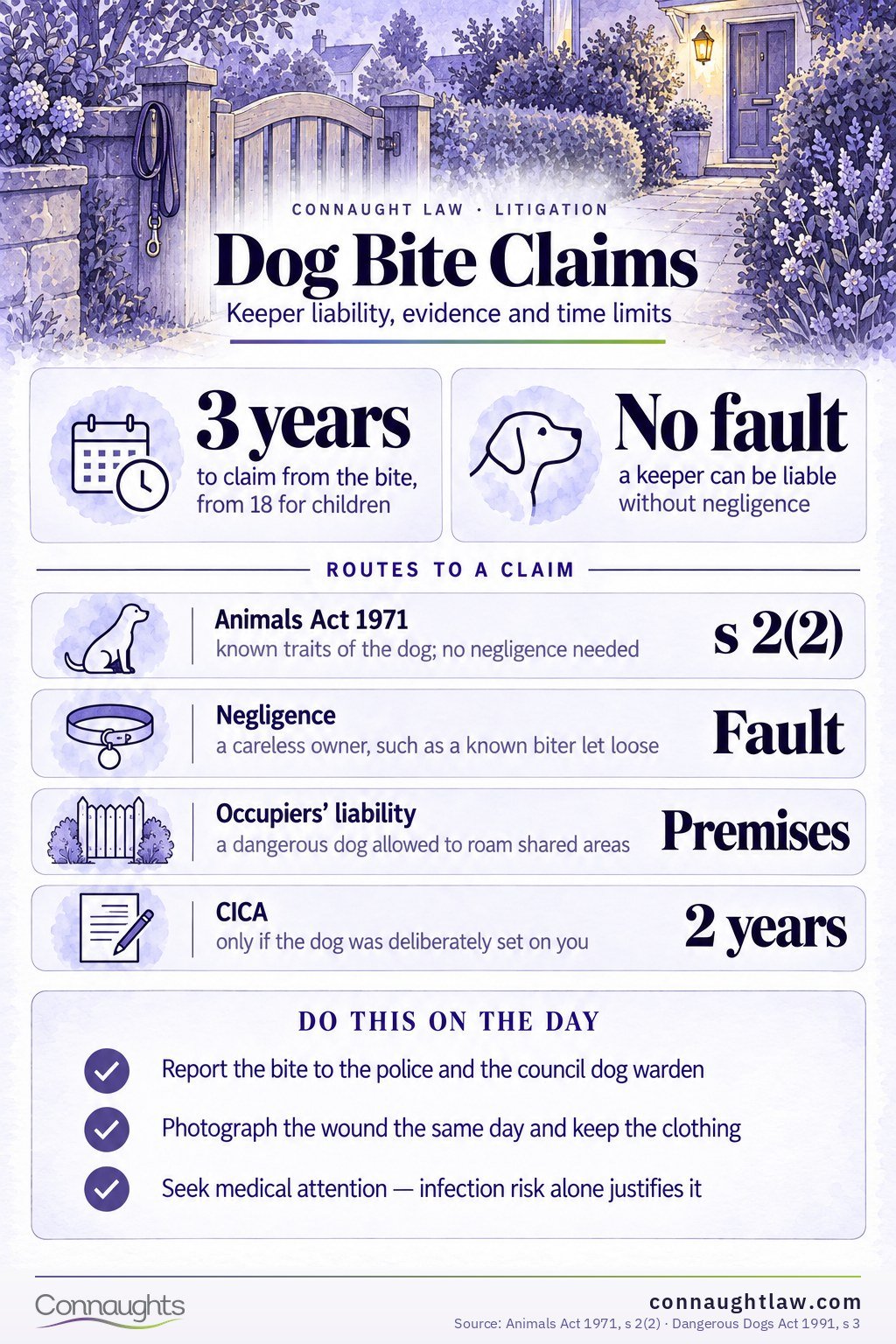
Three civil routes overlap. The Animals Act 1971, section 2(2), imposes liability on a keeper where three conditions align: the damage was of a kind the dog was likely to cause unless restrained, or likely to be severe if caused; that likelihood flowed from characteristics not normally found in dogs, or found only at particular times — a dog aggressive when guarding, in season or startled; and the keeper, or their household, knew of those characteristics. Where the conditions fit, liability needs no negligence.
Ordinary negligence runs alongside — an owner who lets a known biter loose near a playground is simply careless — and occupiers' liability adds a third route where the attack happens on premises whose occupier allowed a dangerous dog to roam customer or communal areas. The Dangerous Dogs Act 1991, section 3, adds the criminal layer: a dog dangerously out of control is an offence, convictions feed civil claims, and criminal courts can order compensation directly.
Defences Keepers Actually Run
Defences have familiar shapes: trespass at the time of the bite, voluntary acceptance of a known risk — the kennel entered despite warnings — and provocation arguments aimed mostly at adult victims. Children are treated with realism: small children cannot meaningfully accept risk or provoke in the legal sense, and contributory arguments against them rarely run far.
Who Counts as the Keeper
The Act fixes liability on keepers — usually owners and householders, including the head of a household where the owner is under sixteen — and possession can make a temporary minder a keeper too. Dog walkers, boarders and daycare operators bring their own insurance and duty questions. Where a prosecution runs, civil claims commonly wait for the outcome, because a conviction resolves liability at a stroke, and compensation orders made in criminal courts are credited against civil recovery rather than duplicated.
CICA and Deliberate Dog Attacks
Criminal injuries compensation through CICA is narrower than many websites suggest. A dog attack qualifies only where it amounts to a crime of violence — where someone deliberately set the dog on the victim, using it as a weapon. In those cases an application can succeed even where the offender is never traced, provided the incident was reported to the police promptly and the application is made within two years. Awards follow a fixed tariff and are generally lower than civil damages; a dog that was merely out of control does not qualify.
Eligibility and Proving a Claim
Eligibility is broad: bitten adults and children, parents claiming for children as litigation friends, workers bitten on duty, and people injured without a bite at all — knocked from bikes, pulled over by lunging dogs, injured fleeing a charge. The Animals Act analysis cares about the dog's characteristics and the keeper's knowledge, so evidence gathering aims there: previous incidents, warnings given to neighbours or delivery firms, "beware of the dog" signage, muzzle habits, and vet or kennel records where disclosure reaches them.
Most bites are inflicted in homes and gardens by dogs the victim knows rather than strays, so the knowledge question is usually answerable from within one street of the victim — if asked early.
Identifying the Dog and Keeper
Identification matters more than victims expect: the dog and keeper must be identified for a civil claim, which is why photographs at the scene, names of walkers, doorbell-camera footage and prompt reports to the police and the council dog warden do early, decisive work. A bite reported the same day, photographed raw, and seen in A&E produces a file that defends itself.
Special Damages and Financial Losses
Financial losses follow the ordinary personal injury pattern: earnings lost during healing, treatment costs including private scar management, silicone therapy, steroid injections and, where advised, revision surgery, plus travel, damaged clothing and care during recovery. In scarring claims the future costs matter most: laser and camouflage treatment, and the psychological therapy that NHS guidance recognises for trauma symptoms, are claimed on expert recommendation rather than hope.
Children's claims add structure: settlements approved by the court, funds held until majority, and scar assessments deferred until maturation — commonly two years or more after the attack — because a scar's final appearance, not its worst month, is what the award must live with. Children are among the most frequent dog-bite victims, and our child injury compensation guide explains the litigation friend and approval process in full.
Gratuitous care counts too: the parent who redressed wounds daily, the partner who drove to every appointment, the weeks of help while a bitten hand could not work. Modest individually, these entries knit into real sums that a well-built schedule must capture.
Infection and Complication Claims
Dog mouths carry organisms that make even small punctures medically serious: antibiotics and tetanus checks are standard, and a wound infection that extends healing extends the award. Where hospital care itself went wrong — delayed cleaning, missed tendon involvement — a clinical negligence claim can sit alongside the bite claim.
The Claim Process and Evidence
The process is conventional: identify keeper and insurer, notify the claim, assemble medical and photographic evidence, obtain scar and psychological reports at the right medical moment, and negotiate with the household or pet insurer — most claims settle without proceedings once liability evidence is assembled. Where the keeper disputes the dog's history, disclosure and neighbour evidence usually resolve the argument.
Photography deserves its own discipline in scarring claims: consistent lighting, dated series from injury through healing to maturation, and honest framing. The tribunal of fact will meet the scar mostly through photographs, and a well-kept series is worth more than any adjective. Keep the clothing too — torn sleeves and punctured gloves corroborate force in a way healed skin cannot.
Psychological evidence deserves early attention in child cases especially: nightmares, refusal to walk school routes, panic around known dogs. A GP note and, where symptoms persist, a child psychology referral both treat the problem and evidence it. Funding is standard practice: conditional fee agreements with adverse-costs insurance, and household legal expenses policies sometimes fund victims' claims too.
Unreported bites are how dangerous dogs stay dangerous, and how later victims lose the knowledge evidence the Animals Act rewards. Report to the police and dog warden, photograph the wound the same day, and seek medical attention — infection risk alone justifies it, and the record anchors any claim.
Workplace Dog Bite Claims
Postal workers, couriers, carers, meter readers and vets are bitten in the course of duty, and two defendants come into view: the keeper, under the Animals Act and negligence as usual, and the employer, whose risk assessments must address known dog hazards on rounds and visits, with warning markers, refusal rights and safe systems for flagged addresses. HSE lone-working guidance frames the duty for the visiting workforce.
Report through work systems as well as to the police: the employer's hazard log both protects colleagues and evidences the claim. Vets, groomers and kennel staff occupy a nuanced corner — their work knowingly involves dog risk, and the law calibrates rather than excludes protection. Time limits follow the Limitation Act 1980: three years from the bite, from 18 for children — though the evidential clock runs far shorter.
Frequently askedQuestions about dog bite compensation claims
What is the average payout for a dog bite in the UK?
No official average exists — published "averages" are marketing estimates. Minor bites with modest scarring typically settle in the low thousands, significant facial scarring attracts £12,040–£39,750 under the Judicial College brackets, and the most severe cases exceed £128,000 plus financial losses.
Can you sue for a minor dog bite in the UK?
Yes, where the keeper is identifiable and the bite caused real injury — punctures, a lasting mark or psychological effects. Very minor bites healing without trace may be worth too little to justify legal costs, but scarring or phobia usually lifts value above that threshold.
How much compensation is a level 4 dog bite worth?
There is no fixed figure — the Dunbar scale describes bite depth, not legal value. Deep punctures with lasting scars typically engage the significant facial scarring bracket (£12,040–£39,750) or the hand injury categories, with psychological injury valued separately.
Do I have to prove the owner was negligent?
Not always. The Animals Act 1971 imposes liability without negligence where the dog had relevant characteristics the keeper knew about — the dog that had snapped before, guarded fiercely or feared strangers. Negligence remains an alternative route.
The dog belongs to a friend or relative — can I still claim?
Yes, and it is usually a claim against their household or pet insurance rather than their pocket. Checking cover early keeps relationships and recoveries intact, and claims are routinely resolved without personal acrimony.
Can my child claim for a dog attack?
Yes, through a parent as litigation friend, with court approval protecting any settlement. Children's facial scarring and psychological evidence is assessed after maturation and with specialist care, and limitation does not begin until 18.
What if the dog was a stray or the owner cannot be found?
Identification is essential to a civil claim, which is why same-day reports to the police and dog warden matter. CICA can compensate only where the dog was deliberately set on you as a weapon — a genuine crime of violence — not merely out of control.
Can I claim for psychological effects without a serious wound?
Yes, where a diagnosable condition results — phobia, anxiety, post-traumatic symptoms — particularly in children. The psychiatric brackets apply in their own right, and treatment costs are recoverable.
I was bitten on my delivery round — who do I claim against?
Potentially both the dog's keeper and your employer, whose systems should manage known dog hazards on rounds. Report through work systems and the police; the combination usually identifies the responsible insurer quickly.
What is the time limit for a dog bite claim?
Three years from the attack, from age 18 for children, with the usual capacity protections. Identification and evidence decay much faster, so report and photograph immediately.
Tell us where it happened, whose dog it was and what treatment you needed. We’ll tell you whether the Animals Act makes the keeper strictly liable and what the scarring is realistically worth.
Get Expert Advice