
Medical negligence compensation in the UK turns on two questions, in strict order: did care fall below a reasonable professional standard, and did that failing cause harm better care would have avoided? Only when both are proved does valuation begin. The scale is real — NHS Resolution paid £3.24 billion in compensation in 2025/26 and resolved a record 84 per cent of claims without court proceedings — yet individual claims are won on records and expert evidence, not statistics. This guide covers the legal tests, hospital negligence claims, realistic compensation figures, the claims process, time limits and funding.
On This Page
Understanding Medical Negligence Compensation UK 2026
A medical negligence claim — clinical negligence, in the courts' vocabulary — is not an accusation that a doctor is bad at their job. It is a legal finding that on one occasion care fell below the standard the profession itself sets, and that someone was hurt as a result. In structure it is a specialised form of personal injury claim: duty, breach, causation and loss, with duty rarely in dispute. The law protects honest clinical judgment; what it compensates, fully, is avoidable harm.
The recurring claim types are familiar: delayed diagnosis of cancer and sepsis — examined in detail in our misdiagnosis compensation guide — missed fractures in emergency departments, surgical errors and retained instruments, medication and anaesthetic mistakes, failures to follow up abnormal results, and negligent maternity care. Across all of them the same two-question structure applies, and the earliest version of events, what the records say happened, controls the case.
Fatal cases add an inquest. Coroners examine unexplained hospital deaths, families are entitled to representation, and a Prevention of Future Deaths report can say in public what a defendant's letters would not. Inquest evidence, given on oath and tested, routinely shapes the civil claim that follows.
One reassurance worth stating plainly: claiming does not mark your family's card with the NHS. Compensation is paid by indemnity schemes, not ward budgets, treatment obligations continue unchanged, and the statutory duty of candour cuts the other way, obliging providers to tell you when something has gone wrong, whether or not you ever claim.
Hospital Negligence: NHS and Private Claims
Compensation for hospital negligence is claimed from the institution, not the individual. For NHS hospital care in England the defendant is the NHS trust, and the claim is handled and paid by NHS Resolution, the health service's indemnity body, under the Clinical Negligence Scheme for Trusts. GP and primary-care claims have run through a parallel state indemnity scheme since 2019, with older matters sitting with the medical defence organisations.
Private treatment changes the defendant, not the law. Claims arising from private hospitals and clinics run against the treating clinician's indemnifiers and, where its own systems failed — nursing care, equipment, post-operative monitoring — the hospital company itself, on exactly the same Bolam, Montgomery and causation principles. Mixed NHS-and-private treatment histories are common and simply mean the investigation allocates responsibility across providers before proceedings are ever issued.
NHS Resolution pays claims against NHS trusts; state indemnity or defence organisations cover GPs; private hospitals and their clinicians carry insurance. Compensation never comes from a ward budget, and your right to NHS treatment is unaffected by claiming.
NHS Resolution Statistics and What They Mean
NHS Resolution's annual report for 2025/26 puts hard numbers on the system: £3.24 billion paid in clinical negligence compensation, 15,236 new claims and reported incidents, and a record 84 per cent of claims resolved without formal court proceedings. Maternity claims remain the largest share of the bill, which is why birth injury claims have their own infrastructure, including the Early Notification Scheme covered in our birth injury compensation guide.
Two of those numbers matter practically. The 84 per cent resolution rate means a properly evidenced claim is likely to settle through the pre-action protocol, mediation or negotiation rather than a trial. And the rising cost explains the scrutiny: the National Audit Office and the Public Accounts Committee both examined clinical negligence spending during the year, and a fixed-costs regime for lower-value claims is already in force.
What the statistics do not mean matters equally. They do not make claims a lottery: the resolution figures include claims resolved at nil, and NHS Resolution defends weak cases robustly. Nor do they suggest most care is negligent; against hundreds of millions of patient contacts each year, claims are rare events. The system pays properly evidenced claims and resists the rest — which is how a claimant should plan.
The Bolam Test and Breach of Duty
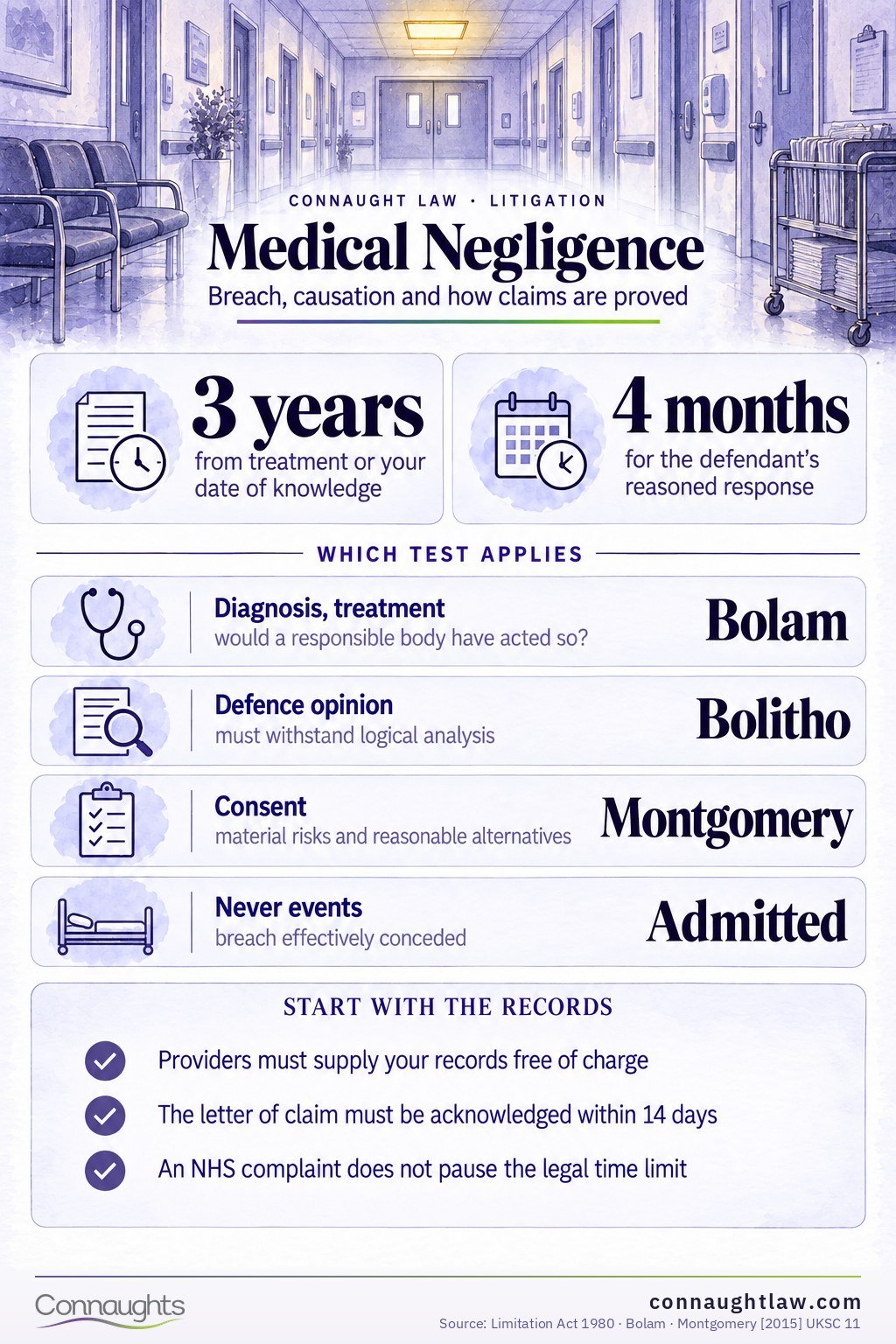
Breach of duty is judged by the Bolam test: care is not negligent if a responsible body of practitioners in the same field would have acted the same way, even if others would have acted differently. Bolitho adds the safeguard that the supporting opinion must withstand logical analysis — a body of opinion that ignores an obvious risk protects no one. Different questions attract different tests, summarised below.
Which Test Applies
| Scenario | Test Applied | What Must Be Shown |
|---|---|---|
| Diagnosis and treatment | Bolam | No responsible body of the profession would have acted this way |
| Logic of the defence opinion | Bolitho | The supporting opinion cannot withstand logical analysis |
| Consent to treatment | Montgomery | Material risks or reasonable alternatives were not disclosed |
| Never events | Breach effectively conceded | What the wholly preventable event caused |
| Admitted breach | Causation focus | The failing caused harm proper care would have avoided |
The practical consequence is that expert evidence decides breach. A claim needs an independent expert in the same discipline — a surgeon for surgery, a midwife for midwifery care — prepared to say no responsible body of their profession would have done what was done. Never events — wrong-site surgery, retained instruments — sit at the far end, where argument moves straight to what the event caused.
How the Standard of Care Is Calibrated
The standard is calibrated to role and specialty rather than personality. A GP is judged as a reasonably competent GP, a consultant neurosurgeon as a consultant neurosurgeon, and a junior doctor by the standard of the post they occupy — inexperience is no defence. Protocols and NICE guidance are not law, but unexplained departures from them need answering.
Montgomery and Informed Consent
Consent is judged from the patient's side of the conversation. Since Montgomery v Lanarkshire Health Board [2015] UKSC 11, clinicians must take reasonable care to ensure the patient is aware of material risks of the recommended treatment and of reasonable alternatives, including doing nothing. A risk is material if a reasonable person in this patient's position would attach significance to it, which makes the patient's own circumstances — occupation, family plans, past experience — legally relevant.
The Supreme Court clarified in McCulloch v Forth Valley Health Board that identifying which alternatives are reasonable remains a matter of professional judgment tested by Bolam, while communicating those alternatives, once identified, is governed by Montgomery. Consent claims succeed where a genuine option was never put on the table and the patient, properly informed, would have chosen differently or at another time.
Consent claims still require causation: the claimant must show that, properly informed, they would have declined, deferred, or chosen the alternative. Contemporaneous evidence — questions asked at the time, anxieties recorded in the notes — does more work here than after-the-event assertion.
How Much Compensation: General and Special Damages
Valuation has two layers. General damages compensate the injury itself — pain, suffering and loss of amenity — and are set by the Judicial College Guidelines, now in their 18th edition (April 2026). Special damages compensate the financial consequences: care and case management, lost earnings, treatment, equipment and adaptations, calculated item by item with documents. In serious clinical claims the special damages usually dwarf the injury award, because decades of care and lost earning capacity cost more than any bracket. Future losses are adjusted by the personal injury discount rate, +0.5 per cent in England and Wales since January 2025.
The current published brackets for the injuries that recur in catastrophic clinical claims give honest anchors.
Serious Outcome Brackets
| Outcome | JCG 18th Edition Bracket |
|---|---|
| Brain damage — less severe | £20,240 – £56,890 |
| Brain damage — moderate | £56,890 – £289,420 |
| Paraplegia | £289,420 – £375,540 |
| Brain damage — moderately severe | £289,420 – £372,570 |
| Brain damage — very severe | £372,570 – £533,720 |
| Tetraplegia (quadriplegia) | £428,850 – £533,720 |
- Multi-million settlements are lifetime packages: an injury bracket plus decades of care, therapies, adapted housing and lost earnings.
- Tables presenting £800,000 to £3 million as the "range" describe whole packages for the worst outcomes, not the injury award.
- Psychiatric injury, post-traumatic stress disorder and loss of a sense or function have their own JCG chapters, valued on the same principles.
The honest way to estimate any individual claim is bottom-up: identify the bracket the medical evidence supports, then cost the actual losses with documents. Headline figures only become meaningful once life expectancy, care needs and earnings are known, which is why serious claims are not valued credibly at a first meeting.
Structural Protections in Serious Claims
Serious claims carry structural protections. Interim payments release funds for treatment, care and income once liability is established in substance, and catastrophic awards are commonly split between a lump sum and index-linked periodical payments that guarantee care funding for life. Where the injured person cannot manage the award, the Court of Protection framework manages it for them.
The Claims Process: Letter of Claim to Resolution
Every claim starts with the complete records — GP, hospital, imaging, prescriptions and correspondence — which providers must supply free of charge, followed by independent expert opinion on breach and causation. Only then is the claim put formally. The letter of claim under the Pre-Action Protocol for the Resolution of Clinical Disputes sets out the allegations, the injuries and the losses; the defendant must acknowledge it within 14 days and give a reasoned response, admitting or denying each allegation, within four months.
Most claims resolve inside that framework, through admissions, negotiation or mediation — the 84 per cent figure above is the protocol working. Claims that will not resolve are issued at court and case-managed to trial, with each side's experts meeting to narrow what is genuinely in dispute.
Fixed Costs for Lower-Value Claims
Since 6 April 2024, most clinical negligence claims valued between £1,501 and £25,000 in England and Wales have run under a fixed recoverable costs scheme, with a streamlined lower-value protocol, standard and light tracks and a mandatory settlement stocktake. Claims involving stillbirth or neonatal death are excluded. The scheme caps the legal costs recoverable from the defendant, not the compensation itself. Above that band, recoverable costs are still assessed conventionally, by reference to the courts' guideline hourly rates.
Evidence That Decides These Claims
The claim is built from the complete records, obtained and read against each other for what was done, when and why. Under the duty of candour, providers must be open about incidents, and internal investigation reports, complaint responses and NHS complaints outcomes frequently supply the chronology a claim is hung on.
Causation is the harder half. It must be shown that the failing caused the harm, or materially contributed to it, against the background of what the underlying condition would have done anyway. English law does not compensate a lost statistical chance of a better outcome in medical cases, so the evidence must establish that proper care would, on balance, have produced a materially different result: an earlier diagnosis, an avoided operation, a survivable presentation.
Independent experts carry the argument at every step: breach experts in the treating discipline, causation experts in the relevant specialty, then condition-and-prognosis and quantum experts. Claims succeed or fail on the quality and independence of this evidence.
Time Limits for Medical Negligence Claims
Under the Limitation Act 1980, proceedings must be issued within three years of the negligence or of the date of knowledge — when the claimant first knew the injury was significant and attributable to the treatment. Knowledge is the battleground in medical claims, because harm from a missed diagnosis or a failed procedure often surfaces long after the event itself.
Time Limits for Children and Protected Parties
Children have until their twenty-first birthday, because the three years run from age 18. People lacking capacity face no running limit, and fatal claims run three years from death or from the family's knowledge. The court holds a section 33 discretion to allow a late claim, exercised on the facts and never guaranteed.
A worked example: a patient whose scan was misread in 2021 learns in 2025, from a later scan, that the abnormality was visible all along. The three years run from 2025, when they connected their worsening condition to the reporting failure, not from the scan itself. Knowledge, not suspicion, starts the clock.
A limitation problem is rarely improved by waiting. Records are free to request, deteriorating memories cannot be refreshed, and protective proceedings can preserve a borderline claim while investigation continues. If in doubt about your dates, take advice on them specifically and immediately.
Funding: No Win No Fee and Legal Aid
Most medical negligence claims are funded by conditional fee agreements: no fee if the claim fails, a capped success fee from damages if it succeeds, with after-the-event insurance protecting against the other side's costs. Legal expenses cover attached to household policies sometimes applies, and is worth checking early.
Legal aid survives in one crucial corner: children who suffer a severe neurological injury during pregnancy, birth or the first eight weeks of life. For everything else, funding is contractual, and a transparent conversation about deductions belongs at the first meeting, not the last. Our medical negligence solicitors set out both routes in writing before a claim begins.
Deductions are regulated rather than open-ended. The success fee under a conditional fee agreement is capped by law at 25 per cent of general damages and past losses, future care and earnings are protected from it entirely, and any shortfall arrangement should be explained and signed before work starts.
Frequently askedQuestions about medical negligence claims
How much compensation do you get for medical negligence in the UK?
The injury award follows Judicial College brackets, from four figures for short-lived harm to £533,720 for very severe brain damage under the 18th edition, with financial losses added on top. Multi-million settlements are lifetime packages dominated by care and lost earnings.
What has to be proved for a claim to succeed?
Breach and causation. Care must have fallen below the standard of a responsible body of the profession, and that failing must have caused harm better care would have avoided. A poor outcome without both elements is not negligence.
Who pays compensation for hospital negligence?
NHS Resolution pays claims against NHS trusts, state indemnity or defence organisations cover GPs, and private hospitals and clinicians are insured. You do not sue the individual nurse or doctor personally, and claiming never affects your treatment rights.
How long do medical negligence claims take?
Investigation alone typically takes months, because records and independent expert reports come first. With 84 per cent of claims resolved without court proceedings, most conclude by settlement, and complex claims properly wait for a stable prognosis before valuation.
What is the time limit for a medical negligence claim?
Three years from the treatment or from your date of knowledge, until 21 for children, no running limit where capacity is lacking, and three years from death in fatal cases. Knowledge arguments are common, so dates should be checked professionally rather than assumed.
Should I complain to the NHS first?
A complaint can produce explanations, apologies and an investigation report that helps a later claim, and it costs nothing. It does not pause the legal time limit, so run it alongside advice on the claim, not instead of it.
What if the negligence made an existing illness worse rather than causing it?
That is claimable. The claim is valued on the difference the negligence made: the additional harm, earlier deterioration or lost treatment window, assessed against what the condition would have done with proper care.
Will my claim end up in court?
Statistically unlikely. The great majority of clinical claims settle through the pre-action protocol, negotiation or mediation. Proceedings are issued where liability is disputed or limitation requires it, and even issued claims usually settle before trial.
Tell us what treatment you had, what you were told beforehand and what has happened since. We’ll obtain the records and tell you honestly whether breach and causation can both be proved.
Get Expert Advice