
Misdiagnosis compensation claims rest on a principle that surprises many families: the claim is not for the illness, but for the difference the diagnostic failure made. A cancer that always needed chemotherapy is not the defendant's doing; a cancer that spread during eighteen months of false reassurance is. Diagnostic error is among the most common allegations in clinical negligence — NHS Resolution paid £3.24 billion across clinical claims in 2025/26 — and this guide explains how misdiagnosis compensation amounts are calculated, cancer and delayed diagnosis claims, NHS claims, time limits and the process.
On This Page
Understanding Misdiagnosis Compensation UK 2026
Three scenarios recur. A wrong diagnosis: the condition was labelled as something else and treated accordingly, sometimes with treatment that itself caused harm. A delayed diagnosis: the right answer arrived, but later than competent care would have delivered it. And a missed diagnosis: results, symptoms or referrals that should have triggered investigation never did. Legally they are analysed the same way, and in each the clock — what changed while the truth waited — is the substance of the claim.
Not every diagnostic error is negligent. Medicine works with incomplete information, some presentations are genuinely atypical, and hindsight makes every answer look obvious. The legal test is whether a reasonably competent clinician, seeing what this clinician saw, would have suspected, tested or referred. When the answer is yes and nothing happened, the claim has its foundation.
When Misdiagnosis Becomes Negligence
Breach of duty follows Bolam and Bolitho: care escapes criticism if a responsible body of the same specialty would have done the same, provided that opinion survives logic. For diagnosis, the question is rarely "should the doctor have known the answer" and almost always "should the doctor have done more to find it": examined further, arranged the scan, repeated the blood test, referred under the suspected-cancer pathway, or safety-netted with clear instructions to return. Where the failure was in explaining options rather than finding answers, Montgomery's informed-consent standard applies instead.
Safety-Netting and Follow-Up Failures
Safety-netting failures deserve their own mention because they are so common. A diagnosis of a minor condition is often defensible on day one; what is not defensible is the absence of a plan for being wrong: no advice on red flags, no follow-up for persisting symptoms, no repeat review after a third attendance with the same complaint. Repeated attendances with a worsening picture are the classic footprint of a negligent missed diagnosis.
Modern misdiagnosis claims are also increasingly system claims. An abnormal scan reported but never communicated, a result filed unactioned, an urgent referral that sat in a queue — these are failures of the provider's systems rather than any individual's judgment, and they are pleaded that way. System failures are often easier to prove than clinical misjudgment, because the paper trail is unambiguous.
The same law governs private medicine: a private GP, consultant or screening service is judged by identical standards, with claims met by their indemnifiers. The recurring claim types below show what each usually turns on in practice.
Common Misdiagnosis Claims
| Common Misdiagnosis Claim | What the Claim Usually Turns On |
|---|---|
| Cancer — breast, lung, colorectal, prostate, skin | Missed red-flag symptoms or results; failure to refer under the two-week suspected-cancer pathway; staging difference caused by the delay |
| Heart attack and cardiac conditions | Chest pain triaged as indigestion or anxiety; ECG or troponin not done or misread; discharge without cardiology review |
| Stroke and TIA | FAST-type symptoms attributed to migraine or vertigo; lost thrombolysis window; no urgent imaging |
| Sepsis, meningitis, appendicitis | Deterioration despite "observation"; early warning scores not acted on; source never investigated |
| Fractures — scaphoid, hip, spine | X-ray misread or wrong view taken; "sprain" label without follow-up imaging despite continuing symptoms |
| GP diagnostic failures | Repeated attendances with worsening symptoms; abnormal results filed unactioned; no referral or safety-netting |
The table describes patterns, not automatic wins: each row still requires expert evidence that competent care demanded more, and proof of what earlier action would have changed — the causation question on which these claims are genuinely won and lost.
How Much Compensation for Misdiagnosis?
Misdiagnosis compensation is calculated from the additional harm the error caused, not the underlying illness. Awards combine a Judicial College Guidelines bracket for the avoidable injury with documented financial losses, so totals run from a few thousand pounds for a short delay to seven figures where lifelong care or a lost life follows.
Valuation starts from the counterfactual the experts establish: what would the outcome have been with a timely diagnosis? Compensation covers the gap between that outcome and what actually happened. The heads of loss are the same as in any personal injury claim, but tables quoting a "typical range" for a cancer or stroke misdiagnosis have no legal source — every component is assessed on evidence in the individual case.
The components of a misdiagnosis award break down as follows.
What Makes Up an Award
| Component | How It Is Assessed |
|---|---|
| Injury (general damages) | Judicial College Guidelines bracket for the additional harm: the avoidable surgery, organ damage, disability or psychiatric injury the delay caused |
| Lost earnings | Payslips, accounts and employment evidence for time off, reduced capacity and, in serious cases, a shortened working life |
| Care and assistance | Professional rates and family care hours, past and future, including case management where needs are complex |
| Treatment and equipment | Private treatment made necessary by the delay, therapies, aids, adaptations and travel, on invoices and expert costing |
| Fatal cases | Dependency, funeral costs and the statutory bereavement award, currently £15,120 |
For scale, the Judicial College Guidelines (18th edition, published April 2026) run from four figures for transient harm to £372,570–£533,720 for very severe brain damage. Psychiatric injury is compensated in addition to the physical consequences — learning that reassurance was false or that a death was avoidable can found a diagnosed depressive or post-traumatic condition, and those brackets rise steeply with severity. The full framework is set out in our medical negligence compensation guide.
Serious cases carry the standard structural protections: interim payments once liability is conceded in substance, and periodical payments or provisional damages where lifetime care or a defined risk of deterioration follows.
Cancer Misdiagnosis Compensation Amounts
There is no fixed tariff for cancer misdiagnosis. Amounts turn on what the delay changed: a short delay with no staging difference typically supports a modest five-figure award for the extra anxiety and treatment, while a delay that let the cancer progress — more radical surgery, avoidable chemotherapy, reduced life expectancy — supports six-figure and sometimes seven-figure claims once earnings, care and dependency are added.
Cancer claims are valued on the staging difference the delay caused. Experts compare the stage at which the cancer was actually treated with the stage timely referral would have caught, then trace the consequences: mastectomy where breast-conserving surgery would have sufficed, chemotherapy or radiotherapy added by progression, lost fertility, reduced life expectancy, and the earnings and pension a shortened working life costs. The wider the gap between those two positions, the larger the award — which is why two delayed diagnoses of the same cancer can settle for figures an order of magnitude apart.
The negligence itself usually lies in a missed referral: red-flag symptoms that NICE's suspected-cancer guidance required to be investigated urgently, an abnormal result filed unactioned, screening misread. Where the delay cost survival, the claim becomes a fatal one: dependency for the family, funeral costs, the statutory bereavement award of £15,120, and an award for the deceased's own suffering — death following a period of full awareness is bracketed at £16,570 to £31,460 under the 18th edition.
NHS Misdiagnosis Claims and NHS Resolution
An NHS misdiagnosis claim is brought against the trust — or, for GP care, the general practice indemnity scheme — never against an individual doctor's own pocket. Compensation is paid by NHS Resolution, which in 2025/26 paid £3.24 billion across clinical claims, received 15,236 new claims and reported incidents, and resolved a record 84 per cent without court proceedings. Diagnosis-related allegations, in emergency departments, general practice and radiology, are consistently among the most common themes in that caseload.
An NHS complaint and a compensation claim are different tracks. The complaints process, and the Parliamentary and Health Service Ombudsman beyond it, can deliver explanations and modest remedies without litigation — but neither pauses the legal time limit nor values a serious claim. Run a complaint alongside legal advice, not instead of it.
The Duty of Candour
The duty of candour supports families here: providers must notify and explain qualifying incidents, and internal investigation reports frequently concede the chronology long before solicitors are involved. A well-run claim can deliver what many families actually want — a coherent explanation, a meaningful apology, and confidence it will not happen again — alongside the compensation the law controls.
Delayed Diagnosis Compensation and Causation
A delayed diagnosis claim alleges that the correct diagnosis was reached later than competent care would have achieved it, and that the delay itself — not the underlying condition — caused measurable additional harm.
Delayed diagnosis disputes have a distinctive shape: the defendant often admits the diagnosis was late but denies the delay mattered. The battleground is causation. The claimant must show, on the balance of probabilities, that the delay produced a materially worse outcome — a later stage, an avoidable operation, a lost treatment window. In stroke and cardiac claims that window is measured in hours; in cancer, in staging intervals.
English law does not compensate the loss of a statistical chance. In Gregg v Scott [2005] UKHL 2, a negligent delay reduced the claimant's survival prospects from 42 to 25 per cent, yet the claim failed: survival was improbable either way, so the delay could not be shown to have changed the probable outcome. The discipline this imposes is factual, not cynical — experts must identify concrete, more-likely-than-not differences, and claims framed that way succeed where chance-based framings fail.
Where the delay made an already poor prognosis somewhat worse, the claim is valued on that difference: additional pain, more radical treatment, lost months of working life, psychiatric harm from learning the truth late. Honest valuation of a modest difference is a strong claim; inflation of it is how good claims die.
Proving the Diagnosis Should Have Been Made
Breach evidence reconstructs the decision point. What symptoms were recorded, what results were available, what did the applicable guidelines require, and what would a reasonably competent clinician have done next? Records are decisive here, including what is absent from them: an examination not documented is difficult to defend as thorough.
- A dated chronology of every attendance, symptom and result
- Guideline breaches — referral pathways, early warning scores, follow-up protocols
- A blind expert re-read of the original imaging or pathology
- A concrete counterfactual: the stage, window or operation earlier diagnosis would have changed
- Documented losses — earnings, care hours, treatment costs
The expert team is assembled to the claim's shape: a radiologist to re-read the imaging blind, an emergency medicine or general practice expert on the standard of the assessment, an oncologist or cardiologist on staging and windows, and psychiatric and care experts on consequences. Cheap claims with one obliging expert are a false economy that defendants recognise on sight.
Where family stepped in during the delay — driving to appointments, nursing through avoidable treatment — those hours are claimable as gratuitous care, valued at commercial rates with a conventional discount. Schedules that capture them settle higher.
Time Limits for Misdiagnosis Claims
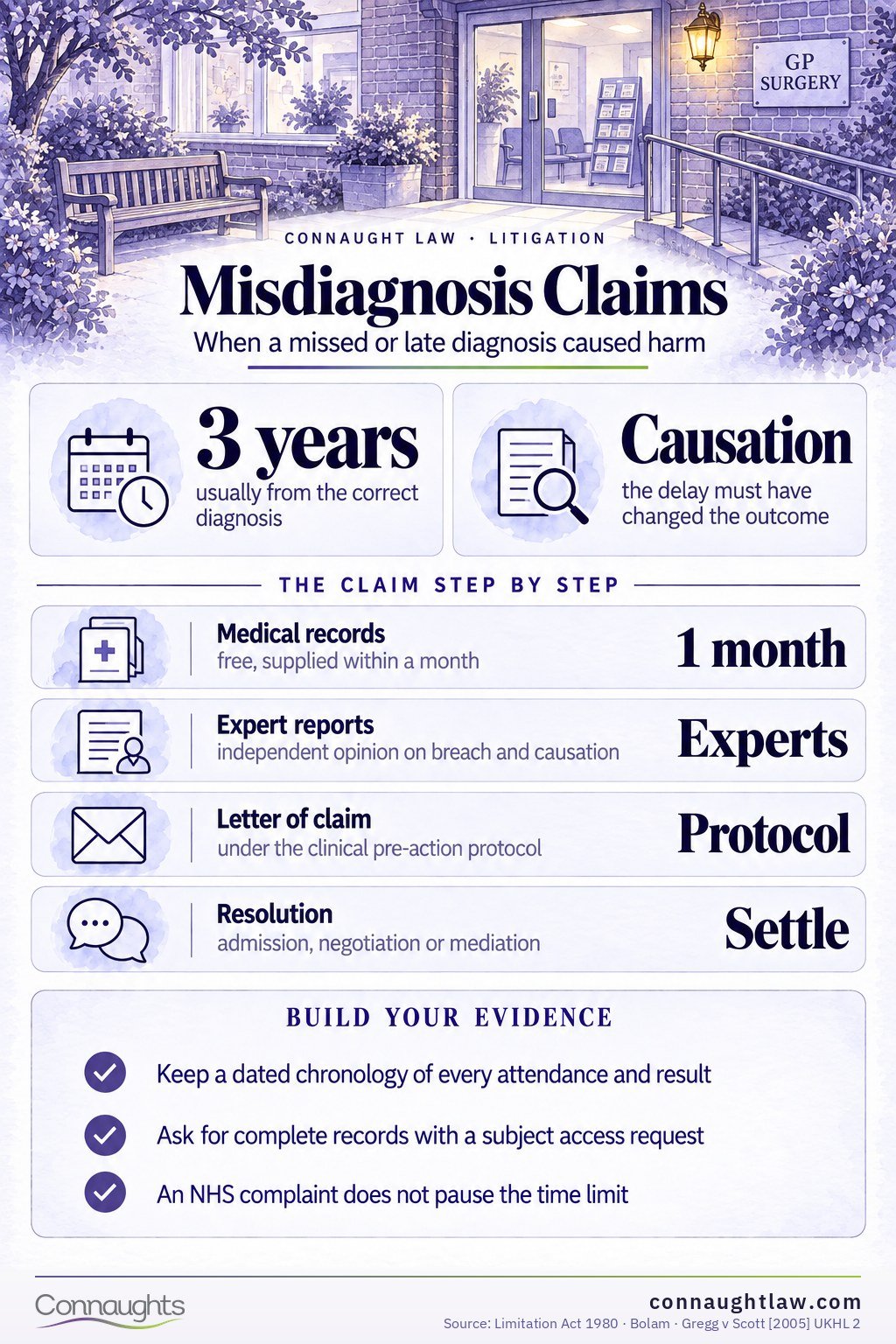
The Limitation Act 1980 allows three years from the negligence or from the date of knowledge, and in misdiagnosis cases knowledge usually arrives with the correct diagnosis: the moment the patient learns the earlier reassurance was wrong is typically when time starts running. Children have until their twenty-first birthday, there is no running limit for those lacking capacity, and fatal claims run three years from death or the family's knowledge.
Fatal misdiagnosis cases usually pass through an inquest first, where the family can test hospital witnesses on oath and a coroner may make a Prevention of Future Deaths report. The civil claim then covers the estate's losses, the family's dependency, funeral costs and the bereavement award, and inquest answers routinely settle liability before the letter of claim is even served.
Defendants argue earlier knowledge — from symptoms, second opinions or overheard concerns — to run limitation down. If a corrected diagnosis has revealed an earlier failure, take advice on your dates now; protective proceedings can hold a borderline claim open while the investigation completes.
The Claim Process Step by Step
The sequence is settled. Full records are obtained and a chronology built; independent experts report on breach and causation; a letter of claim is served under the pre-action protocol for clinical disputes; the defendant investigates and serves a reasoned response; and resolution follows by admission, negotiation or mediation, with court proceedings reserved for the minority that will not settle. Our medical negligence claim page explains how each stage is run in practice.
Records are free: providers must supply them under data protection law within a month, and a subject access request in plain words is enough. Completeness matters more than speed — imaging, nursing observations and audit trails included — because the gaps in a record are frequently where the claim lives.
Funding follows the clinical negligence norm: conditional fee agreements with capped, regulated deductions, after-the-event insurance for adverse costs, and legal aid surviving only for neurological birth injury, covered in our birth injury compensation guide. A serious misdiagnosis claim should never stall on fees, and a funding structure that cannot be explained in one page should not be signed.
Where liability is disputed, mediation has become the workhorse, actively favoured by NHS Resolution and resolving most cases that reach it. Throughout, the claimant's job stays small — attend the medico-legal appointments, keep receipts and a short diary of ongoing effects, and take advice before responding to any offer.
Frequently askedQuestions about misdiagnosis and delayed diagnosis claims
How much compensation do you get for misdiagnosis in the UK?
There is no per-condition rate. Awards are built from the additional harm the delay caused, bracketed under the Judicial College Guidelines, plus documented losses: earnings, care and treatment. The same missed diagnosis can produce vastly different awards depending on what changed.
What are typical cancer misdiagnosis compensation amounts?
They range from modest five-figure awards where a short delay changed little, to six and seven figures where progression forced more radical treatment or reduced life expectancy. The staging difference the delay caused, plus financial losses, drives the figure.
Can I claim compensation for an NHS misdiagnosis?
Yes. The claim is brought against the trust or GP indemnity scheme and paid by NHS Resolution, not the individual doctor. Most properly evidenced claims resolve without court proceedings; an NHS complaint can run alongside but does not pause the time limit.
Is every wrong diagnosis negligent?
No. Medicine tolerates reasonable uncertainty, and atypical presentations mislead competent doctors. The claim arises where a reasonably competent clinician would have examined, tested or referred, and the failure to do so caused avoidable harm.
Can I claim for a delayed cancer diagnosis?
Yes, where earlier referral or investigation was required and the delay materially worsened the position: a later stage, more radical treatment, or reduced prospects established on the balance of probabilities. Staging and progression evidence carries these claims.
What if the outcome would have been the same anyway?
Then the claim is limited to what the delay did change, such as additional pain, avoidable procedures or psychiatric harm, and if it changed nothing material, there is no claim. Causation, not the error alone, defines compensation.
When does the time limit start for a misdiagnosis claim?
Usually from your date of knowledge, often when the correct diagnosis revealed the earlier failure, subject to a three-year period. Children have until 21 and there is no running limit where capacity is lacking. Dates are argued, so verify them early.
Can I claim against my GP as well as the hospital?
Yes, where each contributed: a GP who failed to refer and a hospital that misread the scan can both be defendants, with responsibility apportioned. Indemnity schemes, not individuals, meet the claims.
Do misdiagnosis claims go to court?
Rarely. Most resolve through the pre-action protocol, negotiation or mediation once expert evidence is exchanged. Proceedings are issued for the minority where liability or valuation cannot be agreed, and most of those still settle before trial.
Tell us when you first raised symptoms, what you were told, and when the correct diagnosis finally came. We’ll review the records with independent specialists and tell you what an earlier diagnosis would actually have changed.
Get Expert Advice