
There is no official average payout for stress at work in the UK — and any figure claiming otherwise deserves scepticism. What a claim is actually worth depends on the route: a personal injury claim where workplace stress caused a diagnosable psychiatric injury, valued through the Judicial College brackets plus lost earnings, or an employment tribunal claim where the stress flows from discrimination or harassment, valued through the Vento bands of £1,300 to £62,900 and beyond for claims from 6 April 2026. This guide covers both routes for 2026: the tests, the current figures, the deadlines and the evidence.
On This Page

Understanding Stress at Work Compensation UK 2026
Work is allowed to be demanding, and the law compensates injury, not pressure. That single distinction explains most outcomes in this field: a claimant who felt overwhelmed has no claim; a claimant whose employer piled work onto someone visibly breaking, ignored occupational health advice, or let a harassment campaign run, and who developed clinical depression, anxiety disorder or post-traumatic symptoms as a result, has a serious one. The medical threshold is a recognised psychiatric condition, diagnosed rather than described.
The caseload concentrates where people carry other people: health and social care, teaching, emergency services, and any role where understaffing converts one job into two. A useful self-check before claiming: can you point to a diagnosis, to warnings the employer had or should have had, and to something it could reasonably have done differently? If all three answers are yes, the claim deserves professional assessment.
Route selection then shapes everything: deadlines, forum, and what money is available. Employment tribunal claims for discrimination or harassment must generally begin within six months of the act complained of (three months for acts before 1 October 2026), extended only by early conciliation; civil negligence and harassment claims carry years, not months. Many strong cases hold both options at the outset and lose one to the calendar.
Procedure on the tribunal track starts with ACAS early conciliation: a mandatory, free window in which ACAS explores settlement before a claim form can be issued, pausing the limitation clock while it runs. On the civil track, the claim follows the usual personal injury claim rhythm of records, psychiatric evidence and a letter of claim. Tribunal representation is funded privately, through legal expenses insurance or by unions; civil psychiatric injury claims typically run on conditional fee agreements.
Average Payout for Stress at Work: The Honest Answer
No official average exists: settlements are not centrally recorded, and figures quoted online mix incomparable cases. Valuation is bracket-based instead. A moderate psychiatric injury attracts £7,740 to £25,190 under the Judicial College Guidelines (18th edition, April 2026), with lost earnings and treatment costs claimed on top — often the larger element.
The honest arithmetic runs in two parts. The injury element follows the Judicial College bracket for the psychiatric harm actually diagnosed, set out below. The financial element then adds everything the illness cost: sick pay shortfalls, a missed promotion, career interruption and therapy. Because psychiatric injury so often forces time out of work or a step down in role, loss of earnings compensation frequently exceeds the injury award itself — which is why two claims with identical diagnoses can settle tens of thousands of pounds apart.
The brackets below come from the 18th edition of the Judicial College Guidelines, published 9 April 2026.
Psychiatric Injury Brackets
| Injury (JCG 18th edition) | Bracket | Broad picture |
|---|---|---|
| Psychiatric damage — severe | £72,440 – £152,900 | Poor prognosis; lasting impact on work and relationships |
| Psychiatric damage — moderately severe | £25,190 – £72,440 | Significant problems, but a more optimistic prognosis |
| Psychiatric damage — moderate | £7,740 – £25,190 | Marked improvement by trial; good prognosis |
| Psychiatric damage — less severe | £2,040 – £7,740 | Shorter disturbance of daily life and sleep |
| PTSD — severe | £79,080 – £133,000 | Permanent effects preventing pre-trauma functioning |
| PTSD — moderate | £10,810 – £30,580 | Largely recovered; residual effects not grossly disabling |
Tribunal awards for injury to feelings run on a different scale — the Vento bands covered below — and the two are not added together for the same harm. Where both routes are open, the valuation gap between them is often the deciding factor.
The Legal Framework for Workplace Stress Claims
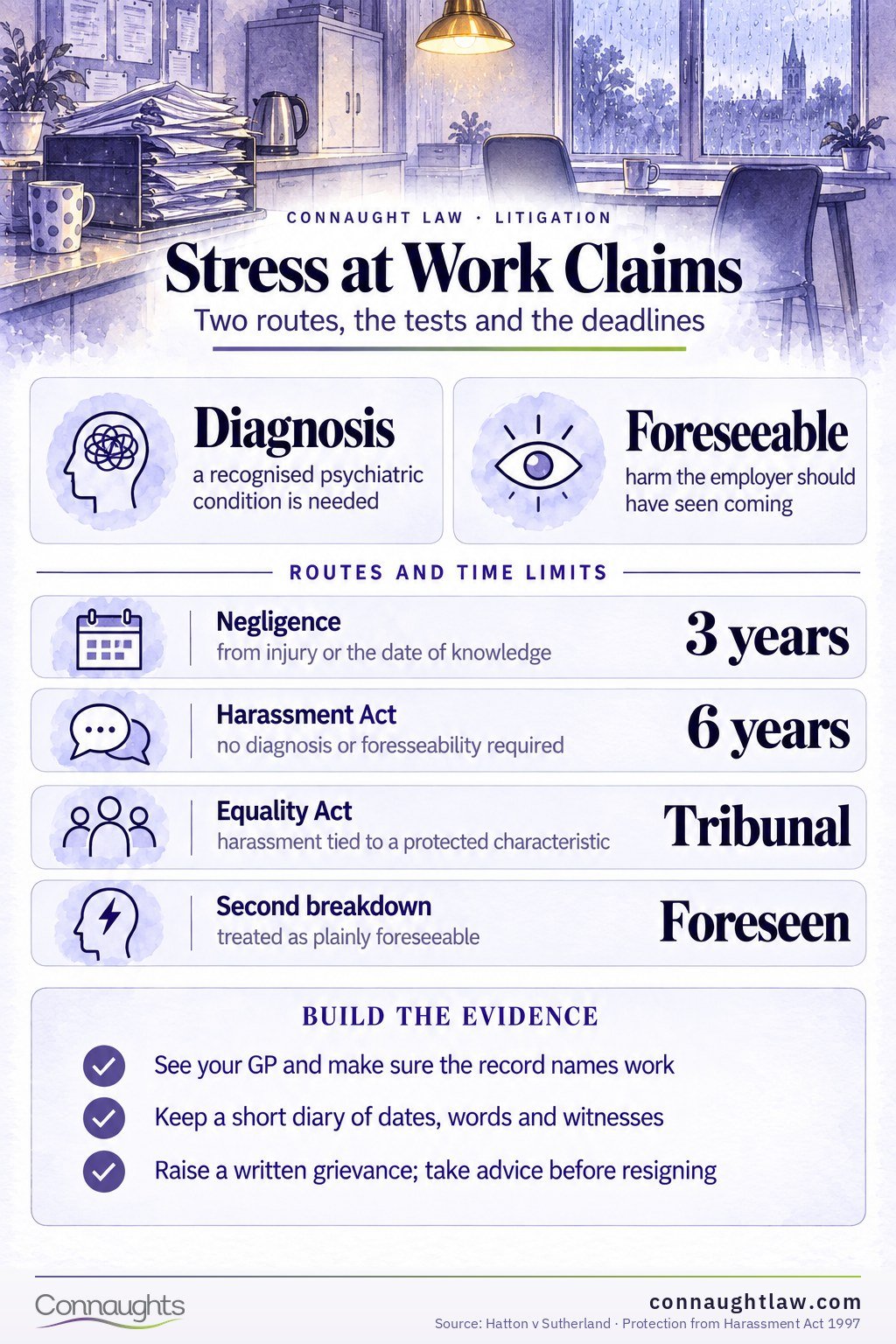
The negligence route rests on the Court of Appeal’s enduring framework in Hatton v Sutherland [2002] EWCA Civ 76, approved by the House of Lords in Barber v Somerset County Council [2004] UKHL 13: an employer is liable where psychiatric injury from workplace stress was reasonably foreseeable and reasonable steps were not taken. Foreseeability is judged on what the employer knew or ought to have known — workload against the norms of the job, complaints made, absences and their stated reasons, and signs of impending harm in a particular employee. No occupation is deemed intrinsically dangerous to mental health; the focus is always this employee, this employer, these warnings.
Two Hatton-era refinements matter daily. An employer may generally take an employee at face value — someone who says they are coping, while hiding the truth, makes foreseeability hard, which is why honest disclosure to managers and occupational health builds the claim as well as the support. And once an employer knows of a first breakdown, a second is treated as plainly foreseeable: the return-to-work period after stress absence is where employers are most often, and most expensively, careless.
Whistleblowing and Detriment Claims
Whistleblowing adds a further strand: workers who suffer detriment for protected disclosures — raising patient safety, financial wrongdoing or health and safety failures — claim without any cap on compensation and without qualifying service — and the person who raised the alarm is so often the person then managed into illness.
Alongside negligence sit statutory frameworks: the Management of Health and Safety at Work Regulations require risk assessment that includes psychosocial risk, the Equality Act 2010 turns stress flowing from discrimination, harassment or victimisation into tribunal claims, and the Protection from Harassment Act 1997 adds a civil route of its own.
The Protection from Harassment Act Route
Under the Protection from Harassment Act, an employer answers vicariously for a course of oppressive conduct by its employees, the threshold is conduct crossing from unattractive to oppressive and unacceptable, and neither foreseeability of injury nor a psychiatric diagnosis is required — though anxiety and distress are compensated more modestly without one. With six years to claim, it is the route of last resort that regularly rescues expired cases.
Compensation Routes and 2026 Award Levels
Tribunal awards for injury to feelings follow the Vento bands, revised by Presidential Guidance for claims presented on or after 6 April 2026 — our employment tribunal awards guide explains how tribunals apply them in practice.
Vento Bands 2026
| Vento Band (from 6 April 2026) | Range | Typical Use |
|---|---|---|
| Lower band | £1,300 – £12,600 | Less serious, one-off or isolated incidents |
| Middle band | £12,600 – £37,700 | Serious cases not meriting the upper band |
| Upper band | £37,700 – £62,900 | The most serious cases, including sustained campaigns |
| Exceptional cases | £62,900 and above | Rare, exceptionally serious circumstances |
Vento Bands Before and After April 2026
Claims presented before 6 April 2026 remain on the previous bands (£1,200 to £60,700). Alongside injury to feelings, tribunals award financial losses, and discrimination losses are uncapped. Unfair dismissal compensation is capped at £123,543 or 52 weeks’ gross pay for dismissals from 6 April 2026, with a week’s pay capped at £751; under the Employment Rights Act 2025 that compensatory cap is due to be removed from January 2027, when the qualifying period is also due to fall from two years to six months.
The personal injury route uses the Judicial College brackets set out earlier, with lost earnings, treatment and care claimed on top, uncapped. Where sexual harassment succeeds in the tribunal, a failure to meet the preventative duty can add an uplift of up to 25 per cent to the compensation, and an ACAS code failure can do the same in relevant claims.
- Tribunal deadline: six months from the act complained of (three months less one day for acts before 1 October 2026), via ACAS early conciliation.
- Civil negligence deadline: three years from injury or date of knowledge; Protection from Harassment Act: six years.
- Tribunal money: Vento injury to feelings plus financial losses, uncapped in discrimination.
- Civil money: Judicial College psychiatric bracket plus uncapped lost earnings, treatment and care.
- The same breakdown can be worth a middle-band Vento award or a six-figure negligence claim — the choice must be made early.
Bullying at Work Compensation: Which Route Fits
Bullying is not a standalone legal claim in the UK. Compensation instead arrives through whichever established route the facts support. Where the bullying relates to a protected characteristic — sex, race, disability, age, religion or belief, sexual orientation — it is harassment under the Equality Act 2010, and the tribunal awards injury to feelings on the Vento bands plus financial losses. Where it does not, the Equality Act falls away and the civil routes carry the case.
Those civil routes are the ones already described: negligence, where a campaign the employer knew about caused psychiatric injury, and the Protection from Harassment Act, which fits sustained bullying particularly well because it needs no protected characteristic and no proof the injury was foreseeable. Resignation in the face of ignored complaints can add constructive dismissal. The practical sequence rarely changes: raise a written grievance, keep records, involve ACAS where the tribunal route is live, and take advice before resigning.
Proving Employer Liability for Stress
Foreseeability is built from the employer’s own records: complaints and grievances, one-to-one notes, emails flagging workload, occupational health referrals and reports, sickness absences citing stress, and the difference between the risk assessment on paper and the rota in practice. An employer who knew nothing because it made sure never to ask does not escape.
Breach is then measured against reasonable steps: adjusting workload or hours, providing support or cover, acting on occupational health advice, investigating grievances properly, and stopping known harassment. The Hatton framework gives employers credit for genuinely available counselling and support services, but a helpline is not an answer to a rota that requires one person to do two jobs indefinitely.
Causation completes the claim, and psychiatric evidence carries it: a consultant psychiatrist addressing diagnosis, cause, apportionment where life brings other stressors, prognosis and treatment. Claims survive mixed causes — work need only make a material contribution to an indivisible injury — but they do not survive vague ones, which is why the GP record made at the time, naming work, matters so much later.
Keep your own record straight from the first bad month: dates, what was said and by whom, copies of rotas and relevant emails where policy allows, and a short contemporaneous diary. Stress claims are chronically under-documented because their victims are exhausted, and the diary is the cheapest evidence the claim will ever get.
Building the Evidence: Colleagues and Records
Colleague evidence helps more than colleagues fear. Witnesses worry about their own positions, but victimising a witness is unlawful in the same way as victimising the claimant, and tribunal witness orders exist for the genuinely reluctant. One contemporaneous colleague account outweighs pages of the claimant’s own recollection.
The Worker Protection Act and New Duties
The Worker Protection (Amendment of Equality Act 2010) Act 2023, in force since 26 October 2024, imposes a positive duty on employers to take reasonable steps to prevent sexual harassment of their workers, including by third parties such as customers and patients.
It is enforceable by the Equality and Human Rights Commission, and tribunals can uplift sexual harassment compensation by up to 25 per cent where the preventative duty was breached. The duty moves the legal question from “did it happen” to “what did you do before it happened”: risk assessments, training that is real rather than annual clicking, reporting channels that work.
The wider employment landscape is shifting in the same direction under the Employment Rights Act 2025: from April 2026, statutory sick pay runs from day one without the lower earnings limit, and paternity and unpaid parental leave became day-one rights; tribunal claim time limits doubled from three to six months for acts on or after 1 October 2026; and from January 2027 the unfair dismissal qualifying period is due to fall to six months.
Stress claims also interact with other workplace rights: suspension handled carelessly can itself found or aggravate a claim, as our employee suspension guide explains, and the wider framework of worker protections is mapped in our UK employment law guide.
Treatment belongs in the plan alongside the claim: NHS talking therapies can be self-referred, and in civil claims the cost of private therapy is recoverable where negligence is established. Courts and tribunals read a treated claimant as a credible one.
Statistics, Trends and Prevention Standards
The scale of the problem is documented by the regulator rather than by marketing. HSE’s statistics consistently identify work-related stress, depression and anxiety as one of the two dominant causes of work-related ill health and lost working days in Great Britain, concentrated in public-facing sectors and driven by workload, lack of support and change management. Psychiatric injury from work is, in this sense, an occupational illness like any other, governed by the same prevention-and-proof logic that runs through industrial disease claims.
The HSE Management Standards set out what competent prevention looks like across demands, control, support, relationships, role and change, and they double as a benchmark in litigation: an employer that never assessed psychosocial risk has already conceded the first half of the argument.
Where cases resolve, they usually resolve contractually: settlement agreements with independent legal advice, agreed references, and confidentiality drafted both ways. Confidentiality cannot lawfully gag protected disclosures or reports to regulators; price the certainty, the reference and the recovery time, not only the headline figure.
Tribunal claims for discrimination and harassment must generally begin, via ACAS early conciliation, within six months of the act complained of (three months less one day for acts before 1 October 2026). People recovering from breakdowns routinely miss it while waiting to feel stronger. If work has made you ill, diarise the deadline before anything else — the civil routes expire more slowly, but the tribunal route dies fastest.
Questions about stress at work claims
What is the average payout for stress at work in the UK?
There is no official average — settlements are not centrally recorded. Claims are valued from the Judicial College brackets: moderate psychiatric injury attracts £7,740 to £25,190 under the 18th edition, plus lost earnings, which often exceed the injury element.
Can I claim compensation for stress at work?
Yes, where stress caused a diagnosable psychiatric injury your employer should have foreseen and prevented, or where it flows from discrimination or harassment. Pressure alone, without injury or unlawful treatment, is not compensable.
How much compensation for stress at work in the UK?
Tribunal injury-to-feelings awards follow the Vento bands — £1,300 to £62,900 and above for claims from 6 April 2026 — plus financial losses. Civil claims use the psychiatric injury brackets, up to £152,900 for severe injury, plus uncapped losses.
Can I claim compensation for bullying at work?
Yes, through an established route: Equality Act harassment where the bullying relates to a protected characteristic, negligence where it caused foreseeable psychiatric injury, the Protection from Harassment Act for oppressive campaigns, or constructive dismissal if you were forced out.
What is the time limit for a stress at work claim?
Tribunal claims: generally six months, via ACAS early conciliation, where the act complained of was on or after 1 October 2026; three months less one day for earlier acts. Civil negligence claims: three years from injury or knowledge. Protection from Harassment Act claims: six years.
Do I need a medical diagnosis to claim?
For a personal injury claim, yes: a recognised psychiatric condition diagnosed by a clinician. Tribunal injury-to-feelings awards do not require psychiatric injury, though medical evidence strengthens the band argued for.
What evidence wins stress at work claims?
The employer’s own paper: complaints, one-to-one notes, occupational health referrals, sickness records and workload data, together with GP records naming work at the time and a psychiatric report on diagnosis and cause.
What is the Worker Protection Act duty?
Since 26 October 2024, employers must take reasonable steps to prevent sexual harassment, including by third parties. Tribunals can uplift compensation by up to 25 per cent for breach, and the EHRC can enforce the duty directly.
Can I claim if I resigned because of stress?
Possibly: resignation in response to a fundamental breach, such as sustained overloading or ignored grievances, can found constructive dismissal alongside discrimination or negligence claims. Take advice before resigning where possible; timing and wording matter.
Tell us what has been happening, whether you have raised a grievance and whether you have a diagnosis. We’ll tell you which route fits — tribunal or civil — and which deadline is running first.
Get Expert Advice