
A restaurant lease fails differently from an office lease: the extraction duct that cannot be installed, the use class that does not cover hot food, the licence that arrives six weeks after the rent started. The ten factors below are the ones that decide whether a site can actually trade — checked in the right order, before signing, while each one is still a negotiating point rather than a sunk cost.
On This Page

Leasing a Restaurant: Ten Factors That Decide Whether the Site Works
Read This First: The Order of Checks
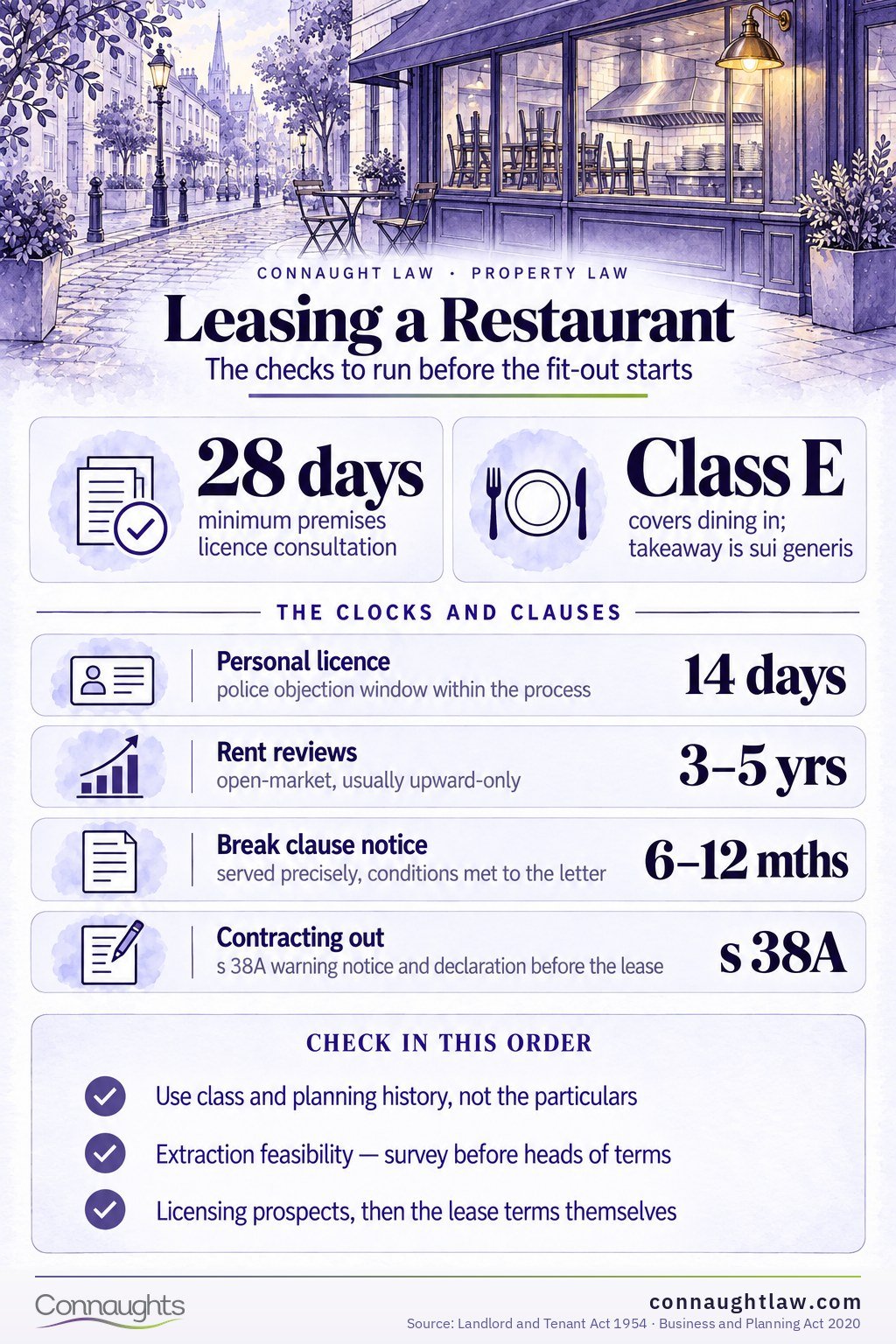
Run the physical and regulatory checks before negotiating money. A brilliant rent on a site whose landlord will never consent to external ductwork, or whose use class excludes your menu, is not a deal — it is a deposit at risk. The sequence that works: use class and planning, extraction feasibility, licensing prospects, then the lease terms themselves.
Factor 1: Planning and the Use Class
What the Class Must Cover
Restaurants and cafés serving food on the premises sit inside Class E; a hot-food takeaway is sui generis and needs its own permission. The distinction decides menus and business models — a Class E bistro cannot quietly become a takeaway — and it needs verifying against the premises' actual planning history, not the agent's particulars. Conditions on old consents (hours, extraction, delivery restrictions) bind you from day one.
Factor 2: Extraction and Ventilation
The Duct That Decides the Deal
Commercial kitchen extraction must satisfy Building Regulations on ventilation and fire safety, environmental health expectations on odour, and — the one that kills deals — the landlord's consent to external ductwork. In listed buildings and conservation areas, total extraction projects can run well into five figures and sometimes fail outright. No extraction route, no kitchen: survey it before heads of terms, and make the lease's consent conditional and specific.
Factor 3: Neighbours and Noise
Living Above a Restaurant
Leases in mixed buildings carry nuisance covenants on noise, odour and vibration, and residential neighbours enforce them — directly and through the council. Acoustic assessment before fit-out, sound-dampened plant, and realistic operating hours written into your own plans cost far less than an abatement notice after opening. Check what the lease promises the neighbours before promising your customers late service.
Factor 4: Licensing
The Licence Timeline
- Premises licence: a 28-day consultation period at minimum, realistically six to eight weeks where representations or a hearing arise.
- Personal licence for the designated supervisor, with a 14-day police objection window in the process.
- Conditions follow the local licensing policy — hours, door staff, dispersal — and bind the business, not just the application.
- Rent usually starts before trading does: negotiate the rent-free period against the licensing timeline, not the fit-out alone.
Factor 5: Outdoor Seating
Pavement and Private Terrace
Pavement seating on the highway needs a pavement licence under the streamlined Business and Planning Act 2020 regime — budget four figures annually in central locations, more where conservation-area design conditions apply. Seating on the landlord's own forecourt is different: it needs the lease to demise or licence the space, the premises licence to cover it, and the insurance to follow. Outdoor covers are profitable exactly in proportion to how properly they are papered.
Factor 6: Security of Tenure
Renewal Rights and the Contracting-Out Decision
A restaurant's value lives at its address: fit-out, licence and goodwill all attach to the premises. Inside the Landlord and Tenant Act 1954, you hold a renewal right at market rent that protects that investment and makes the business saleable. Contracting out — done by the section 38A warning-notice and declaration procedure before the lease — trades that protection for, usually, a modest rent saving. For a first site with heavy fit-out, that is rarely a good trade; price it consciously, never sign it as boilerplate.
Factor 7: Insurance
The Cover the Lease and the Law Demand
Employer's liability is compulsory at a £5 million legal minimum — £10 million is the market standard policy. Public liability at £2–6 million is what leases and licensing conditions typically require, with product liability and business interruption completing the hospitality set. Read the lease's insurance clause against your broker's schedule before completion: the gap between what the landlord requires and what the quote covers is a personal exposure.
Factor 8: Rent Reviews and Break Clauses
The Money Clauses Over the Term
Expect open-market reviews every three to five years, upward-only as the market standard — meaning the rent never falls at review, whatever happens to the high street. Break clauses are the counterweight, and they are construed strictly: six to twelve months' notice, served precisely, with conditions met to the letter, or the right is lost. A restaurant tenant's realistic protections are a first break aligned with the business plan's proof point and a rent-free period that absorbs licensing and fit-out time.
Factor 9: Food Safety and Health & Safety
The Compliance Baseline
The Health and Safety at Work Act 1974 and the food safety regime set the operating floor: HACCP-based food safety management, allergen controls, temperature records, fire risk assessment under the Fire Safety Order, and staff training that can be evidenced. These are operational rather than lease matters — but the lease's yield-up and compliance clauses make regulatory failures the landlord's business too, and an environmental health closure is a rent bill with no revenue behind it.
Factor 10: Assignment and Subletting
Your Exit Is Negotiated at Entry
- Assignment with landlord's consent, not to be unreasonably withheld — the clause every restaurant sale runs through.
- Expect an authorised guarantee agreement keeping you liable for your buyer's performance.
- Conditions on assignee covenant strength and experience: reasonable ones protect the building, drafted ones can make the lease unsaleable.
- Subletting rights for part — the mezzanine, the dark kitchen — add resilience if the format changes.
- A lease you cannot assign is a business you cannot sell; negotiate this clause as hard as the rent.
Questions about leasing a restaurant
Do I need planning permission to open a restaurant?
If the premises already sit in Class E with no restrictive conditions, on-premises dining needs no new permission. A hot-food takeaway is sui generis and does — and old consents can carry hours or extraction conditions that bind you. Verify the planning history before signing anything.
How much does kitchen extraction cost?
From five figures for a straightforward installation to substantially more where external ductwork, acoustic treatment or listed-building consent is involved — and in some buildings it simply cannot be done. Survey extraction feasibility before heads of terms; it is the most expensive assumption in hospitality.
How long does a premises licence take?
Twenty-eight days of consultation at minimum, and six to eight weeks realistically where representations or a hearing arise. Negotiate the rent-free period against that timeline — rent that starts before trading is licensing delay paid for at full price.
Should I accept a lease contracted out of the 1954 Act?
Only with your eyes open. Contracting out removes your renewal right, which is what protects fit-out, licence and goodwill — the things a restaurant's sale value is made of. The rent discount for giving that up is usually smaller than the value surrendered.
What insurance does a restaurant lease require?
Employer's liability at the £5 million statutory minimum (£10 million is standard), public liability typically £2–6 million, plus product liability and business interruption. Match the broker's schedule to the lease's insurance clause before completion, not at the first claim.
Can I sell my restaurant with the lease?
Only as freely as the assignment clause allows. Consent-based assignment with reasonable conditions and an AGA is normal; tightly drafted assignee tests can make the business unsaleable. Negotiate the exit provisions at entry — they set your sale price years in advance.
Send us the heads of terms, the planning history and the extraction position. We will tell you which of the ten factors bites on this site, and what to fix in the lease before you commit the fit-out budget.
Get Expert Advice