
Assigning a lease means transferring the whole of your leasehold interest to someone else — the assignee steps into the lease as tenant, and you step out, subject to whatever liability the documents leave behind. The machinery is a deed of assignment, usually a licence to assign from the landlord, and often an authorised guarantee agreement that keeps you on the hook longer than sellers expect. This guide covers the documents, the consent rules, the costs and who pays them.
On This Page

Assignment of a Lease: The Transfer That Ends Your Tenancy
Assignment transfers the lease itself: the assignee becomes the tenant, pays the rent and answers to the landlord. Subletting creates a new tenancy underneath yours while you remain on the lease. The choice matters because it allocates risk — an assignor wants a clean exit and must negotiate for it; a subletting leaseholder keeps both the asset and the liability. Our subletting guide covers the second route.
What Lease Assignment Means in Practice
The assignee takes the lease as it stands — the rent, the repair covenants, the remaining term, the service charge history's consequences. Nothing is renegotiated by the transfer itself, which is why an assignee's due diligence reads like a purchase: the lease, the licences, the arrears position, the state of the premises. For the assignor, the transaction's whole value is the exit; for the landlord, its whole risk is the covenant strength walking in the door. Every rule below exists to balance those three positions.
Commercial and Residential Assignments
Commercial leases are where assignment is negotiated hardest: alienation clauses, pre-conditions and guarantee requirements are drafted terms, and the lease you sign at the start fixes the exit you get years later. Long residential leases assign more routinely — a leasehold flat sale is an assignment — with the lease typically requiring notice of the transfer to the landlord with a modest fixed fee, rather than consent. Short residential tenancies rarely permit assignment at all without express agreement.
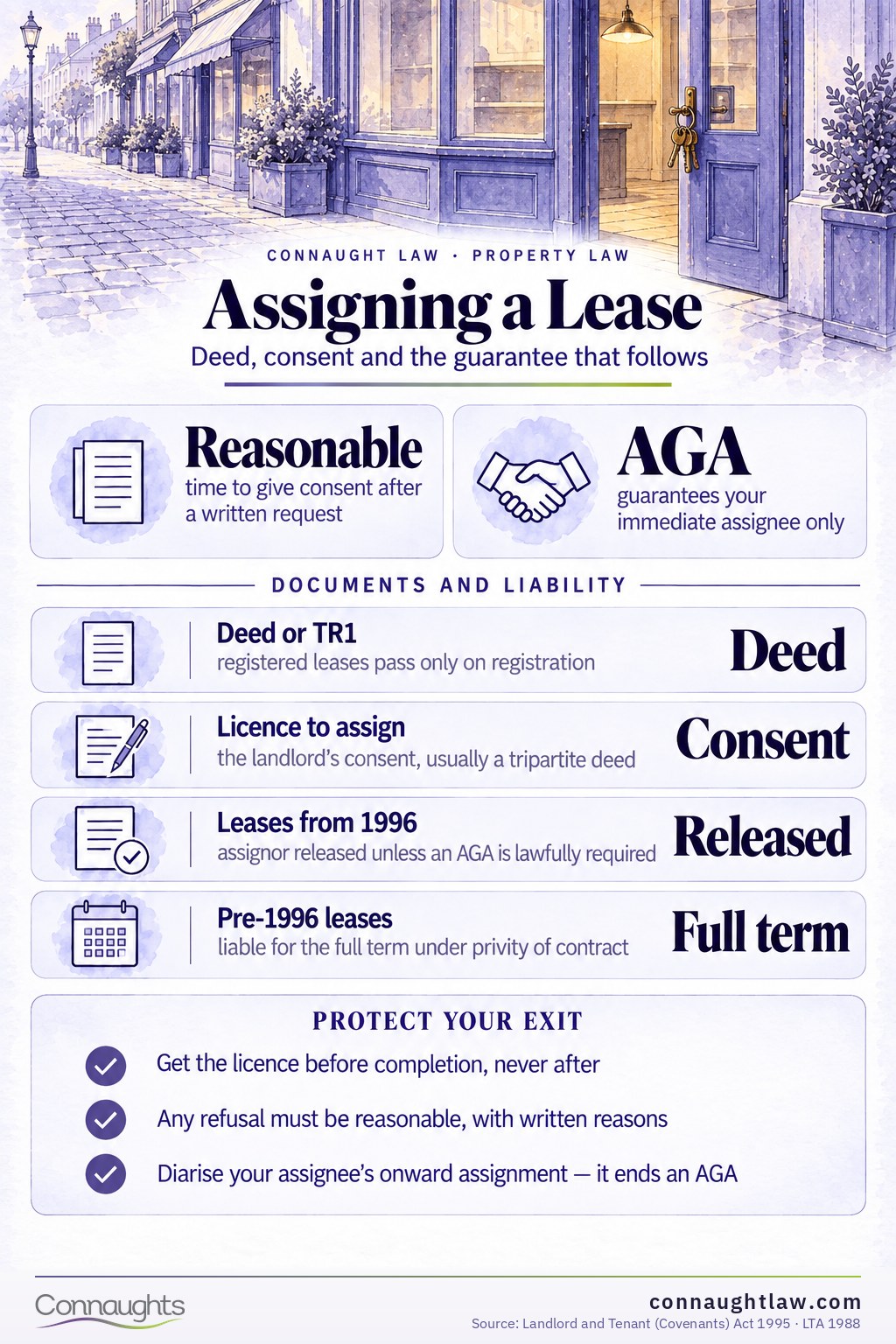
The Documents
Documents an Assignment Needs
- Deed of assignment (or Form TR1 for a registered lease): the instrument that moves the leasehold interest.
- Licence to assign: the landlord's formal consent, usually a tripartite deed, where the lease requires it.
- Authorised guarantee agreement: the assignor's guarantee of the incoming tenant, where the landlord lawfully requires one.
- Rent deposit deed: where the assignee's covenant needs cash behind it.
- Notice of assignment (and of any charge) served on the landlord after completion, with the lease's registration fee.
The Deed of Assignment
The deed is executed as such — signed, witnessed, dated — because a lease is a legal estate and transfers formally or not at all. For leases registered at HM Land Registry, the transfer uses Form TR1 and takes effect fully on registration; an unregistered assignment leaves the assignee with an equitable mess and the assignor with continuing exposure. The deed also carries the covenants the parties give each other: indemnities for pre- and post-completion breaches, apportionments of rent and service charge, and any agreed treatment of arrears.
Licence to Assign and Landlord Consent
Where the lease says "not to assign without consent", the licence to assign is how consent arrives — typically a deed between landlord, assignor and assignee recording the consent, its conditions and any guarantee. Assigning without a required licence is a breach committed on day one of the assignee's occupation: the landlord's remedies can include forfeiture, and lenders and buyers treat an unlicensed assignment as a title defect. The licence is not a formality to chase after completion; it is the condition of completing.
The Process, Start to Finish
Finding the Assignee
The landlord will test what you present, so present what survives testing: accounts or references demonstrating covenant strength, a use consistent with the lease, and a deal structure — guarantee, deposit — matched to any weakness. Four to twelve weeks end to end is a realistic transaction window, with landlord consent usually the pacing item.
Consent Within a Reasonable Time
Once a written application is made, the Landlord and Tenant Act 1988 puts the landlord under a statutory duty: consent within a reasonable time unless refusal is reasonable, written reasons for any refusal or conditions, and damages for breach. "Reasonable time" is not a fixed fortnight — the case law measures it in days and weeks on straightforward applications, and a landlord who sits on a complete application builds the tenant's claim with every silent week. The tenant's discipline is symmetrical: a complete application with the assignee's information starts the clock; a dribble of half-answers never does.
Completion and Registration
Completion executes the deed and licence together, apportions the money and hands over the premises. Registrable assignments go to HM Land Registry promptly — the assignee is not legal owner until registration — and the notice of assignment goes to the landlord with the lease's fee, so the rent demands follow the right tenant. Loose ends here surface years later as title requisitions on the next transaction.
When Consent Can Be Refused
Reasonable Grounds
- Genuine doubt about the assignee's ability to pay the rent and perform the covenants.
- A proposed use outside or hostile to the lease's user clause.
- Substantial existing breaches — serious disrepair, arrears — that assignment would strand.
- Estate management reasons with real content, such as tenant-mix covenants the landlord owes others.
- Conditions drawn from the lease itself: commercial leases agreed after 1995 may specify circumstances and conditions in advance, and those bind.
Unreasonable Refusals
Personal distaste, the pursuit of a premium for consent, an attempt to renegotiate the lease's terms, or delay dressed up as diligence — none of these survives section 19(1) of the Landlord and Tenant Act 1927 and the 1988 Act's duties. A tenant facing a bad refusal can assign anyway at their own risk, seek a declaration, or claim damages; in practice the well-documented threat of the 1988 Act claim resolves most of them.
What Assignment Costs
Who Pays What
Assignment Cost Allocation
| Cost Head | Typical Range | Usually Paid By |
|---|---|---|
| Assignor's legal fees | £800 – £2,000+ | Assignor |
| Assignee's legal fees and searches | £1,000 – £2,500+ | Assignee |
| Landlord's costs of the licence | £500 – £1,500+ | Assignor, most commonly |
| Land Registry fee | Scale fee, value-based | Assignee |
| Notice of assignment fee | Fixed by the lease | Assignee |
Premiums and Reverse Premiums
Money can flow either way. A lease at below-market rent, or a flat with a long term, commands a premium from the assignee. A lease that is a liability — over-rented space, heavy dilapidations, a use nobody wants — moves only with a reverse premium from assignor to assignee, and the negotiation is really about pricing the escape. Both figures should be built from the rent-against-market arithmetic and the dilapidations exposure, not from hope.
Liability After You Assign
For leases granted from 1996 onwards, the Landlord and Tenant (Covenants) Act 1995 releases the assignor on assignment — unless the landlord lawfully requires an authorised guarantee agreement, under which you guarantee your immediate assignee's performance until they assign in turn. Older leases are harsher: pre-1996 tenants can remain liable for the full term under privity of contract. The practical rules: resist an AGA where the assignee's covenant justifies it, never guarantee beyond the immediate assignee, and diarise the assignee's onward assignment — it is the event that sets you free.
Reform Watch
Two live workstreams touch assignments. The Law Commission's review of the Landlord and Tenant Act 1954 — interim statement in June 2025 retaining contracting-out, second consultation run through to September 2026 — may reshape renewal rights on commercial leases, which feed directly into what an assignee is buying. And the 2024 leasehold reforms improve the residential asset being assigned: extension rights now exercisable from day one of ownership make a short-lease flat easier to sell with a strategy attached. Leaseholders weighing exit routes should compare assignment against extending first or taking a new lease — our real estate team prices the alternatives side by side.
Frequently askedQuestions about assigning a lease
What does assignment of a lease mean?
The transfer of your entire leasehold interest to a new tenant, who takes the lease as it stands — rent, covenants, remaining term. You leave the tenancy; whether you leave the liability depends on the lease's date and any authorised guarantee agreement.
What is a deed of assignment of a lease?
The formal instrument that transfers the lease — executed as a deed, or as a Form TR1 where the lease is registered — carrying the indemnities and apportionments between assignor and assignee. Registered leases transfer fully only on registration at HM Land Registry.
Can a landlord refuse consent to an assignment?
Only on reasonable grounds — covenant strength, use, serious breaches — and within a reasonable time of a written application, with written reasons. Unreasonable refusal or silence breaches the Landlord and Tenant Act 1988 and sounds in damages.
How much does it cost to assign a lease?
Typically £1,500 to £5,000-plus across both sides: each party's legal fees, the landlord's licence costs (usually the assignor's to pay), Land Registry scale fees and the lease's notice fee. Complex licences, guarantees and deposits push the figure up.
Who pays lease assignment fees?
Convention, not law: the assignor pays their own solicitor and usually the landlord's licence costs; the assignee pays their own fees, searches, registration and the notice fee. Everything is negotiable, and in weak markets assignors pay more to escape.
What is an authorised guarantee agreement?
A guarantee the landlord can require on assigning a post-1995 lease: you stand behind your immediate assignee's performance until they assign onward. It is the price of release from the lease — negotiate its scope, and never extend it beyond the immediate assignee.
Send us the lease, the heads of terms and the assignee's details. We will handle the licence to assign, keep the guarantee exposure as narrow as the law allows and complete the transfer with the registration done properly.
Get Expert Advice