
A grant of a new lease creates a leasehold estate that did not exist before — the landlord carves a term out of their own title and hands it to the tenant, on terms negotiated from a blank page. Nothing is inherited, so everything is up for negotiation: the term, the rent, the premium and its tax treatment, whether the tenant gets renewal rights at the end, and whether the building's EPC even permits the letting. This guide works through each decision in the order a real transaction meets it.
On This Page

Creating a Lease from Scratch: What a Grant Involves
Most lease transactions inherit their terms — an assignment takes the lease as it stands, a renewal starts from the old terms. A grant inherits nothing. That freedom is the opportunity and the risk: every clause the parties fail to think about is a clause the law fills in for them, sometimes generously, sometimes not at all.
Who carries the statutory renewal right at the end of the term (the 1954 Act decision)? How is the landlord paid — premium, rent, or a blend — and what does each cost in tax? And can the building lawfully be let at all under the energy efficiency rules? Everything else in the transaction is detail hanging off those three.
What a Grant of a Lease Means
A grant is the creation of a new leasehold estate out of the landlord's reversion. The landlord keeps the freehold (or their own superior lease) and grants the tenant a term of years carved from it; when the term ends, possession returns. The tenant of an existing lease can grant too — a sublease is a grant of a shorter term out of the headlease. If the term granted exceeds seven years, the new lease must be registered at HM Land Registry with its own title.
One source of confusion deserves clearing up: in residential leasehold, the statutory lease extension is also delivered as the grant of a new lease — the 1993 Act substitutes a fresh lease at a peppercorn rent for the old one. Leaseholders extending a flat lease should start with our lease extension service; this guide covers the commercial transaction.
Grant, Extension or Assignment: Three Different Transactions
An assignment transfers an existing lease to a new tenant — the terms travel with it, and the outgoing tenant usually guarantees the incoming one. A statutory extension rewrites a residential lease's length and rent inside a valuation framework fixed by statute. A commercial grant is neither: terms are free, valuation is market-driven, and the only statutory framework that bites is the one the parties choose not to exclude. Knowing which transaction you are actually in decides which rulebook applies.
Types of Grant and the Terms That Define Them
Choosing Between Them
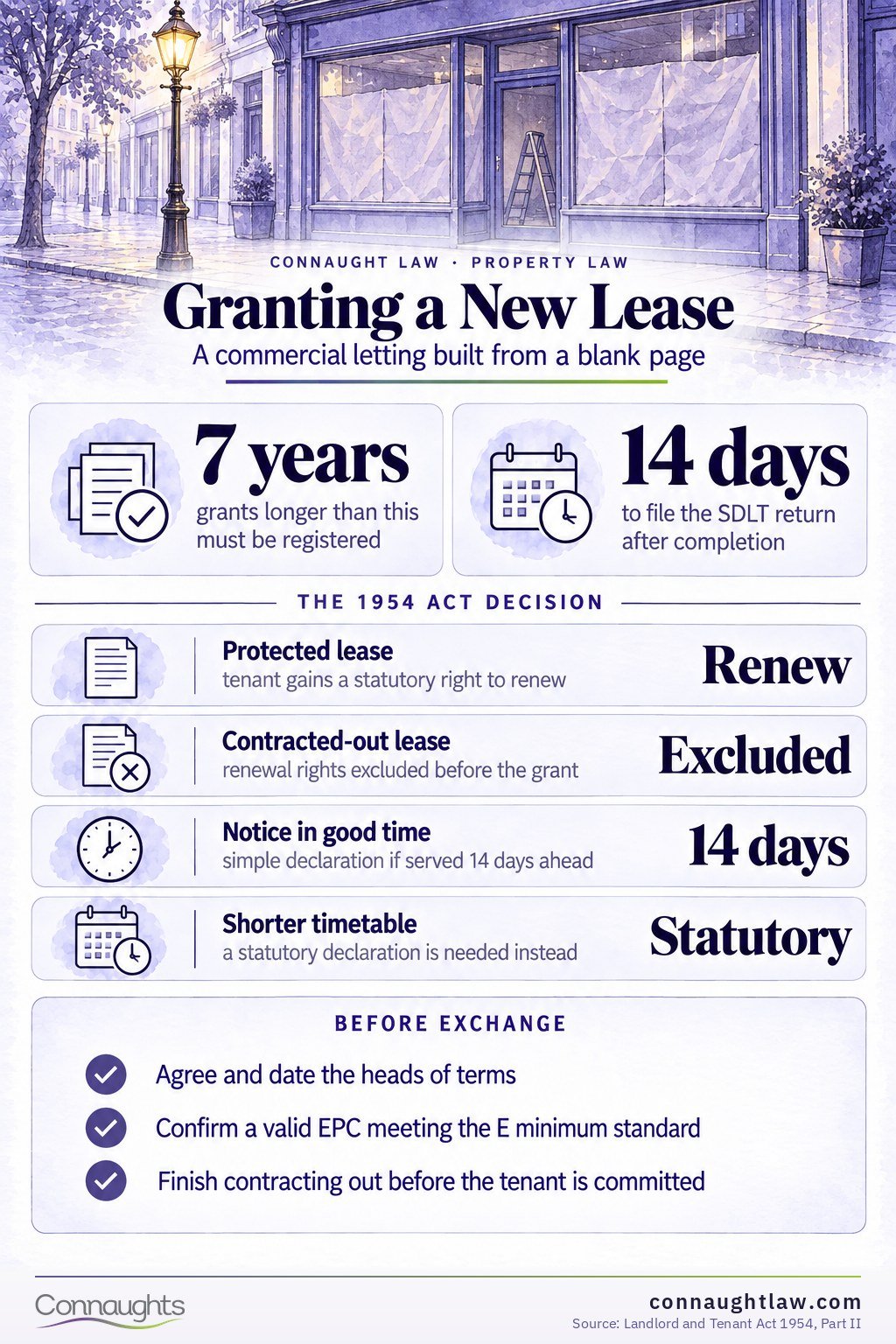
- Protected lease. Inside the 1954 Act: the tenant gains a statutory right to renew at term end. The default for any business letting unless excluded.
- Contracted-out lease. Renewal rights excluded by the statutory procedure before grant. Standard for landlords protecting redevelopment plans or their own future occupation.
- Short-term or flexible letting. Tenancies at will and short contracted-out terms serve pop-ups and testing phases — but a tenancy at will misdrafted into a periodic tenancy acquires 1954 Act protection by accident.
- Sublease. Granted out of an existing lease, always shorter than the headlease term, and only as good as the headlease consent behind it.
The choice is rarely about the current tenant. It is about who controls the property at the end of the term — a protected lease hands the tenant a renewal right the landlord can only defeat on statutory grounds with compensation attached, while a contracted-out lease returns possession cleanly but rents at a discount for exactly that reason.
Premiums: Meaning, Tax and SDLT
What a Lease Premium Is
A premium is a capital sum paid for the grant itself, on top of any rent. In residential leasehold the premium is the price of the flat; in commercial lettings premiums are the exception, because landlords generally prefer full rent — which is deductible for the tenant and reviewable for the landlord — over capital up front. Where a commercial premium does appear, it is usually buying something specific: a below-market rent, a long term, or fitted-out space.
How a Premium Is Taxed in the Landlord's Hands
For a lease of 50 years or less, part of the premium is taxed as property income in the year of grant, under the formula in HMRC's Property Income Manual: the income element is the premium multiplied by (51 minus the term in complete years), divided by 50. The rest is dealt with under capital gains rules. Grant a lease of more than 50 years and the whole premium is capital.
Income element: £100,000 × (51 − 21) ÷ 50 = £60,000, taxed as property income in the year of grant. The remaining £40,000 falls into the capital gains computation. The shorter the lease, the larger the income slice — a 2-year term puts £98,000 of the same premium into income.
SDLT: What the Tenant Pays
On a non-residential grant the tenant pays SDLT on two elements. The premium is taxed at the commercial rates — nothing to £150,000, 2% to £250,000, 5% above. The rent is taxed on its net present value over the term: 1% of the NPV above £150,000, rising to 2% on any NPV above £5 million, per HMRC's leasehold SDLT guidance. The return and payment are due within 14 days of completion, and a lease over seven years then needs registering — two deadlines that arrive while everyone is celebrating the deal.
Granting a Commercial Lease: The Process Step by Step
The sequence runs: heads of terms recording the commercial deal (not binding, but hard to renegotiate); the tenant's due diligence on title and the property, through CPSE enquiries; the contracting-out procedure if renewal rights are being excluded — it must complete before the tenant is contractually committed; then lease agreed, executed and completed, followed by SDLT and registration. Landlords who market the space before checking their own title, their lender's consent requirements and the EPC rating discover the expensive way that each of those can stop a signed deal from completing.
The Documents That Make or Break Completion
- Heads of terms, agreed and dated.
- Land Registry-compliant lease plan — grants out of part fail registration without one.
- A valid EPC at the minimum standard, and the letting's MEES position confirmed.
- Replies to CPSE enquiries and the title documents behind them.
- Superior lender's or landlord's consent, where the reversion is charged or itself leasehold.
- The contracting-out warning notice and declaration, correctly sequenced and dated.
- Rent deposit deed or guarantee, if the covenant needs support.
Security of Tenure: The 1954 Act Decision
Part II of the Landlord and Tenant Act 1954 gives business tenants a statutory right to a renewal lease at term end, defeatable only on defined grounds — several of which carry compensation. Parties can exclude it, but only prospectively and only by the prescribed route: the landlord serves a warning notice, and the tenant makes a declaration before committing — a simple declaration if the notice came at least 14 days before, a statutory declaration if the timetable was compressed. Get the sequence wrong and the exclusion is void, leaving the landlord with a protected tenant priced as an unprotected one.
The Law Commission's review of Part II is live: its June 2025 interim statement concluded the contracting-out model should stay, and a second consultation on modernising the Act's machinery ran from 16 June 2026 to 16 September 2026. Reform is coming to the procedure's plumbing, not its principle — leases granted now should assume the current rules for their full term.
Premium or Rent: Structuring the Deal
The same value can reach the landlord as capital or as income, and the tax outcomes differ on both sides of the table. A premium accelerates the landlord's receipt but triggers the 50-year formula and the tenant's SDLT at capital rates; full rent spreads the landlord's income, stays deductible for the tenant, and feeds rent reviews. Most commercial deals resolve in favour of rent for exactly these reasons — a structure worth modelling with your accountant before heads of terms fix it, not after.
EPC Rules for New Lettings: What Changed in June 2026
The minimum energy efficiency standard for letting non-domestic property is EPC E — it has applied to new lettings since 1 April 2018 and to continuing lettings since 1 April 2023. On 23 June 2026 the government's interim response reset the trajectory that older guides still describe.
- The proposed EPC C milestone for 2027 is dropped — it will not be taken forward.
- From 2031, commercial buildings over 1,000 m² must reach EPC B, subject to exemptions.
- Smaller buildings stay at the EPC E floor, with no further deadline set.
- Secondary legislation is still to come — enforcement detail and a possible shell-and-core exemption remain open.
For a landlord granting a lease now, the practical questions are the building's current rating, whether the term runs past 2031, and who pays for improvement works if the threshold rises mid-term — a service charge and yielding-up drafting point that is cheaper to settle at grant than to litigate in 2030.
Exemptions and How to Register Them
MEES exemptions exist where all cost-effective improvements have been made, where works would devalue the property, or where a required consent is refused. Each must be registered on the PRS Exemptions Register with supporting evidence, lasts five years, and dies with a change of landlord — a buyer of a tenanted sub-standard building cannot inherit the seller's exemption and must register afresh or improve.
Market Context: What Is Shaping New Grants
Two forces are visible in the terms being agreed. Occupiers keep pushing for shorter, more flexible commitments — break options, turnover elements in retail, fitted space over shell — and landlords concede term length in exchange for covenant strength and fewer incentives. And energy efficiency now splits the market: buildings already at or near EPC B let faster and hold rents, while owners of weaker stock face the choice between funding works and watching the 2031 threshold shrink their pool of lawful lettings.
Where Demand Is Concentrating
Demand concentrates where those two forces meet: energy-efficient, well-connected space in central London and the major regional office markets, and logistics floorspace close to population centres. For a landlord weighing a grant against a sale — or a tenant choosing between competing buildings — the negotiating room in any given deal is set less by headline market statistics than by how many compliant alternatives sit within the occupier's search area, which is a question your agent can answer building by building.
Frequently askedQuestions about granting a new lease
What does "grant of a new lease" mean?
It is the creation of a brand-new leasehold estate: the landlord carves a term of years out of their own title and grants it to the tenant. It differs from an assignment, which transfers an existing lease, and from a renewal, which follows on from one.
What is a lease premium?
A capital sum paid for the grant itself, on top of any rent. Premiums are standard in residential leasehold — the flat's price — and rare in commercial lettings, where landlords usually prefer full, reviewable rent. Premiums on leases of 50 years or under are partly taxed as the landlord's income.
Is a grant of a new lease the same as a lease extension?
Technically a statutory extension is delivered by granting a new lease in place of the old one, which is why the phrases overlap. But the extension follows a fixed statutory framework for residential flats; a commercial grant is negotiated freely from scratch. Different rulebooks entirely.
Can we agree that the tenant has no right to renew?
Yes, by contracting out of the 1954 Act before the grant: the landlord serves a warning notice and the tenant declares — a simple declaration with 14 days' notice, a statutory declaration on a shorter timetable. Done out of sequence, the exclusion fails and the tenant keeps renewal rights.
What are the tenant's deadlines after completion?
Two. The SDLT return and payment are due within 14 days of completion — on the premium at commercial rates and on rent above the £150,000 net-present-value threshold. And a lease granted for more than seven years must be registered at HM Land Registry with its own title.
Tell us the term, the rent and premium on the table, and whether renewal rights are staying in. We will structure the grant, run the contracting-out procedure in the right order and keep both post-completion deadlines.
Get Expert Advice