
For thirty-six years a long lease with ground rent above £250 a year — £1,000 in Greater London — could count as an assured shorthold tenancy, exposing the leaseholder to mandatory possession under Ground 8 for a few hundred pounds of arrears. Section 31 of the Renters' Rights Act 2025 closed that trap on 27 December 2025. What remains is the aftermath: arrears that accrued before the fix, lenders still applying lease-length and ground-rent criteria, and escalation clauses the 2025 Act never touched.
On This Page

How a 999-Year Lease Could Be an Assured Shorthold Tenancy
The Housing Act 1988 was written for renters, but its definition of an assured tenancy turned on rent level and occupation, not on the length of the term. A lease of 99, 125 or 999 years whose ground rent crept above £250 a year — £1,000 in Greater London — fell outside the "low rent" exclusion and could satisfy the definition in full. Parliament never intended homeowners to hold their homes on the same statutory footing as a tenant on a six-month contract, yet that is exactly what the drafting produced.
The consequences were serious: mandatory possession under Ground 8 for modest ground rent arrears, mortgage refusals, and the loss of statutory rights that long leaseholders assume they hold. Section 31 of the Renters' Rights Act 2025 ended the anomaly by excluding fixed terms of more than 21 years from assured tenancy status altogether.
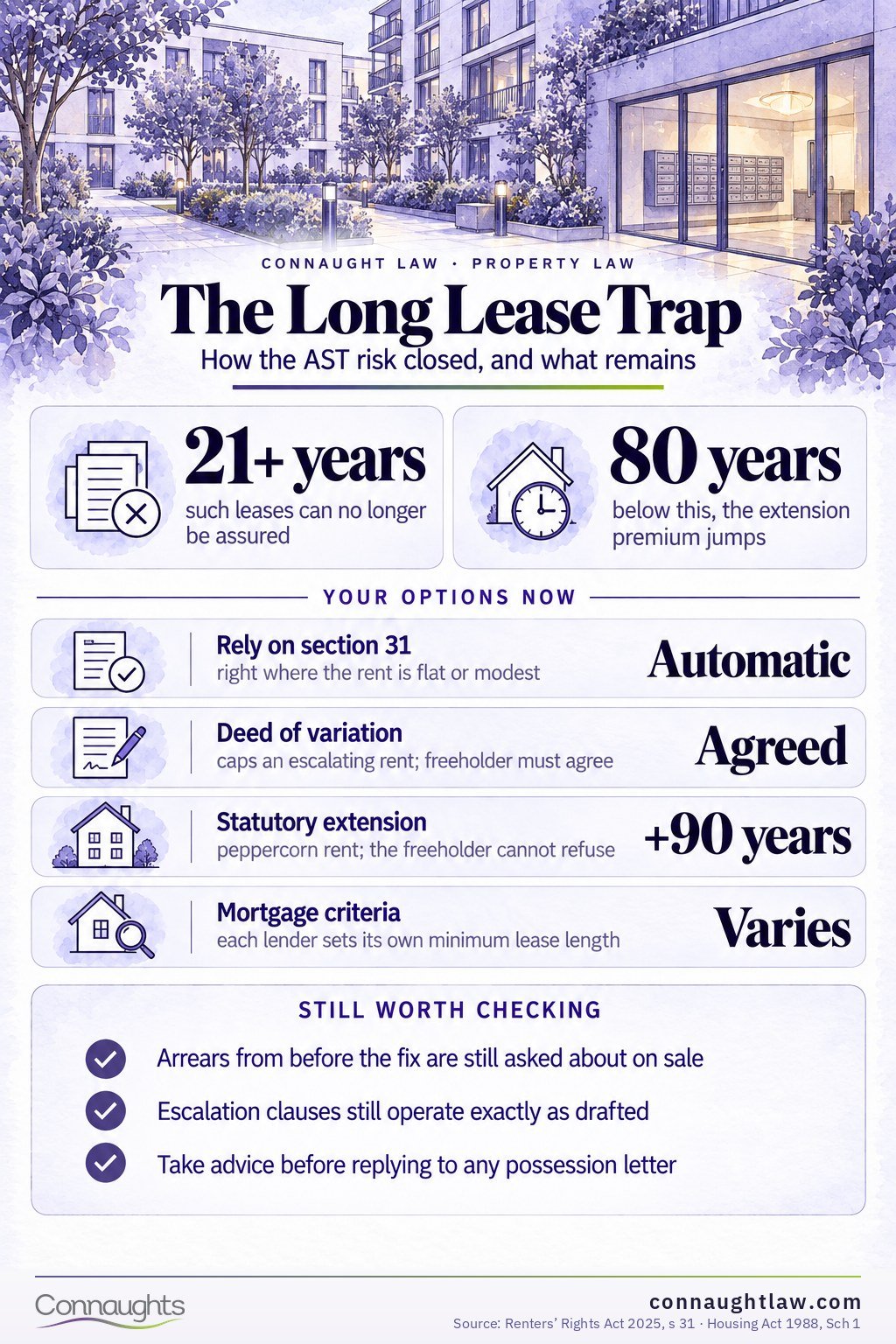
From 27 December 2025 no lease granted for more than 21 years can be an assured tenancy, whenever it was granted. Ground 8 possession for ground rent arrears is gone. What the fix does not touch: arrears history a buyer's conveyancer will still ask about, lender criteria on lease length and escalating rent, and the escalation clauses themselves.
What the AST Trap Was
Schedule 1 to the Housing Act 1988 excludes tenancies "at a low rent" from assured status. When the thresholds were set — £250 outside London, £1,000 within Greater London — ground rents were nominal and almost every long lease passed comfortably underneath. Then developers discovered ground rent as an income stream. New-build leases from the mid-2000s routinely reserved £300 to £500 a year, often with clauses doubling the rent every ten or fifteen years, and each of those leases sailed over the threshold from the day it was granted.
A £300 ground rent doubling every ten years reaches £2,400 by year thirty and £153,600 by year ninety. The AST trap was only the sharpest edge of that drafting: even with the trap closed, a rent on that trajectory fails most lenders' criteria and blights resale long before the figures become absurd.
The result was a legal category error. An owner who had paid several hundred thousand pounds for a flat, and who could pass it to their heirs, occupied it in law under the same tenancy type used for a short-term rental — with the possession regime to match.
Four Conditions That Put a Lease in the Trap
AST classification was never automatic. It required four conditions to hold at the same time, which is why some leaseholders with identical ground rents were caught and their neighbours were not.
The Conditions in Detail
- Ground rent above £250 a year, or above £1,000 in Greater London.
- The property occupied as the leaseholder's only or principal home.
- The leaseholder an individual — company-owned leases could not be assured.
- The lease granted on or after 15 January 1989, when the Housing Act 1988 came into force.
Because section 1 of the 1988 Act applies "if and so long as" the conditions are met, status switched on and off with the facts. Letting the flat out took the lease outside the trap; moving back in brought it back inside. A lease that was safe on the day of purchase could become an AST years later simply because an escalation clause pushed the rent over the threshold.
Ground 8: Mandatory Possession for a Few Hundred Pounds
Ground 8 in Schedule 2 to the Housing Act 1988 is a mandatory ground: where rent is payable yearly and at least three months' rent is more than three months in arrears at both service and hearing, the court must order possession. No discretion, no proportionality assessment, and none of the relief that protects a leaseholder facing forfeiture.
- Annual ground rent £1,200 → three months' rent is £300.
- £300 unpaid for more than three months → the mandatory ground was made out.
- Compare forfeiture: arrears must exceed £350 or run for three years, and relief from forfeiture is available. Ground 8 offered neither floor nor relief.
The imbalance was the scandal. A freeholder stood to recover a property worth hundreds of thousands of pounds for arrears smaller than a service charge instalment, while the leaseholder — and their mortgage lender — lost everything secured on the lease. That windfall risk, remote as it was in practice, is what drove lenders' reaction.
Beyond Eviction: What Else AST Status Cost
- Loss of the right of first refusal under the Landlord and Tenant Act 1987 — assured tenants are not qualifying tenants.
- Mortgage refusals, or lending only behind indemnity insurance priced for Ground 8 risk.
- Sales falling through once the buyer's lender saw the ground rent schedule.
- Remortgage friction whenever a new lender applied stricter criteria than the incumbent.
The first refusal point deserves emphasis because it is invisible until it bites. When a freeholder sells a building, qualifying tenants must be offered the purchase first; a leaseholder whose lease had tipped into AST status silently dropped out of that protection. Few discovered the loss until a freehold changed hands around them.
What Lease Length Lenders Accept in 2026
There is no single statutory threshold for a mortgageable lease — each lender sets its own minimum, published in Part 2 of the UK Finance Mortgage Lenders' Handbook. The practical picture in 2026: most mainstream lenders want between 70 and 85 years unexpired at completion, and many separately require 30 to 40 years to remain at the end of the mortgage term. A 25-year mortgage against a 72-year lease can therefore fail the second test even where it passes the first.
The Bands Lenders Work To
Unexpired Term and Mortgageability
| Unexpired Term | What to Expect |
|---|---|
| 85 years or more | Full lender choice; lease length raises no pricing or criteria issue. |
| 80–84 years | Lending is routine, but the extension clock is running — acting before the lease hits 80 keeps marriage value out of the premium. |
| 70–79 years | Choice narrows and some lenders decline; marriage value is now payable on a statutory extension, and buyers negotiate accordingly. |
| Under 70 years | Mainstream lending thins out sharply; specialist lenders may proceed at lower loan-to-value with closer valuation scrutiny. |
Why Eighty Years Is the Cliff That Matters
Once a lease falls below 80 years unexpired, marriage value becomes payable on a statutory extension, and the premium jumps. The Leasehold and Freehold Reform Act 2024 abolishes marriage value on paper, but the valuation provisions are not yet in force — the position we set out in our guide to the 2024 Act's implementation status — so in 2026 the 80-year line still prices every extension.
Lease length is also only half of a lender's leasehold assessment. Ground rent terms are the other half: an escalating or RPI-linked rent can fail a lender's criteria on its own, even now that the AST risk is gone. Buyers weighing a leasehold purchase should read both tests together, as our leasehold purchase guide explains.
Section 31: The Fix That Closed the Trap
The Renters' Rights Act 2025 received Royal Assent on 27 October 2025. Section 31 inserts a new paragraph 3D into Schedule 1 to the Housing Act 1988: a fixed term tenancy "of a term certain of more than 21 years from the date of the grant" cannot be an assured tenancy. The exclusion came into force on 27 December 2025 under section 145(5)(a).
It reaches existing leases, not just future grants. A 125-year lease with £400 ground rent that sat squarely in the trap on Boxing Day 2025 was outside it the following day, with nothing to sign and nothing to pay.
Commencement and the Transitional Rules
- 27 October 2025 — Royal Assent.
- 27 December 2025 — section 31 in force: fixed terms over 21 years excluded from assured status.
- Paragraph 3E adds a transitional exclusion for fixed terms between 7 and 21 years granted before the Act, or within two months after it — intermediate leases are not left stranded.
- 1 May 2026 — the Act's central private-rented-sector reforms commence.
What section 31 does not do is rewrite history or contracts. Arrears that accrued, and orders made, before commencement are unaffected — which is why a buyer's conveyancer will still ask about the pre-2026 position — and escalation clauses continue to operate exactly as drafted.
Is the AST Itself Abolished?
Yes, separately and slightly later. Since 1 May 2026 no new assured shorthold tenancy can be created anywhere in England, and existing ASTs converted to periodic assured tenancies — the reform we cover in our Renters' Rights Act guide for landlords. For long leaseholders the operative fix remains section 31: their leases are not converted into anything, but excluded from the assured regime entirely.
What the 2024 Act Adds — and What It Does Not
The Leasehold and Freehold Reform Act 2024 runs alongside all of this, and it is widely misread. In force now: the abolition of the two-year ownership requirement for lease extensions (31 January 2025) and the right to manage reforms (3 March 2025). Not in force: the valuation reforms — marriage value abolition, the 990-year standard extension and the 0.1% ground rent cap used in premium calculations.
Two misconceptions do the rounds. The 0.1% figure caps the ground rent assumed when valuing an extension premium; it does not cap the ground rent anyone actually pays. And peppercorn rents under the Leasehold Reform (Ground Rent) Act 2022 apply only to regulated leases granted after 30 June 2022 — existing leases keep the rent their deeds reserve until varied or extended.
Protecting Your Position: Four Options Compared
Before December 2025, leaseholders paid real money to escape the trap. Now that section 31 does the work free of charge, the question has changed: not "how do I stop being an AST" but "does my lease still have a defect — an escalating rent, a shortening term — that the statute leaves in place?"
The Options Side by Side
- Rely on section 31. Cost: nothing. Right where the rent is flat or modest and no sale or remortgage is imminent.
- Deed of variation capping the rent. Typically £1,500–£5,000 plus the freeholder's costs; needs the freeholder's agreement. The answer where an escalation clause fails lender criteria.
- Mortgagee-protection variation. Typically £1,000–£2,000; obliges the freeholder to notify the lender before possession steps. Largely historic now Ground 8 is off the table.
- Statutory lease extension. Premium plus costs, rising as the term shortens. The comprehensive fix: peppercorn rent and 90 additional years.
Statutory Extension: The Comprehensive Fix
A statutory extension under the 1993 Act reduces the ground rent to a peppercorn and adds 90 years to the term — 990 once the 2024 Act's provisions commence — and the freeholder cannot refuse. It solves the escalation problem and the shortening-term problem in one transaction, which no deed of variation achieves. The premium is the price of that completeness, and it rises steeply once the lease drops below 80 years; our lease extension team can run the arithmetic both sides of that line before you commit.
When Advice Cannot Wait
Most leaseholders can now take stock at leisure; four situations cannot. If a sale or remortgage is in progress, the lease terms need reviewing before the lender's valuation, not after — a variation agreed pre-valuation is worth more than the same variation agreed later. If any ground rent arrears exist, they need clearing or disputing before they surface in replies to enquiries. If the lease has fewer than 90 years to run, every year of delay adds to the extension premium. And if the freeholder has written about possession or forfeiture, take advice before responding at all.
Frequently askedQuestions about the AST trap and lease length
Do I still need a deed of variation now the AST trap has closed?
Not for the trap — section 31 excludes your lease automatically and free of charge. A variation still earns its cost where the rent escalates or is RPI-linked, because lenders assess those clauses on their own terms and a capped rent can be the difference between an offer and a decline.
What lease length do I need for a mortgage in 2026?
There is no universal threshold. Most mainstream lenders want 70 to 85 years unexpired at completion, and many require 30 to 40 years left at the end of the mortgage term. Below 80 years, marriage value inflates the cost of extending, so the practical answer is: act before 80.
Can a lender still refuse over ground rent above £250?
Yes, but for different reasons. The Ground 8 possession risk is gone, so the old refusals tied to AST status should fall away. Lenders still apply their own criteria to escalating rents, RPI-linked reviews and rents that are high relative to property value.
Is my existing long lease still an assured shorthold tenancy today?
No. Since 27 December 2025 no fixed term of more than 21 years can be an assured tenancy, whatever the ground rent and whenever the lease was granted. Expect a buyer's conveyancer to ask about the position before that date, particularly any arrears.
What replaced the AST from May 2026?
Periodic assured tenancies — since 1 May 2026 the rented sector runs on open-ended tenancies with possession through section 8 grounds only. Long residential leases sit entirely outside that regime thanks to section 31, so nothing "replaced" the AST for leaseholders.
Tell us the unexpired term, the rent schedule and whether a sale or remortgage is in play. We will tell you whether section 31 alone protects you, or whether a variation or extension is worth the money.
Get Expert Advice