
A surrender ends a lease before its time by agreement — and only by agreement. Neither side can force it: the tenant cannot walk away by posting the keys back through the letterbox, and the landlord cannot demand the property early without paying for it. This guide covers both routes — the deed and operation of law — alongside the traps: dilapidations claims, premiums and VAT, the section 38A procedure for business tenancies, the Land Registry steps that close the title, and the lease variations that surrender a lease without anyone noticing.
On This Page
Ending a Lease Early: How Surrender Actually Works
A surrender is the tenant handing the leasehold estate back to the landlord, who accepts it, so that the lease merges into the landlord's reversion and dies. It is a creature of common law rather than statute, which is why so much turns on conduct and drafting rather than prescribed forms. Business tenancies add one statutory overlay that catches people out: under section 38A of the Landlord and Tenant Act 1954, an agreement to surrender a protected tenancy at a future date is void unless the warning-notice and declaration procedure is followed first.
Two elements, always: the tenant giving up possession, and the landlord unequivocally accepting the lease is over. A deed supplies certainty on both. Without a deed, the law implies a surrender only from conduct that is inconsistent with the lease continuing — a high bar that vacating and returning keys does not, by itself, clear.
What a Surrender Is — and What It Is Not
Surrender is consensual termination. It is not a break right, which is exercised unilaterally under a clause the lease already contains; not forfeiture, which is the landlord's remedy for breach; and not abandonment, which in law is usually nothing at all — a tenant who vacates and stops paying still holds the lease and still owes the rent. The distinction matters because each route allocates the costs differently, and a tenant who assumes walking away ends liability is building up arrears, not ending them.
Commercial and Residential Surrenders Compared
Commercial surrenders are dominated by money questions: dilapidations, the premium, business rates on the empty unit and VAT. Residential surrenders are dominated by protection questions — a landlord and tenant can always agree a genuine surrender, but statutory regimes sit underneath, and since 1 May 2026 every private residential tenancy is a periodic assured tenancy under the Renters' Rights Act, ended by the tenant on two months' notice. That right makes formal surrenders of ordinary residential tenancies largely unnecessary; long residential leases are the exception, and they follow the commercial mechanics.
Can a Landlord Refuse a Surrender?
Yes. A landlord can simply say no, and most will where the lease has value to them — a solvent tenant paying above-market rent is an asset nobody hands back for free. There is no procedure to force acceptance; the tenant's leverage is commercial. A realistic premium offer, a settled dilapidations figure and a replacement tenant waiting in the wings change the conversation. Where the landlord will not move at any price, the practical routes are the ones covered under alternatives: assignment, subletting, or waiting for a break date.
Express or Implied: The Two Ways a Lease Dies by Agreement
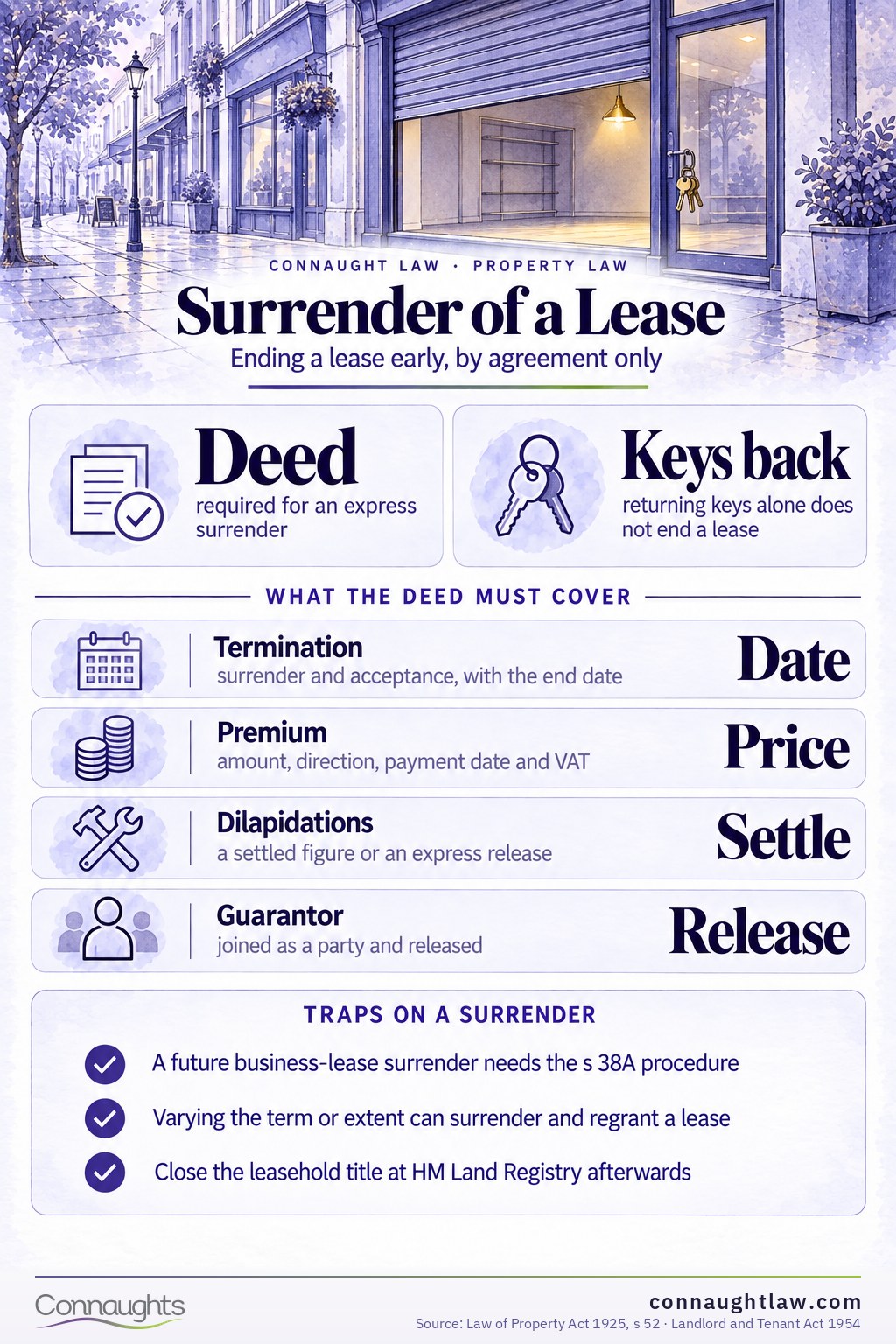
Express surrender is done by deed — section 52 of the Law of Property Act 1925 requires it, and the same section carves out surrenders by operation of law as the one exception. Implied surrender arises where both parties behave in a way that only makes sense if the lease is over. The first route is chosen; the second is found, sometimes to the surprise of one of the parties.
Three Routes in Practice
- Deed of surrender. Negotiated, priced and documented. The only route that deals with dilapidations, premium and release in one instrument.
- Operation of law. Tenant gives up possession, landlord retakes it unequivocally — relets the unit, occupies it, or accepts a new tenant. The lease ends without a signature.
- Surrender and regrant. The accidental route: a variation so fundamental that the law treats the old lease as surrendered and a new one granted — covered below.
Operation of Law and the Padwick Lesson
The leading modern authority is Padwick Properties Ltd v Punj Lloyd Ltd [2016] EWHC 502 (Ch). The tenant vacated, its agents returned the keys, and the landlord secured the premises and marketed them for reletting. The court held there was no surrender: securing and marketing an abandoned property protects the landlord's asset and is not conduct unequivocally accepting the lease's end. The lease survived — and so did the guarantor's liability for the rent.
For tenants: leaving does not end anything, and every quarter's rent keeps falling due. For landlords: you can secure, insure and market an abandoned unit without accidentally accepting a surrender — but granting a new lease of it, or moving in, ends the old one and with it your claim to future rent.
The Deed of Surrender: What It Must Contain
There is no prescribed form of deed, which is why "surrender of lease template" searches end badly. The document is short; the negotiation compressed into it is not. A deed that records the termination date but is silent on dilapidations, arrears or the guarantor has not settled the relationship — it has preserved every dispute while giving away the leverage to resolve them.
Clauses That Earn Their Place
- Surrender and acceptance of the lease, with the termination date.
- The premium — amount, direction, payment date and VAT treatment.
- Dilapidations: a settled figure, or an express release of the repair covenants.
- Mutual release of future obligations, stating clearly whether past breaches are released too.
- The guarantor joined as a party and released — silence leaves historic liability alive.
- Subleases and occupiers: a surrender does not end a lawful sublease, which becomes the landlord's direct problem.
- Lender consent where the lease is charged — a surrender without it is a breach of the mortgage.
Closing the Title at the Land Registry
A registered lease does not vanish when surrendered — someone must apply to close the leasehold title, following HM Land Registry Practice Guide 26. For an express surrender that means an application (form AP1) with a certified copy of the deed and evidence of the landlord's consent. For a surrender by operation of law, a statutory declaration or statement of truth setting out the facts is needed, unless both titles are registered and both proprietors join in the application.
Where the lease was merely noted against the landlord's title, form CN1 cancels the notice. Skipping the registry work leaves a dead lease on the register, surfacing years later as a title query that stalls a sale.
Surrender and Regrant: When a Variation Ends the Lease by Accident
Vary a lease's term or extend the property it demises and the law does not treat it as a variation at all: the old lease is surrendered by operation of law and a new one granted on the spot. Only those two changes — term and extent — trigger it; rent reviews, user clauses and most other amendments do not.
The "new" lease needs registration if granted for over seven years, can trigger SDLT, releases former tenants and guarantors whose covenants attached to the old lease, and — most expensively for landlords — is not contracted out of the 1954 Act unless the exclusion procedure is run again before completion. A side letter drafted as a favour can hand a business tenant security of tenure nobody priced.
Dilapidations: The Bill That Arrives at the End
On a commercial surrender the terminal dilapidations claim is usually the largest number in the negotiation. The landlord's surveyor schedules every breach of the repair, decoration and reinstatement covenants; the tenant's surveyor responds; and the deed should capture the settled figure so the claim dies with the lease. Settling dilapidations inside the deed is the point of doing a deed at all — a surrender that leaves the schedule open has simply moved the dispute past the leaving date.
Section 18 and the Diminution Cap
Section 18(1) of the Landlord and Tenant Act 1927 caps repair damages at the reduction in the value of the landlord's reversion — a £200,000 schedule of works is worth nothing beyond what the disrepair actually knocks off the building's value. Its second limb goes further: no damages at all for works the landlord intends to supersede by demolition or structural alteration. A tenant negotiating a surrender where the landlord plans redevelopment should be asking hard questions before paying anything for repairs the wrecking ball will finish.
Premiums: Which Way the Money Flows
Who Pays Whom, and How Much
The premium follows the motive. Where the tenant wants out of a lease with years to run, the tenant pays — the price reflects the rent the landlord loses until the unit relets, void costs and rates, discounted for how lettable the space is. Where the landlord wants vacant possession for redevelopment or a stronger tenant, the flow reverses, and a tenant with security of tenure and a profitable trading position can hold out for a serious figure. There is no tariff; the arithmetic is the parties' respective alternatives, priced.
VAT on Premiums and Dilapidations Money
A surrender is a supply of an interest in land for VAT purposes, so the treatment of the premium follows the payee's VAT position: if the party receiving the money has opted to tax, VAT is chargeable on top, and the deed should say so expressly. Dilapidations settlements sit outside the scope of VAT as compensation for breach rather than payment for a supply — the position confirmed in HMRC's VAT land and property manual. Getting the deed's VAT clause wrong converts an agreed figure into an agreed figure plus 20%.
Where the 2024 Act Touches Surrender Decisions
The Leasehold and Freehold Reform Act 2024 changes the alternatives, not the mechanics. Since 31 January 2025 a long leaseholder no longer needs two years' ownership before claiming a statutory lease extension — so a leaseholder being offered money to surrender should price the extension route first, because the right to extend is exactly what the freeholder may be buying back. Commercial surrender procedure is untouched by the Act.
Right to Manage and Negotiating Position
Since 3 March 2025 buildings with up to 50% non-residential floorspace qualify for the right to manage, doubling the previous 25% limit. In mixed-use buildings that shifts negotiating weight: a freeholder facing an RTM claim loses management income and control, and a leaseholder group holding that card is negotiating any individual surrender from a stronger position than before.
Alternatives: When Not to Surrender at All
A surrender is clean but priced. Before paying the premium, a tenant should cost the other exits against it.
Assignment Instead: Passing the Lease On
- Assignment transfers the lease to a new tenant, usually with landlord's consent not to be unreasonably withheld — but expect an authorised guarantee agreement keeping you on the hook for the assignee under the Landlord and Tenant (Covenants) Act 1995.
- Subletting keeps your lease and your liability, with rental income offsetting it — the answer where the market rent now exceeds your passing rent.
- Break clause ends the lease free of premium if one exists — but break conditions are construed strictly, so treat compliance as a project, not a formality.
- Surrender buys certainty: one payment, full release, no residual covenant liability — the only exit where nothing follows you out.
The comparison is rarely close once the numbers are real. An assignment with an AGA is cheaper today and riskier for years; a surrender is dearer today and final. Which is right depends on covenant strength, the state of the letting market and how much the landlord wants the space back — the same three facts that set the premium. Our commercial lease guide covers the clauses that decide how much room you have.
Frequently askedQuestions about surrendering a lease
Does handing back the keys end my lease?
No. Returning keys is an offer, not a surrender. Unless the landlord unequivocally accepts — by reletting, occupying, or granting a new lease — the lease and the rent continue. In Padwick the landlord secured and marketed the empty unit for years without ever accepting a surrender.
Is there a standard surrender of lease template?
No prescribed form exists. Any competent deed records the surrender, the date, the premium and its VAT treatment, the dilapidations settlement, mutual releases, and the guarantor's release. The drafting is simple; knowing which of those numbers to concede is where the value sits.
Do we need anything special to agree a surrender of a business lease in advance?
Yes. An agreement to surrender a 1954 Act protected tenancy at a future date is void unless the section 38A procedure — landlord's warning notice, then the tenant's declaration — is completed first. An immediate surrender executed on the spot needs no such procedure.
Who pays a surrender premium?
Whoever wants the surrender more. A tenant escaping years of remaining term pays the landlord; a landlord clearing the building for redevelopment pays the tenant. The figure is negotiated from the rent remaining, reletting prospects and each side's alternatives — there is no set scale.
What happens at the Land Registry after a surrender?
The leasehold title must be closed: an application with a certified copy of the deed, or a statement of truth for a surrender by operation of law, and cancellation of any notice on the landlord's title. Left undone, the dead lease resurfaces as a title problem on the next sale.
Tell us the term remaining, the dilapidations position and who is paying whom. We will put the deed together so that nothing survives the surrender that should have died with the lease.
Get Expert Advice