
Can you rent out your leasehold flat? Usually yes — but the permission does not come from owning it. It comes from the lease, the lender and, in a growing number of areas, the council's licensing schemes, and every consent has to be in place before a subtenant moves in. Since 1 May 2026 the tenancy you grant is an assured periodic tenancy under the new regime, which changes what you are signing up to as a landlord. This guide runs the full chain.
On This Page
Renting Out a Leasehold Flat: The Permission Chain
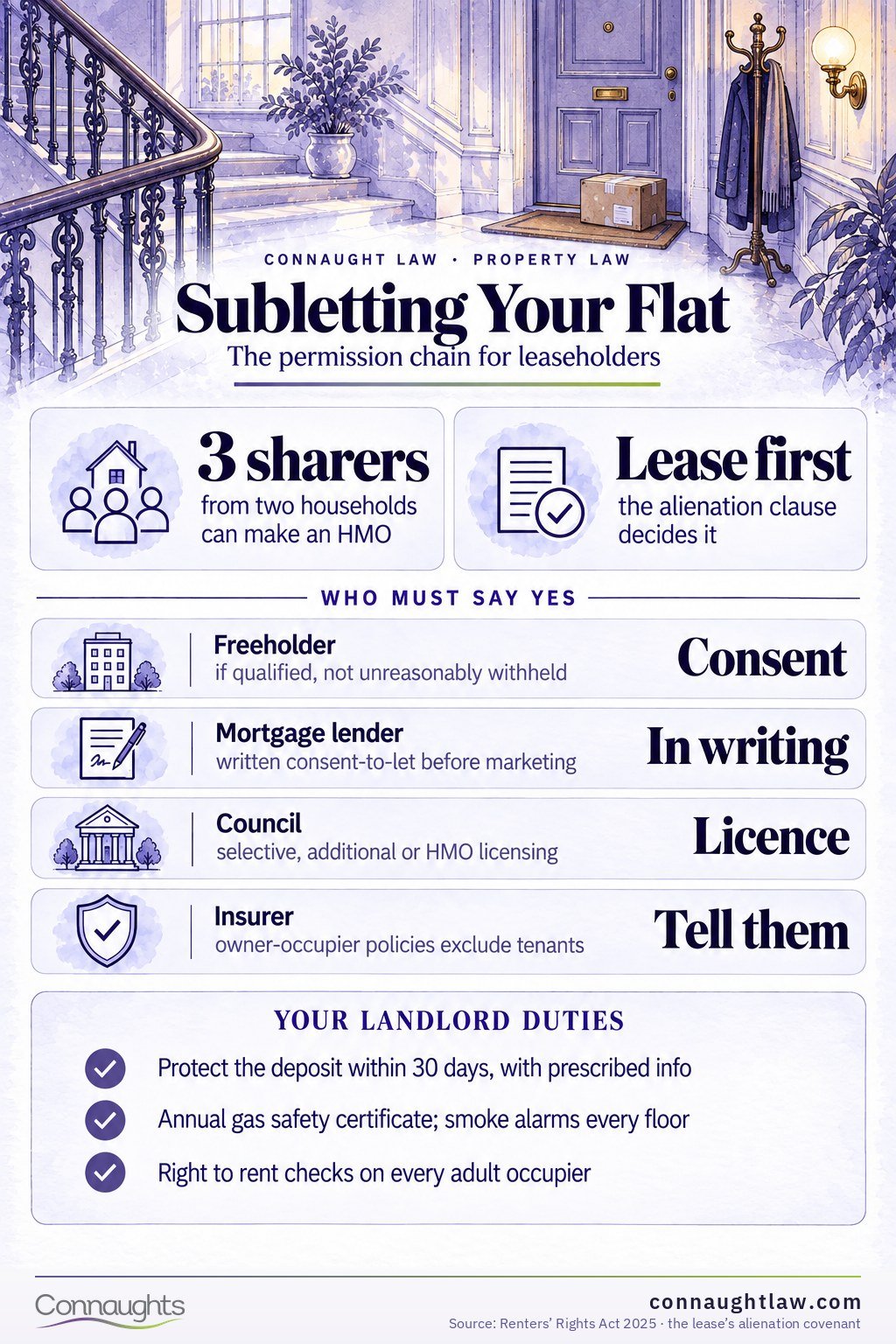
Most leases allow subletting with the freeholder's consent, most lenders allow it with theirs, and neither consent is optional because the other was given. The order that works: read the lease's alienation clause, ask the lender in writing, check the council's licensing map, then grant the tenancy with the landlord paperwork done. Skip a link in that chain and the remedies range from forfeiture proceedings to a mortgage called in.
Where Your Right to Sublet Comes From
A leaseholder holds a term of years on conditions — and subletting is one of the conditions, not an incident of ownership. The lease's alienation covenant decides everything: what may be sublet, for how long, with whose consent and on what notice. A "single private residence" user clause can separately prevent sharing arrangements even where subletting itself is allowed. Nothing about paying the service charge, owning the flat outright or having a long lease overrides the covenant's wording.
Lease Covenant Analysis
What the Covenant Permits
- Absolute prohibition: no subletting at all — the freeholder can waive it, but nothing compels them to.
- Qualified covenant: subletting with consent, which statute requires not to be unreasonably withheld — the most common form, and the one worth negotiating within.
- Permitted with notice: subletting allowed, subject to registering the subtenancy with the freeholder, usually with a modest fee under the lease.
- Whole-versus-part matters: many leases allow underletting the whole flat but prohibit parting with possession of part — which is exactly what a lodger arrangement can be.
The Consents That Must Line Up
Mortgage Lender Consent
Residential mortgage conditions prohibit letting without written consent; letting anyway is a breach that can trigger acceleration — the whole loan demanded — and, where the deception is deliberate, sits in mortgage fraud territory. Lenders grant consent-to-let for a fee or a rate adjustment, and some products, Help to Buy and shared ownership prominent among them, bar subletting almost entirely. Get the consent in writing before marketing the flat, and tell your insurer the same day: owner-occupier policies exclude tenanted occupation.
Councils, Licensing and the Coming Database
There is no universal council "subletting register" — what exists is sharper: selective licensing schemes that require a licence for ordinary lets in designated areas, additional licensing for smaller HMOs, and mandatory HMO licensing above the five-person threshold. Check the council's schemes before granting the tenancy, because licence-first is the rule and fees run to several hundred pounds. Separately, the PRS database under the Renters' Rights Act begins its rollout in late 2026 — subletting leaseholders will register as landlords like any other, and marketing a property unregistered will itself become an offence once the duty switches on.
The Three-Sharer Trap: HMO Rules
HMO Triggers and Licensing
An HMO forms at three or more occupiers from two or more households sharing facilities — not at five. Five or more occupiers in two-plus households makes the licence mandatory everywhere; below that, additional licensing schemes in many boroughs licence the smaller HMOs too. The trap for leaseholders is arithmetic: a couple plus one friend renting the spare room is an HMO, and a flat sublet to three sharers needs the HMO analysis before the tenancy, not after the council's letter. Liability can reach up the chain — superior landlords and agents have been penalised alongside the immediate landlord.
Penalties for Getting It Wrong
Criminal and Civil Enforcement
Penalties and Who Enforces
- The freeholder: breach of covenant proceedings and, ultimately, forfeiture of the lease — the asset itself at stake.
- The lender: acceleration of the loan and possession where letting breached the mortgage conditions.
- The council: prosecution with an unlimited fine or a civil penalty of up to £40,000 per offence for licensing failures.
- The subtenants: rent repayment orders of up to 24 months' rent under the current regime.
- Social housing tenants: subletting the home is a criminal offence under the Prevention of Social Housing Fraud Act 2013, carrying up to two years' imprisonment.
Becoming a Landlord: Your New Duties
Statutory Obligations to Your Subtenant
- An assured periodic tenancy under the post-May-2026 regime — no fixed terms, possession only on the statutory grounds, and the tenant able to leave on two months' notice.
- Gas safety certificate annually, electrical installation report five-yearly, smoke alarms every floor and carbon monoxide alarms where required.
- An EPC at band E or better before the tenancy starts — penalties for breach reach £5,000 under the current minimum standards.
- Deposit protected in an approved scheme within 30 days, with the prescribed information served — failure costs one to three times the deposit.
- Right to rent checks on all adult occupiers, and the current How to Rent guide served.
Ongoing Liability Under the Head Lease
Granting the subtenancy does not move you out of the firing line above: you remain the freeholder's covenanting tenant for noise, damage, service charges and user breaches — including the ones your subtenant commits. The practical protections are contractual mirroring (the subtenancy repeats the head lease's restrictions), referencing worth the name, and inspections your agreement actually permits. When the flat comes back, the head lease condition is yours to answer for, whoever caused it.
Doing It Properly
Pre-Subletting Checklist
- Lease review: alienation and user covenants, notice-and-fee requirements, whole-versus-part restrictions.
- Freeholder consent applied for in writing where the covenant is qualified — with the statutory reasonableness protection in mind.
- Lender consent-to-let and landlord insurance confirmed in writing.
- Council licensing map checked: selective, additional and mandatory HMO schemes.
- Landlord compliance kit assembled before move-in — certificates, deposit scheme, right to rent, How to Rent.
- Occupancy counted against the HMO thresholds, including everyone who will actually live there.
Leaseholders planning a longer exit should weigh the alternatives against subletting: assigning the lease passes the whole interest on, a sale realises it, and blocks pursuing collective enfranchisement may prefer owners to investors on the participation list. The 2024 reform programme changes none of the consent chain above — the subletting rules are lease and licensing law, and they are already in force.
Frequently askedQuestions about subletting a leasehold
Can I rent out my leasehold flat?
Usually yes — if the lease permits it and the consents are in place: freeholder consent where the covenant is qualified, lender consent-to-let, landlord insurance, and any council licence the area requires. The lease's alienation clause is the first document to read, not the last.
Can I sublet without the freeholder's permission?
Only if the lease genuinely permits it without consent — and even then notice and a fee are commonly required. Where consent is required and skipped, the freeholder can pursue breach of covenant and ultimately forfeiture. Consent under a qualified covenant cannot be unreasonably withheld.
When does subletting create an HMO?
At three or more occupiers forming two or more households sharing facilities. Licensing becomes mandatory at five occupiers, and many councils licence the smaller HMOs through additional schemes. Count everyone who will live in the flat before granting anything.
What are the penalties for illegal subletting?
Forfeiture proceedings from the freeholder, loan acceleration from the lender, unlimited fines or civil penalties up to £40,000 for licensing offences, and rent repayment orders up to 24 months' rent. Social housing subletting is a criminal offence with imprisonment available.
What kind of tenancy will my subtenant have in 2026?
An assured periodic tenancy under the Renters' Rights Act regime in force since 1 May 2026: no fixed term, possession only on statutory grounds, and the tenant free to leave on two months' notice. The old section 21 route no longer exists for new or existing tenancies.
Am I responsible for my subtenant's behaviour?
Under the head lease, yes — noise, damage and covenant breaches land on you as the freeholder's tenant, whoever caused them. Mirror the head lease restrictions in the subtenancy and reference properly; your remedy against the subtenant is only as good as the agreement you drafted.
Send us the lease and tell us who would be living there. We will confirm what the covenant allows, obtain the consents in the right order and set up the tenancy so the new regime works for you rather than against you.
Get Expert Advice