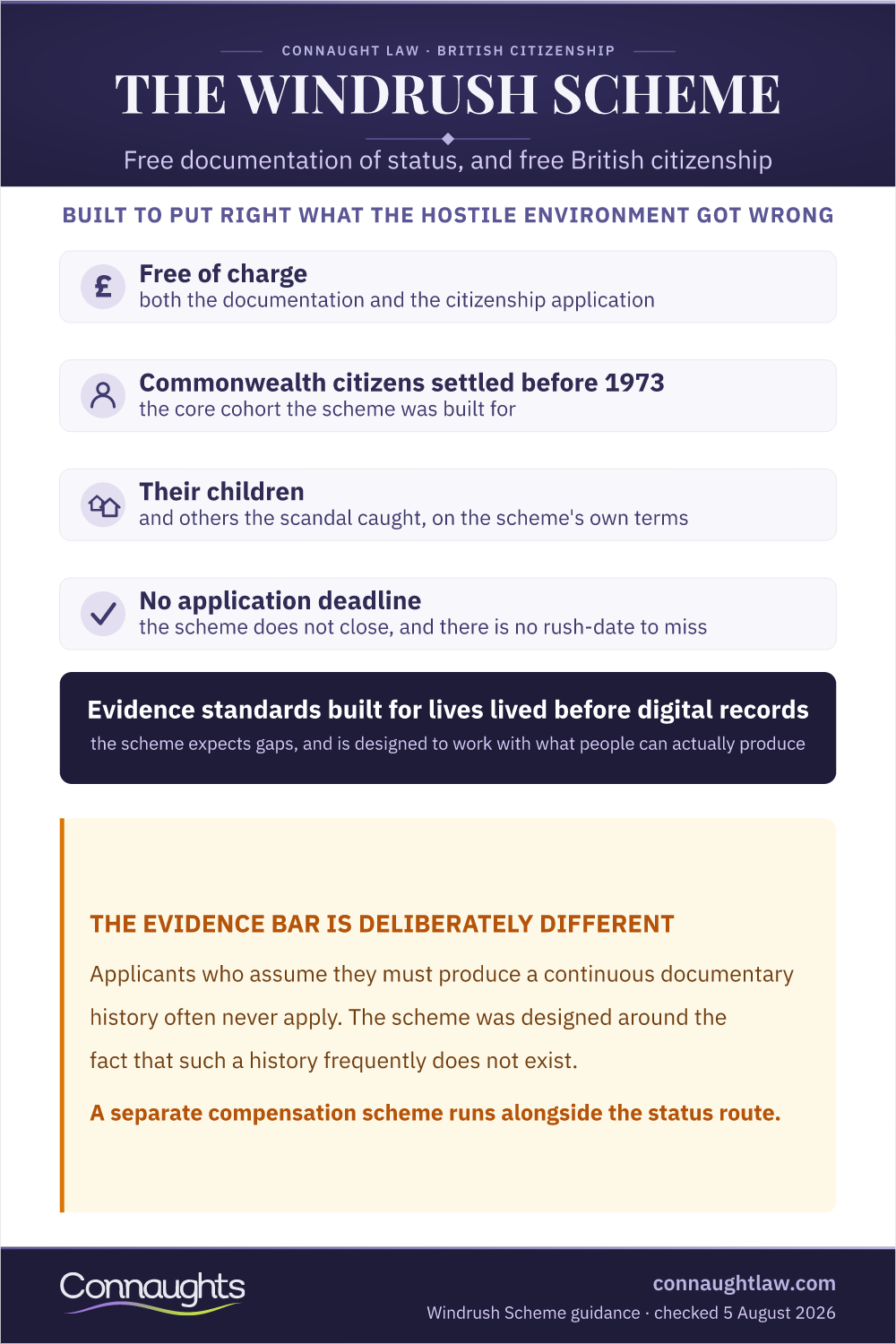
The Windrush Scheme puts right what the hostile environment got wrong: free documentation of status — and free British citizenship — for Commonwealth citizens who settled before 1973, their children, and others the scandal caught, with no application deadline and evidence standards built for lives lived before digital records. This guide covers who qualifies, the application and its evidence, the eVisa outcome, and the separate compensation scheme for what was lost.
On This Page

Status the Law Always Intended
The Windrush generation held rights the system later refused to recognise — settled by law in 1973, undocumented by administration ever since. The Windrush Scheme exists to document those rights free of charge: no application fee, no citizenship fee, no Life in the UK test or English requirement for the core cohort, and no deadline. What it cannot waive is evidence — and evidence is where these applications are really decided.
Who Qualifies
Eligibility Categories
Who the Scheme Covers
- Commonwealth citizens who settled in the UK before 1 January 1973 — the core Windrush generation.
- Their children, born in the UK or arriving as minors, whose status flows from the parents'.
- Commonwealth citizens with right of abode or settled status who lost documents proving it.
- People of any nationality who settled before 31 December 1988 and stayed, on defined terms.
The scheme documents existing rights rather than granting new ones — which is why it has no fee and no deadline, and why the diagnosis question ("what status did the law already give this person?") comes before any form. Caribbean families weighing modern visa routes, like those in our Trinidad and Tobago guide, should always check Windrush entitlement first.
Applying
Application and Evidence Gathering
Applications go through the Windrush Scheme forms — from inside the UK or abroad, where returning members of the generation use the scheme rather than the paid Returning Resident route — with a dedicated Home Office team and the Windrush Help Team supporting applicants through evidence gathering.
Timelines and Support
Decisions turn on how quickly the residence history can be verified — the scheme's caseworkers check government records themselves, and cases with school, NHS or National Insurance trails resolve fastest. Urgent circumstances — ill health, imminent travel, hardship flowing from undocumented status — should be flagged for expedited handling, and the help team can be involved from the first call.
Evidence
Primary Evidence and Alternatives
The scheme's evidential generosity is its point: where passports and landing cards are long gone, school records, medical registration, employment and National Insurance histories, tenancy records, and detailed personal testimony all count, assembled into a residence narrative rather than measured against a checklist. Decades can be evidenced thinly if the thread is continuous.
Cross-Departmental Verification
Caseworkers must check other departments' records — HMRC, DWP, education — before refusing for lack of evidence, a burden-sharing principle born of the scandal itself. Applicants should still name where the records will be found: the application that says "I attended X school 1965–1970 and worked at Y from 1972" gives verification something to bite on.
Digital Status
The eVisa Outcome
Successful applications now produce digital status — an eVisa in a UKVI account — or a citizenship grant where that entitlement is confirmed. For a generation failed by paper documentation, the digital record is both fix and irony; the account-hygiene rules apply as they do for everyone.
Share Codes and Verification
Work, renting and benefits checks then run on share codes, and the scheme's documentation ends the recurring humiliations — the job lost to a right-to-work check, the tenancy refused — that defined the scandal. Employers and landlords meeting Windrush-era documents in the meantime should use the Home Office checking services, never blanket refusal.
Compensation
What Can Be Claimed
The separate Windrush Compensation Scheme pays for what undocumented status cost: lost employment and benefits, detention and removal, denied NHS care, homelessness, fees paid for applications that should never have been needed, and the impact on daily life — with awards tracked in the Home Office's published scheme statistics. Claims need no lawyer, but complex loss categories reward careful evidencing, and claims can be made for deceased relatives' estates.
Reforms
The scheme operates under continuing scrutiny — reviews have pressed on decision speed, compensation levels and the treatment of criminal-record cases, and reform announcements continue. Two standing rules for applicants: the status scheme's good character considerations are applied with the scandal's context in mind (take advice rather than self-refusing over old convictions — the framework sits in our good character guide), and no policy change has touched the core entitlements: free documentation, free citizenship, no deadline. Our settlement and citizenship team and wider immigration practice handle both scheme and compensation claims.
Frequently askedQuestions about the Windrush Scheme
Who is eligible for the Windrush Scheme?
Commonwealth citizens settled in the UK before 1973 and their children, Commonwealth citizens with lost proof of right of abode or settlement, and people of any nationality settled before the end of 1988 — all documented free of charge.
Is there a deadline for Windrush applications?
No — the scheme has no closing date, and citizenship through it remains free. The practical urgency is human: evidence and witnesses age, so earlier applications are easier applications.
What if I have no documents from the 1960s or 1970s?
Apply anyway — school, NHS, tax and employment records count, caseworkers must check other departments' files, and detailed personal testimony fills gaps. The scheme was built for exactly this evidential position.
Does the Windrush Scheme give citizenship or just status?
Both, depending on entitlement: documentation of settled status or right of abode, and free naturalisation or registration where citizenship is the right answer — without the fees and tests ordinary applicants face.
How does Windrush compensation work?
A separate claim for what undocumented status cost — lost work, benefits, housing, health care, detention and daily-life impact — with no fee and awards by loss category. Estates can claim for relatives who died before justice arrived.
Will old convictions stop a Windrush application?
Not automatically — character considerations are applied with the scheme's remedial purpose in mind, and refusals on old minor records are challengeable. Disclose fully and take advice before assuming exclusion.
Tell us the arrival story — who came, when, and what records might exist. We'll build the residence narrative, run the scheme application and the compensation claim together.
Get Expert Advice