
The EU Settlement Scheme deadline passed on 30 June 2021, but a late application can still be made where there are reasonable grounds for the delay. The test is stricter than most descriptions of it: it asks about the whole delay up to the date you apply, not just about why you missed the deadline, and the longer you leave it the harder it becomes. Get it wrong and the application is rejected as invalid rather than refused.
On This Page

Where a Late Applicant Stands
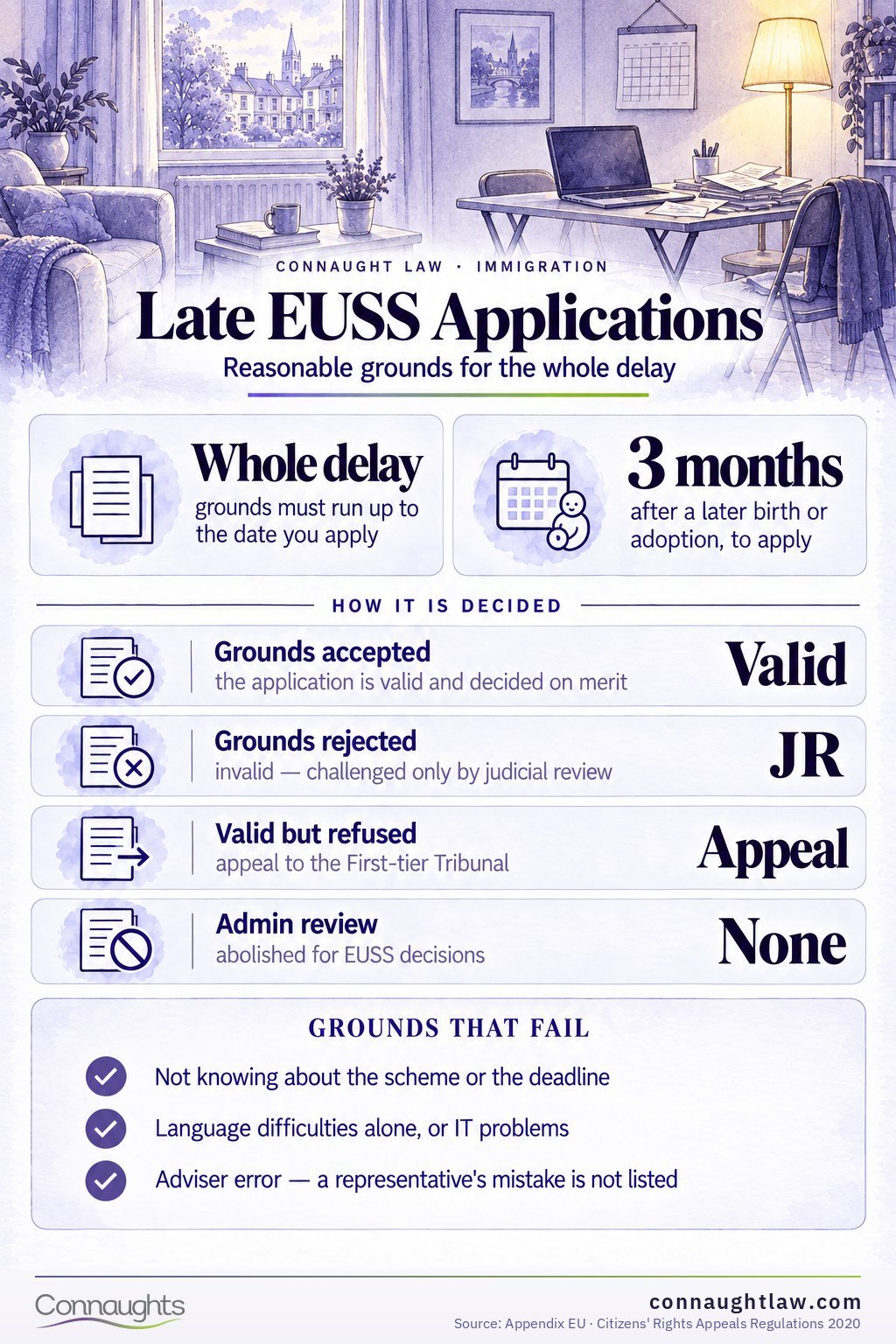
Two outcomes are possible and they are not the same thing. If the Home Office accepts that you have reasonable grounds, your application is valid and is decided on its merits. If it does not, the application is rejected as invalid under EU9(e) and EU10(1) — there is no decision on the merits, no refusal, and therefore nothing to appeal.
That distinction decides your remedy. A rejection as invalid can only be challenged by judicial review. A refusal of a valid application carries a statutory right of appeal to the First-tier Tribunal under regulation 3 of the Immigration (Citizens’ Rights Appeals) (EU Exit) Regulations 2020.
Meanwhile you have no status. Time spent waiting is not retrospectively made lawful, and the practical exposure while a late application is pending is real: right to work checks, right to rent, and NHS charging all proceed on the basis of the status you currently hold, which is none.
What Reasonable Grounds Means
The test is set out in the EU Settlement Scheme caseworker guidance, version 32.0 of 30 July 2026. It is decided on the balance of probabilities, and the wording matters: a person “must have reasonable grounds for their delay as a whole, and not simply for failing to meet the deadline applicable to them”. The guidance adds that “in general, the more time which has elapsed since the deadline applicable to the person under the scheme, the harder it will be” to satisfy the caseworker.
So an explanation that covers 2021 but says nothing about the years since will not do. The account has to run from the deadline to the date of application, and every substantial gap in it has to be explained.
- Not knowing about the scheme or about the deadline.
- Language difficulties on their own.
- Lack of internet access or IT difficulties, including problems accessing the system during the pandemic.
- Work or study commitments.
- Adviser error. A representative’s mistake is not among the listed categories, and presenting it as one sets an application up to fail.
What the guidance does recognise runs to ten categories, including serious medical conditions and hospitalisation, being a victim of domestic abuse or modern slavery, and being prevented by a controlling person. Incorrect advice from an employer or landlord after the grace period ended is a relevant factor in the assessment rather than a ground in itself — a distinction worth preserving in how the application is framed.
Children and Vulnerable Applicants
A child born or adopted after 1 April 2021 has three months from the birth or adoption to apply. Beyond that the same reasonable grounds test applies.
Where a parent or a local authority failed to apply on a child’s behalf, that failure is accepted as reasonable grounds — and it carries into adulthood, provided the person applies within a reasonable period of becoming aware of their position. A young adult who discovers at 20 that nobody made an application for them has not lost the route.
Evidence
The guidance asks for objectively verifiable evidence — its own example is a letter from a doctor. It does not require expert reports, and an application should not be delayed while one is commissioned. What it does require is evidence that covers the period, not a single document about a single moment.
Build the file chronologically: the deadline, what was happening then, and what has happened since. Where a period cannot be evidenced, say so and explain why rather than leaving a silent gap for a caseworker to fill.
Applying
The application is made through the settlement scheme system in the ordinary way, with the reasonable grounds explanation and its evidence attached. There is no separate late application form and no separate fee.
Statement of Changes HC 259, laid on 9 July 2026 and in force from 30 July 2026, made further changes to Appendix EU, and the guidance was reissued at version 32.0 on the same day. Anyone working from an older version of either is working from superseded material.
Refusals and Appeals
From 4 April 2024 there is no scope to apply for an administrative review of any decision made on a valid application under Appendix EU. The administrative review guidance puts it in terms: there is no provision in the Immigration Rules for such an application to be submitted, whether in time or out of time. Any advice to seek administrative review within 28 days is describing a remedy that was abolished more than two years ago — and the appeal deadline runs while the applicant waits for a review that will never happen.
Where the application was valid and refused, the remedy is an appeal to the First-tier Tribunal under regulation 3 of the 2020 Regulations. Where it was rejected as invalid because reasonable grounds were not accepted, there is no appealable decision and the route is judicial review.
The High Court confirmed in 2026 that a later grant operates prospectively — it does not retrospectively make the intervening period lawful. That is why the exposure described at the top of this page matters, and why a late application is worth making sooner rather than at the point a problem forces it. Our litigation team handles both routes, and case studies show how the grounds have been argued.
Frequently askedQuestions about late EU Settlement Scheme applications
Can I still apply after the deadline?
Yes, where you have reasonable grounds for the delay. The deadline was 30 June 2021 and there is no separate late application form or fee — the grounds and evidence go in with the ordinary application.
What counts as reasonable grounds?
The guidance lists ten categories, including serious medical conditions, hospitalisation, being a victim of domestic abuse or modern slavery, and being prevented from applying by a controlling person. Not knowing about the scheme is not one of them.
Does the delay since 2021 matter?
Yes, very much. The test asks about the whole delay to the date of application, not just about missing the deadline, and the guidance says the more time that has passed the harder it becomes.
What happens if my grounds are not accepted?
The application is rejected as invalid rather than refused. There is no decision on the merits and no right of appeal — the only challenge is judicial review.
Can I request an administrative review?
No. Administrative review was abolished for EU Settlement Scheme decisions from 4 April 2024. If a valid application is refused, the remedy is an appeal to the First-tier Tribunal.
My parents never applied for me — is it too late?
No. A parent's or local authority's failure to apply on a child's behalf is accepted as reasonable grounds, and it carries into adulthood if you apply within a reasonable period of learning your position.
My child was born after the deadline. What applies?
A child born or adopted after 1 April 2021 has three months from the birth or adoption to apply. After that the reasonable grounds test applies in the usual way.
Do I have status while I wait?
No. A late application does not give you status in the meantime and a later grant operates prospectively. Right to work, right to rent and NHS charging all proceed on your current status until it is granted.
Tell us when you last had status, why the application was not made and what has happened since. We'll tell you whether the reasonable grounds test is met on those facts and what evidence it needs.
Get Expert Advice