
New build conveyancing runs on the developer's paperwork and the developer's clock: a reservation fee, a 28-day exchange deadline, a contract drafted for the builder, and — off-plan — a completion date that depends on when the property actually exists. The protections are real but need engaging: deposit security, longstop dates, a ten-year structural warranty and the new-homes complaints regime. This guide covers the contract, the money, the warranties and the traps, in the order a buyer meets them.
On This Page

Buying Off-Plan and New: Why the Contract Is Different
A standard purchase transfers an existing property on a negotiated timetable. A new build purchase signs the developer's standard contract, usually under time pressure, often for a property that exists only as a plot number — and the balance of drafting power sits firmly with the party who wrote the documents. The conveyancer's job shifts accordingly: less discovery, more negotiation of the terms that bite later.
Exchange happens months before completion, not days. The completion date is triggered by the builder finishing, not by a date you chose. And the contract arrives drafted for the developer — longstop dates, variation clauses and incentive terms all need reading against your interests, because nobody else will.
Where New Build Differs from Any Other Purchase
The differences are structural, not cosmetic. Title is being carved out of a development site, so the plot's rights and obligations — roads, drains, estate areas — are created rather than inherited. Planning conditions and building regulations sign-off may still be outstanding at exchange. Incentives from the developer must be disclosed to your lender on the industry's disclosure form. And the specification you bought from the brochure is only as binding as the contract makes it.
Do You Need Your Own Conveyancer?
Yes — and specifically your own. Developers routinely recommend a "suggested" solicitor who knows the site; the discount for using them is real, and so is the structural problem: a firm receiving a stream of referrals from the developer is a poor negotiator against that developer's contract. Independent representation costs little more and is the only party in the transaction whose incentives point entirely at you.
Reservation, the 28-Day Exchange and Off-Plan Contracts
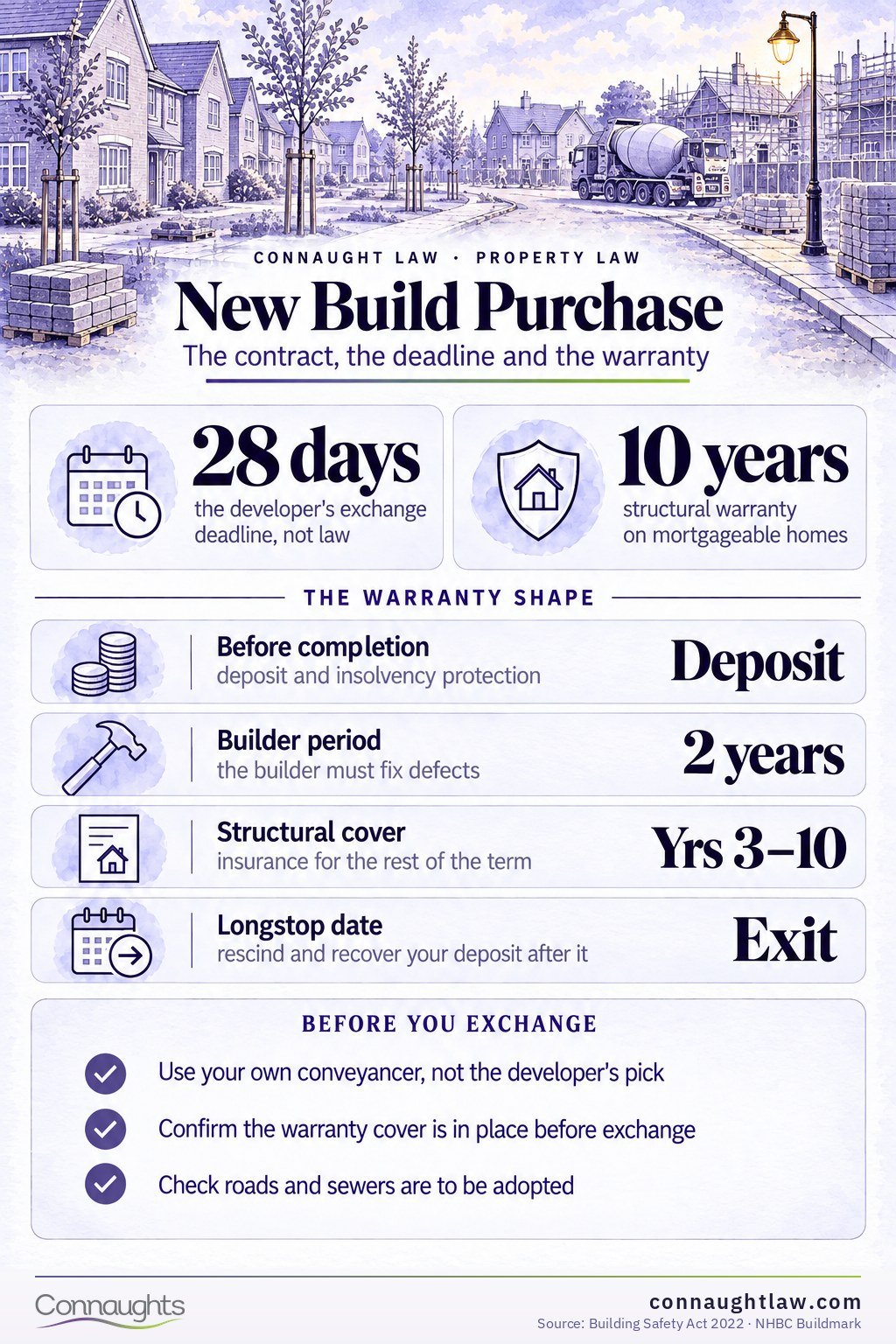
The reservation form takes a holding fee and starts a clock: most developers require exchange within 28 days, on pain of losing the plot and some of the fee. The deadline is the developer's sales tool, not law — a conveyancer who receives the pack on day one can usually meet it, and where the searches or mortgage offer genuinely cannot land in time, an extension is negotiable far more often than sales offices suggest.
Deposits and How They Are Held
Exchange deposits run at the usual 10%, with off-plan contracts sometimes staging further payments as construction progresses. What matters more than the size is the holding: who has the money between exchange and a completion that may be a year away, and what happens to it if the builder fails before the keys exist.
How Your Deposit Is Protected
- Held by solicitors as stakeholder — the cleanest protection, released only on completion.
- Released to the developer against warranty-backed insolvency cover — common, and acceptable only because the warranty's deposit protection stands behind it, within the policy's limits.
- The contract states which applies; your conveyancer confirms the warranty cover is actually in place before exchange, not after.
Delays, Longstop Dates and Your Exit
Off-plan contracts complete "on notice" — typically ten working days after the developer certifies practical completion — so the real protections are the anticipated date, the short-stop that triggers compensation, and the longstop date after which you can rescind and recover your deposit. A contract with no longstop, or one set years out, is asking you to lend the developer your deposit indefinitely. Mortgage offers also expire; a delayed build can mean re-applying on worse terms, which is a reason to negotiate the dates, not just note them.
Building Safety and the New-Homes Regime
The Building Safety Act 2022 sits behind every new build: dutyholder accountability through design and construction, the gateway regime for higher-risk buildings, and extended limitation periods for defective work. For flats, your conveyancer checks how the building cleared its gateways and what the developer certifies; for houses, the Act's main gift is the longer claim window if defects emerge.
Recent Developments That Changed the Checklist
- New leases of houses and flats carry peppercorn ground rents under the Leasehold Reform (Ground Rent) Act 2022 — the ground rent income model is dead for new stock.
- Most major developers are registered with the New Homes Quality Board, putting the New Homes Ombudsman behind your complaints in the first two years.
- Building Safety Act duties and documentation now follow the building from construction into occupation.
- Estate management charges on freehold plots remain unregulated — the one area where the paperwork still deserves suspicion (see the final checks below).
What New Build Conveyancing Costs
Why the Legal Fee Runs Higher
New build legal fees price above a standard purchase of the same value because the work is genuinely larger: a site title rather than a single property, the developer's contract to negotiate, incentive disclosure, warranty documentation, and — off-plan — a transaction held open for months. A quote that matches a standard purchase usually signals volume processing rather than a bargain.
The Costs Hiding in the Plot File
- Reservation fee — credited to the price, partially at risk if you withdraw.
- Snagging inspection before completion — the survey new builds actually need.
- Estate charges on freehold plots: annual service charges for unadopted roads and open spaces, plus transfer fees on later sales.
- Extras and upgrades, which belong in the contract, not in a side conversation with the sales office.
- SDLT on the full price including chargeable extras — first-time buyer relief applies to new builds exactly as elsewhere.
Warranties: Buildmark and the Alternatives
Every mortgageable new build carries a ten-year structural warranty. The standard shape: deposit and insolvency protection before completion, a defects period for the first two years in which the builder must fix problems, then structural insurance for years three to ten. The warranty is the document your children's roof relies on — its terms, exclusions and claim limits deserve ten minutes of your attention before exchange.
Comparing the Schemes
NHBC's Buildmark is the market leader, covering the large majority of new homes; Premier Guarantee, LABC Warranty and other approved schemes stand behind most of the rest, and lenders keep lists of the providers they accept. The practical differences live in claim excesses, what counts as "structural", and how the first-two-years builder obligation is enforced — which is where the New Homes Ombudsman now adds a route that did not exist for earlier generations of buyers.
Common Complications and How to Manage Them
The recurring problems are delay, specification drift and snagging. Delay is managed in the contract before exchange — the longstop and compensation terms above. Specification drift — the contract letting the developer vary materials and layout — is managed by tying the specification into the contract and limiting variation clauses to genuine substitutes. Snagging is managed by inspecting before completion where the developer allows it, and immediately after where they do not, with every defect logged in writing inside the two-year builder period.
Developer Insolvency
If the developer fails before completion, the warranty's deposit cover is the backstop — which is why confirming the policy exists before money moves is non-negotiable. If failure comes after completion, the warranty carries the structural risk for the decade. The buyers who lose in insolvencies are almost always those whose deposits were released without cover in place.
Compliance Checks Before Completion
Before completion your conveyancer confirms the paperwork that makes the house lawful as well as finished: building regulations sign-off, planning conditions discharged, the warranty activated, and the new-build energy and safety documentation delivered. None of this is optional garnish — a missing completion certificate resurfaces on your own sale years later.
Estates, Roads and Drains: The Long Tail
- Are the roads and sewers to be adopted by the council and water company — and is the developer's bond in place until they are?
- What estate charges attach to the plot, who sets them, and what consent fees bite on later sales?
- Do the plot's rights cover everything you need — access, services, parking — once the developer exits the site?
- Unadopted infrastructure plus open-ended estate charges is the "fleecehold" pattern; it is negotiable now and expensive later.
Questions about new build conveyancing
Do I need my own conveyancer for a new build?
Yes — and independent of the developer's recommendation. The contract is drafted for the builder, and the discount for using their suggested firm buys a negotiator with divided loyalties. Independent advice is the one part of the transaction working solely for you.
Is the 28-day exchange deadline fixed?
It is the developer's policy, not the law. A conveyancer instructed on reservation day can usually meet it; where searches or the mortgage offer genuinely cannot land in time, extensions are negotiated more often than sales offices admit. What you should not do is exchange unread to hit it.
What happens if the build is delayed?
The contract governs: an anticipated date, compensation triggers, and a longstop after which you can rescind and take your deposit back. Check your mortgage offer's expiry against the build timetable too — re-applying after a long delay can mean worse terms.
How is my deposit protected if the developer goes bust?
Either the money never left your solicitor's stakeholder account, or the new-home warranty's insolvency cover stands behind it within policy limits. Confirming which — and that the warranty is actually in force — belongs before exchange, not in the administrator's queue.
What warranty does a new build come with?
A ten-year structural warranty — NHBC's Buildmark on most homes, with Premier Guarantee, LABC and other approved schemes covering the rest. The builder must fix defects in the first two years; structural insurance carries years three to ten; and the New Homes Ombudsman now backs early complaints.
Should I get a snagging survey?
Yes — it is the survey new builds actually need. Inspect before completion where the developer permits, immediately after where they do not, and log every defect in writing inside the two-year period while the builder is obliged to fix them.
Send us the reservation form and the developer's contract pack before the 28 days start disappearing. We will tell you what to negotiate, how your deposit is held and whether the longstop protects you.
Get Expert Advice