
When the hammer falls at a property auction, you have exchanged contracts — no survey condition, no cooling-off, no renegotiation. Caveat emptor still governs what you buy: the building's condition is your risk, and the time to discover problems is before you bid, not after. This guide explains what buyer beware still means, what sellers must now disclose, and how to read an auction legal pack before it costs you.
On This Page

Buying at Auction: Where Caveat Emptor Still Rules
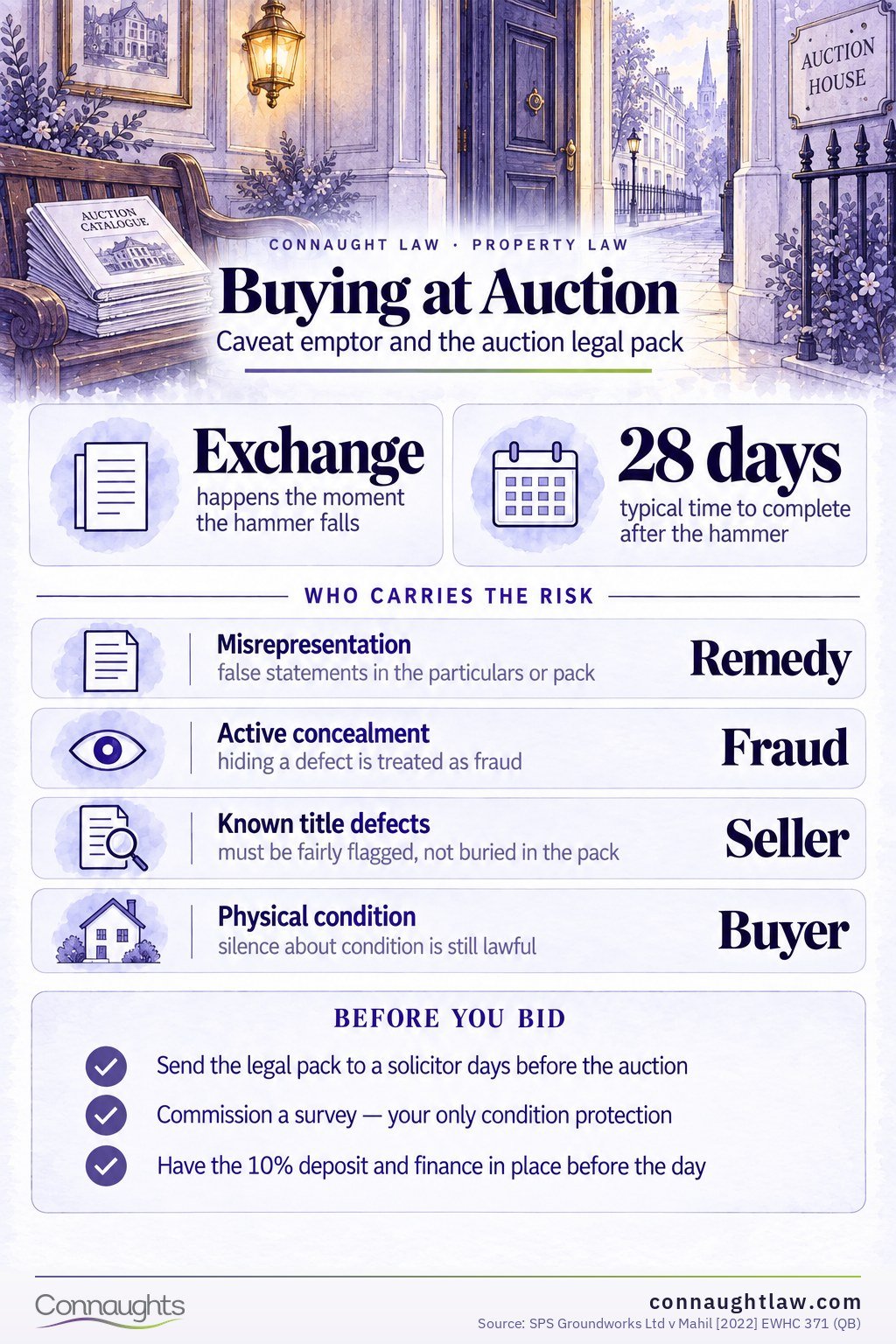
Auction purchases are the last corner of residential property where caveat emptor operates at close to full strength. A private treaty buyer can renegotiate after a bad survey or walk away before exchange. An auction buyer cannot: the fall of the hammer is exchange, the deposit — usually 10% — is committed, and completion typically follows within 28 days whether or not the roof turns out to be sound.
The rule is not absolute, and the sections below cover the ways it has been cut back — misrepresentation, consumer protection rules, and a seller's duty to disclose known title defects that the High Court has recently sharpened. But none of the erosions touch the core: the physical condition of the building is the buyer's risk, and no one is obliged to point out the subsidence.
There is no cooling-off period at auction. The successful bid creates a binding contract, the deposit is payable immediately, and failing to complete forfeits it — with the seller able to claim further losses on a resale. Every check described in this guide has to happen before auction day.
What Caveat Emptor Means in Property Law
Caveat emptor — let the buyer beware — means the buyer takes the property as they find it. Land has never carried the implied quality terms that protect buyers of goods: a kettle must be of satisfactory quality by statute, but a house need only exist. If the wiring is dangerous or the extension has no building regulations sign-off, the loss falls on the buyer who did not investigate, not the seller who stayed silent.
What the seller cannot do is lie, actively conceal, or misdescribe. The auctioneer's particulars, the replies to enquiries and the legal pack must be accurate as far as they go — and a seller who papers over a defect, rather than merely failing to mention it, crosses from silence into misrepresentation.
How Far the Rule Has Been Eroded
- Misrepresentation: false statements in particulars, the pack or replies to enquiries give rise to remedies, including rescission
- Active concealment: physically hiding a defect — the fresh plasterboard over the damp — is treated as fraud, not silence
- Known title defects: encumbrances the seller knows about must be fairly disclosed, not buried (the Mahil line of cases below)
- Consumer protection: the unfair commercial practices rules in Part 4 of the Digital Markets, Competition and Consumers Act 2024 (which replaced the 2008 Regulations from 6 April 2025) reach auctioneers' marketing — misleading omissions included
Disclosure Duties: Where the Law Has Tightened
Two developments matter to anyone bidding in 2026 — one from the High Court about what sellers must disclose, one from Parliament about the short-lease lots that fill auction catalogues.
SPS Groundworks v Mahil: What Sellers Must Disclose
In SPS Groundworks Ltd v Mahil [2022] EWHC 371 (QB), land was auctioned with an overage clause — a substantial uplift payable on development — sitting in the legal pack but never flagged in the particulars or by the auctioneer. The High Court held that was not good enough: a seller must make full and frank disclosure of known defects in title, fairly and openly, and cannot rely on the buyer's theoretical ability to excavate the pack.
The decision does not abolish caveat emptor; it polices the boundary between silence about condition, which remains the buyer's problem, and burying a title defect, which is now firmly the seller's. If something in the pack materially changes what the lot is worth, it should be signposted — and a buyer caught by a buried clause has a real remedy.
Disclosure means drawing attention to the problem, not lodging it where a diligent lawyer might find it. For sellers, that means flagging overage, covenants and irregularities in the particulars. For buyers, it means a buried defect discovered after the hammer may found a claim — but litigation is a poor substitute for reading the pack first.
Leasehold Reform and Short-Lease Auction Lots
Short leases cluster at auction, and the Leasehold and Freehold Reform Act 2024 changed their arithmetic. Since 31 January 2025 the two-year ownership requirement has gone: a buyer can begin a lease extension claim immediately after completion rather than waiting. The Act's valuation reforms — including the abolition of marriage value — are not yet in force, which leaves short-lease pricing genuinely uncertain until commencement.
What the 2024 Act Adds
| Change | Status | What It Means at Auction |
|---|---|---|
| Two-year ownership rule abolished | In force since 31 January 2025 | Extend the lease immediately after completion — no waiting period |
| 990-year extensions | Awaiting commencement | Longer security once in force; timing unknown |
| Marriage value abolished in valuations | Awaiting commencement | Short-lease premiums should fall — but pricing on that assumption is a gamble until the provisions commence |
The Auction Legal Pack: Check It Before You Bid
The legal pack is the seller's answer to caveat emptor: everything you are deemed to know sits inside it, whether or not you opened it. It is published before the auction, and the only safe assumption is that anything unusual in it is there for a reason.
What a Legal Pack Contains
- Title register and plan: ownership, charges, covenants and rights affecting the lot
- Special conditions of sale: where sellers relocate their own costs onto the buyer — read every line
- Searches: local authority, drainage and environmental — and if they are missing, ask why
- Leases and tenancy documents: for tenanted or leasehold lots, the terms you inherit
- Replies to enquiries and planning documents: what the seller has formally said, and what consent the building actually has
Reading the Pack Like a Lawyer
The hunt is for what changes the price. Overage clauses and restrictive covenants — the Mahil territory. Special conditions charging the seller's legal fees, search costs or a percentage "administration fee" to the buyer, which can add thousands to the hammer price. Missing searches, which usually mean the seller preferred you not to see them. And the occupation position: if the pack does not promise vacant possession, removing a tenant or an occupier found in the property after completion is your problem, at your cost, on the timetable the law allows — for tenanted lots, one now shaped by the Renters' Rights Act 2025.
A solicitor's pack review before auction day costs a fraction of any one of those surprises. Send the pack over days before the auction, not the night before — the point of a professional review is time to raise enquiries while answers can still change your bid.
Why Problem Properties End Up at Auction
The Selection Effect
Auctions reward speed and certainty, and those qualities are worth most to sellers whose properties struggle under private treaty scrutiny: short leases, structural issues, failed sales, probate lots, tenanted stock. None of that makes auction buying a mistake — it makes the catalogue a concentration of exactly the risks caveat emptor leaves with you.
What the Selection Effect Means for Bidders
Assume the lot is at auction for a reason, and make finding the reason your job. Sometimes it is innocent — an executor who wants a clean, fast sale. Sometimes it is a lease with 62 years left, a covenant that blocks the obvious development, or a sitting occupier. The discount that attracted you is the market pricing that reason in; bidding without knowing it means paying retail for wholesale risk.
Protecting Yourself Before the Hammer Falls
Where the Law Protects You — and Where It Stops
You are protected against being lied to: misdescription in the particulars, false replies to enquiries and buried title defects all carry remedies. You are not protected against what nobody said: condition, planning breaches a search would have shown, or the cost of works you never priced. The law's line is between deception and silence — and silence about condition is still lawful.
The Pre-Auction Checklist
- Legal pack to a solicitor: days before the auction, with time for enquiries
- View and survey: the only condition protection you will ever get is the one you commission
- Finance in place: 10% deposit on the day, completion typically in 28 days — bridging arranged before, not after
- Vacant possession confirmed: or a clear-eyed plan for the occupiers you inherit
- Special conditions costed: seller's fees shifted to you belong in your bid arithmetic
- Reserve reality: the guide price is marketing; set your ceiling from the pack, not the brochure — and in "modern method" conditional auctions, price the reservation fee too
Questions about caveat emptor and buying at auction
What does caveat emptor mean at a property auction?
Let the buyer beware: you take the property as you find it, and its physical condition is your risk. At auction the rule bites hardest because the hammer creates a binding contract — there is no survey condition to fall back on and no renegotiation after a bad discovery.
Can I back out after winning an auction bid?
Not without losing your deposit. The fall of the hammer is exchange of contracts: the 10% deposit is committed immediately and completion usually follows within 28 days. Fail to complete and the seller keeps the deposit and can claim further losses if the lot resells for less.
What should be in an auction legal pack?
The title register and plan, special conditions of sale, searches, any leases or tenancy documents, replies to enquiries and planning paperwork. Treat gaps as information: a missing search usually means the seller preferred you not to see it, and you are deemed to know everything the pack contains.
What if a problem was hidden in the legal pack?
Since SPS Groundworks v Mahil, a seller must fairly disclose known title defects — burying an overage clause or covenant deep in the pack without flagging it is not disclosure. A buyer caught that way may have remedies including rescission, but reading the pack first beats litigating afterwards.
Do I have any protection for defects found after completion?
Only where the seller misrepresented or concealed. Defects nobody mentioned — condition, unauthorised works, damp behind furniture — stay where caveat emptor puts them: with you. That is why the survey and pack review happen before auction day; afterwards, the law assumes you priced what you bought.
Is a survey worth it on an auction property?
Yes — it is the only condition protection an auction buyer ever gets. Weigh the survey fee against the deposit you forfeit if you discover the problem after the hammer. On unmodernised or long-empty lots, the survey is not a cost of bidding; it is what tells you whether to bid at all.
Send us the legal pack and the auction date. We will tell you what is buried in it, what the special conditions really cost and what your ceiling bid should account for.
Get Expert Advice