
Being knocked off and abandoned by a driver who does not stop is one of the hardest things that can happen to a cyclist. Under section 170 of the Road Traffic Act 1988 a driver must stop and give their details after an injury accident, and failing to do so is a criminal offence. But even when the driver is never found, you are not without a claim: the Motor Insurers' Bureau compensates cyclists hurt by untraced and uninsured drivers. This guide explains how that route works, what you must prove, and the reporting steps a claim depends on.
On This Page
How a Hit-and-Run Cycling Claim Works
Yes, you can claim even if the driver never stopped. The Motor Insurers' Bureau (MIB) compensates cyclists through its Untraced Drivers' Agreement where the driver cannot be found, and its Uninsured Drivers' Agreement where the driver is identified but has no insurance. You must report the collision to the police, and apply within the three-year limit. Compensation for your injuries is assessed on the same Judicial College basis as any claim; only property damage carries a small excess.
A hit-and-run claim is a claim against a scheme rather than a named driver, and that changes what matters. The burden is on you to show a motor vehicle caused your injury, which puts evidence front and centre. The sections below explain the two MIB agreements, the reporting the scheme requires, the proof it looks for, and how its compensation compares with an ordinary claim.
The MIB: Your Route When the Driver Can't Be Traced
The Motor Insurers' Bureau exists precisely for this situation. Funded by a levy on every motor insurance policy, it acts as a safety net so that a driver's decision to flee does not deprive an injured cyclist of compensation. Under the Untraced Drivers' Agreement it investigates the claim, may appoint its own medical expert, and makes an award on the same Judicial College Guidelines that govern an ordinary claim.
A body funded by motor insurers that compensates people injured by uninsured or untraced drivers. It runs two schemes: the Untraced Drivers' Agreement, for victims of hit-and-run drivers who are never identified, and the Uninsured Drivers' Agreement, for cases where the driver is identified but has no valid insurance. Each has its own procedure and conditions.
Untraced versus uninsured: two agreements
The distinction matters. The Untraced Drivers' Agreement applies where the driver is never found. The Uninsured Drivers' Agreement applies where the driver is identified but turns out to be uninsured — here the MIB effectively stands in the insurer's shoes and handles the claim much like an insurance company would. A partial registration or a clear vehicle description can move a claim from the untraced route to the uninsured route, which often eases the evidential burden and removes the property-damage excess.
Making a claim begins with an application to the MIB setting out the collision and the evidence that a vehicle was responsible. The MIB then investigates — reviewing the police report and any footage, and often appointing its own medical expert — before making an award. An offer you consider too low can be challenged, and representation helps here because the scheme's procedure and evidence thresholds differ from an ordinary insurance claim.
Reporting to the Police
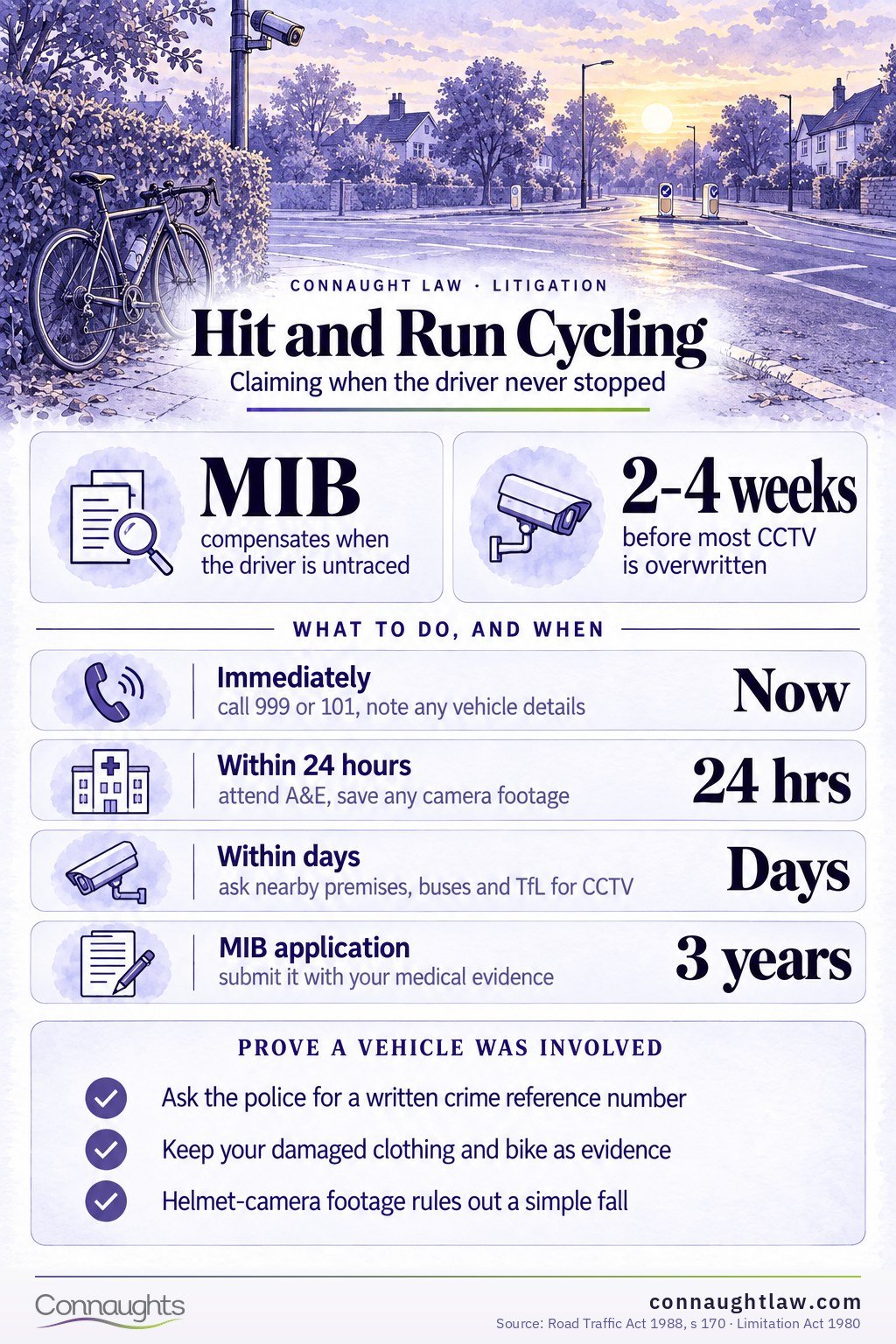
Reporting the collision to the police is a condition of an MIB claim. The Untraced Drivers' Agreement expects this to be done as soon as reasonably practicable, so the safest course is to report immediately — call 999 where an ambulance is needed, which brings the police too, or use 101 otherwise. Ask for a written crime reference number and the investigating officer's details.
A police investigation can involve council CCTV, automatic number-plate recognition along likely routes, and witness appeals, and its findings can support your MIB application. If the police identify the driver, the claim converts to the Uninsured Drivers' Agreement or proceeds as a standard insurance claim — usually improving your position. The driver's failure to stop is itself an offence under section 170, giving the police independent grounds to investigate.
The Evidence a Hit-and-Run Claim Needs
Because there is no driver to admit fault, you must prove that a motor vehicle caused your injury — not simply that you fell. That makes early evidence decisive, and some of the most valuable evidence disappears within days.
Proving a vehicle was involved
The central hurdle is causation. The MIB must be satisfied that a motor vehicle caused the injury, not that the cyclist simply lost control, so anything that establishes vehicle involvement carries weight — a witness who saw the car, paint or debris left at the scene, damage consistent with a strike rather than a fall, and above all footage. Building that picture early, while the traces still exist, is what turns a difficult claim into a provable one.
What to do, and when
| When | What to do | Why it matters |
|---|---|---|
| Immediately | Call 999 or 101, note any vehicle details, photograph the scene | Police reporting is required; witnesses disperse fast |
| Within 24 hours | Attend A&E, save any camera footage, keep damaged clothing and bike | Links the injuries to the collision date |
| Within days | Ask nearby premises, buses and TfL for CCTV | Most CCTV is overwritten within two to four weeks |
| Within 3 years | Submit the MIB application with medical evidence | The limitation period bars late claims |
Helmet-camera footage is especially valuable: even where it does not capture a registration, it proves a vehicle was involved and rules out a simple fall. Witnesses, and physical traces such as paint transferred to the bike or clothing, can corroborate the collision and even help identify the vehicle. Once a driver is traced, liability is proven as in any collision — our guide for a cyclist knocked off their bike explains how that is done.
How MIB Compensation Differs
For your injuries, MIB compensation mirrors an ordinary claim. General damages are assessed on the same Judicial College Guidelines, so a cyclist with a broken collarbone from a hit-and-run recovers a comparable award to one whose driver stayed. Lost earnings, treatment, care and other financial losses are fully recoverable, and our complete guide to bicycle accident compensation sets out how those are valued.
Two differences are worth knowing. Under the Untraced Drivers' Agreement the MIB may deduct a £400 excess from a property-damage claim — that reduces the recovery for your bike and equipment, but it does not touch your personal-injury compensation. And because the MIB carries out its own investigation, these claims usually take longer than an ordinary insurer negotiation, often a year or more. Neither changes your entitlement to be properly compensated for the injury itself. Most hit-and-run claims run on a "no win, no fee" basis, so pursuing a personal injury claim turns on the evidence rather than the cost.
Tracing the Driver
It is always worth trying to identify the driver, because doing so can move the claim onto better terms. Even a partial description lets the police filter number-plate data along the route, and council, bus and TfL cameras cover much of the urban network — our London cycling accident claims guide covers how city footage is obtained.
Appeals on local community and cycling groups often surface a witness or a dashcam clip, and forensic analysis of paint and debris can narrow the search to a make and model. If the driver is found, the claim leaves the untraced route, the £400 excess falls away, and the process comes to resemble a standard claim.
Time Limits for Your Claim
A hit-and-run claim carries the usual three-year limit for personal injury under the Limitation Act 1980, running from the date of the accident. Property-damage-only claims have a longer period, but injury is what drives most cycling claims.
Late or missing police reporting is one of the commonest reasons a hit-and-run claim fails, and the CCTV that proves a vehicle was involved is often gone within a fortnight. Report to the police straight away, secure the footage within days, and take advice early — the scheme's conditions leave little room to make up lost ground.
For a child, the three years do not start until their 18th birthday, so a claim can be brought until they are 21, with any settlement approved by the court. Where an injured person lacks the mental capacity to conduct a claim, no time limit runs while that continues.
Frequently askedQuestions about hit-and-run and MIB claims
Can I claim if the hit-and-run driver is never found?
Yes. The MIB Untraced Drivers' Agreement exists to compensate people injured by drivers who cannot be identified. Provided you reported the collision to the police and apply within the three-year limit, your claim is investigated by the MIB and compensation is assessed on the same Judicial College Guidelines as an ordinary claim.
How quickly must I report a hit-and-run to the police?
As soon as reasonably practicable — so report immediately wherever you can. Police reporting is a condition of an MIB claim, and prompt reporting also protects the evidence, especially CCTV that is often overwritten within two to four weeks. Ask for a crime reference number when you report.
How much compensation can I get through an MIB hit-and-run claim?
Your injury is valued on the same Judicial College Guidelines (18th edition, 2026) as any claim, from a few thousand pounds for minor injuries to £372,570–£533,720 for very severe brain damage, plus lost earnings, treatment and care. Only property damage — your bike and equipment — carries a £400 excess under the Untraced Drivers' Agreement; your personal-injury compensation is not reduced.
How long does an MIB hit-and-run claim take?
Longer than an ordinary insurer claim, often a year or more, because the MIB runs its own investigation and may appoint its own medical expert. Complex or serious cases take longer still. Prompt, well-organised evidence and early legal help keep the process moving.
What if the driver is later found but has no insurance?
The claim then moves to the MIB Uninsured Drivers' Agreement, which broadly resembles a standard insurance claim with the MIB handling it in the insurer's place. The £400 property-damage excess that applies to untraced claims does not apply, so identifying the driver usually improves your position.
Can CCTV really help identify a hit-and-run driver?
Yes. Footage from shops, buses, doorbells, dashcams and council or TfL cameras has identified many fleeing drivers, and even a partial description lets the police filter number-plate data. The catch is time: most systems overwrite footage within two to four weeks, so the request has to be made within days.
What is the time limit for a hit-and-run cycling claim?
Three years from the date of the accident for personal injury under the Limitation Act 1980, with the period running from a child's 18th birthday and no limit while an injured person lacks the mental capacity to claim. The MIB also requires that the collision was reported to the police, so both conditions need to be met.
Tell us when it happened and whether you reported it to the police. We’ll tell you whether the MIB route is open to you and what the deadlines are.
Get Expert Advice