
Hire e-bikes have transformed city cycling, with schemes such as Lime, Forest and Santander Cycles carrying millions of rides a year. They have also created a distinct kind of accident claim. A crash on an e-bike can be an ordinary road accident, but where a hired machine was faulty it also engages consumer and product-safety law against the operator and the manufacturer. This guide explains how an e-bike accident claim works: how the law classifies your bike, who is liable when a hire bike fails, and the evidence these claims turn on.
On This Page
How an E-Bike Accident Claim Works
Yes, you can claim for an e-bike accident. A collision with a vehicle is an ordinary road accident claim. But where a hire e-bike was defective, two extra routes open up: the Consumer Rights Act 2015 against the operator that supplied an unsafe bike, and the Consumer Protection Act 1987 against the manufacturer, which is strictly liable for a defective product. Your injury is valued on the same Judicial College basis as any cycling claim, and a "use at your own risk" clause cannot remove your right to claim for personal injury.
What makes e-bike claims distinctive is that several areas of law can apply at once. The same accident may involve a negligent driver, a defective machine and an operator that failed to maintain it. Working out which frameworks apply — and against whom — is the key to the claim. The sections below take the classification of the bike, the liable parties, the role of defects and maintenance, and the evidence in turn.
How the Law Classifies Your E-Bike
Most e-bikes on UK roads are treated exactly like ordinary bicycles. A bike that meets the "electrically assisted pedal cycle" rules needs no licence, insurance, registration or road tax, and can be ridden on roads and cycle paths from the age of 14. Hire-scheme e-bikes are built to these rules, which is why claims involving them proceed as cycling claims rather than motor-vehicle claims.
An e-bike with a motor of no more than 250 watts continuous rated power, where the motor only assists while the rider pedals and cuts out at 15.5mph. A compliant EAPC is treated in law as a pedal cycle — no licence, insurance, registration or tax, minimum rider age 14. These limits were reviewed in 2024 but left unchanged. An e-bike that exceeds them is a motor vehicle in law.
E-bikes versus e-scooters
The two are often confused but sit very differently in law. A compliant e-bike is legal on the road as a bicycle. A privately owned e-scooter is not: private e-scooters remain illegal to ride on public roads and pavements, and only rental e-scooters in government-approved trials may be used in public. The distinction matters for a claim, because an illegal vehicle affects insurance and can be raised on the question of fault, whereas a compliant e-bike carries the full protection the law gives cyclists.
Who Is Liable for a Hire E-Bike Accident?
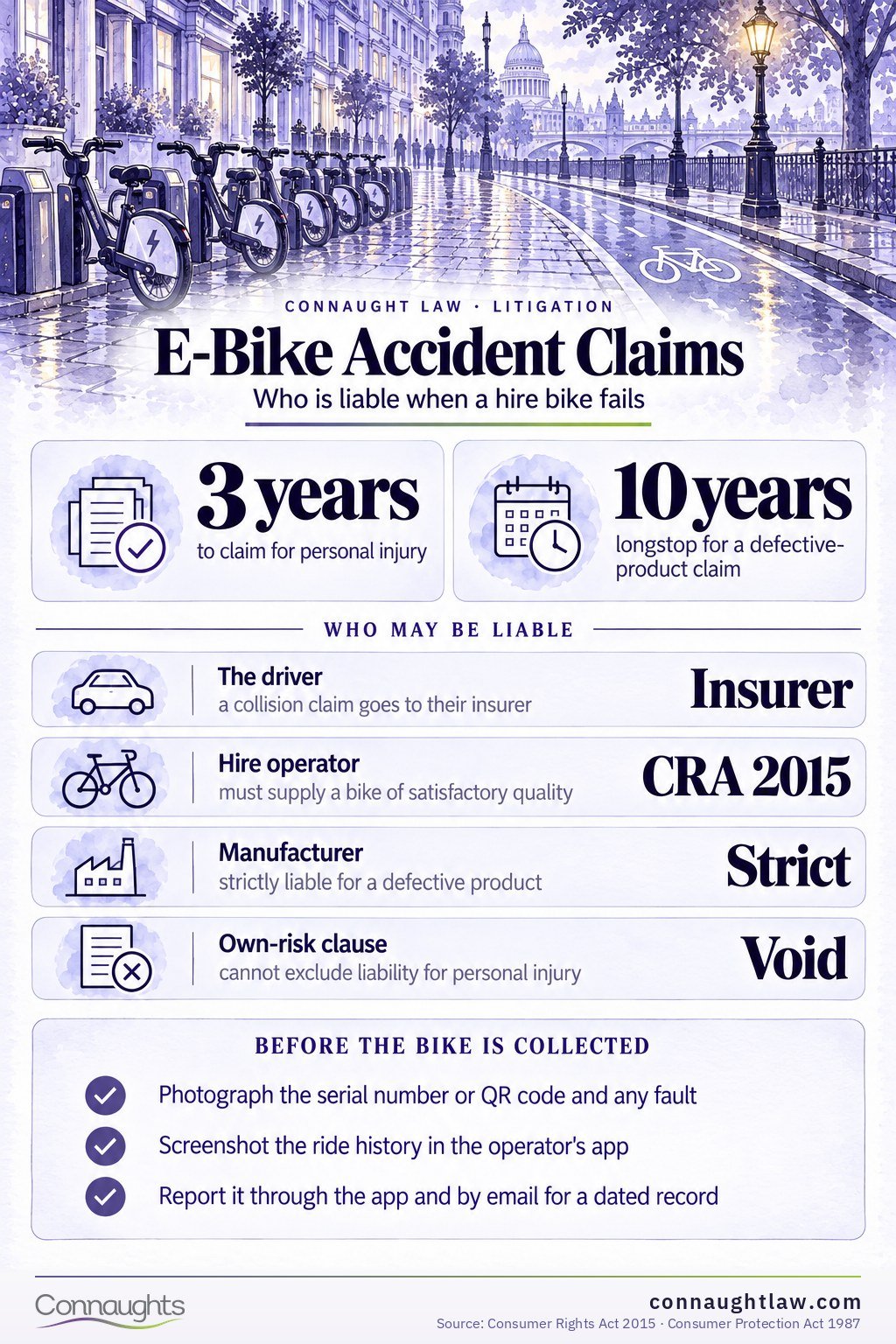
If a driver caused the crash, the claim is against their insurer as in any collision. Where the hire e-bike itself was at fault, two consumer-law routes run alongside ordinary negligence — and more than one party can be liable at the same time.
The Consumer Rights Act and the hire operator
Hiring a bike is a contract to supply goods, so the Consumer Rights Act 2015 applies. The bike must be of satisfactory quality and fit for purpose; if it is supplied with a fault that causes injury, the operator is liable. Just as important, the Act strikes down any term that tries to exclude liability for personal injury caused by negligence — so a "you ride at your own risk" clause in the app does not defeat a genuine claim.
The Consumer Protection Act and the manufacturer
Where the fault is a product defect, the Consumer Protection Act 1987 imposes strict liability on the manufacturer: you prove the product was defective and caused injury, without having to show carelessness. Liability cannot be signed away by contract. This route can reach the maker of the bike, its battery or a component, and it runs alongside — not instead of — the operator's responsibility.
Often more than one party is liable. A single accident can involve a defective bike, an operator that failed to maintain it, and a driver who contributed to the collision, with responsibility shared between them. Where an operator puts its own brand on a bike made by someone else, it can be treated as the producer for product-liability purposes. Identifying every liable party matters, because it widens the routes to compensation and the insurance available to meet the claim.
Defects and Maintenance
Hire e-bikes are heavy machines, often around 35 kilograms, and that weight changes how an accident unfolds; clinicians have reported a pattern of lower-limb injuries where a toppling hire bike lands on the rider. A machine that is left in service with worn brakes, a loose stem, a flat tyre or a battery fault is a foreseeable danger, and an operator that fails to maintain its fleet to a reasonable standard is exposed in negligence as well as under the Consumer Rights Act.
What the law expects of the rider is modest. A pre-ride check is judged by what a reasonable user — not a trained mechanic — would notice, so a hidden fault such as a frayed internal brake cable, a battery defect or fatigue in a frame weld does not count against you. That distinction often decides whether an operator's allegation of rider fault has any force.
An e-bike is also exposed to the same road hazards as any cycle, and its extra weight and speed can make a defect more punishing — a pothole that unseats a rider is dealt with in our pothole cycling accident claim guide, where the claim lies against the highway authority rather than the bike operator.
Evidence for a Hire E-Bike Claim
Hire e-bike claims are uniquely time-sensitive because the bike does not belong to you. The operator can collect, repair or redistribute it within hours, taking the physical evidence of the defect with it — so capturing that evidence before it disappears is critical.
- Photograph the bike's serial number or QR code and any visible fault before it is collected
- Screenshot the ride history in the operator's app, showing the bike ID and timestamps
- Report the incident through the app and by email, so there is a dated written record
- Photograph the scene, the road, any other vehicle and your injuries
- Take witness details, and attend A&E so the injuries are recorded
- Report to the police on 101 and ask for a reference number
Operators log GPS, speed, braking and battery data for every ride, and that record can show whether the bike was working correctly — evidence a specialist can request. These city claims often turn on how quickly footage and the bike itself are secured, and our London cycling accident claims guide covers evidence-gathering in urban traffic.
Compensation and Time Limits
An e-bike injury is valued like any cycling injury: general damages under the Judicial College Guidelines, plus lost earnings, treatment and care. The 18th edition (April 2026) raised the brackets by roughly 8.26%. The figures below cover common e-bike injuries; our complete guide to bicycle accident compensation sets out the full range.
Typical e-bike injury brackets
| Common e-bike injury | JCG 18th edition bracket |
|---|---|
| Shoulder — moderate | £10,420 – £16,870 |
| Wrist — less severe injury | £16,640 – £32,370 |
| Ankle — moderate fracture or ligament injury | £18,150 – £35,130 |
| Brain — less severe injury | £20,240 – £56,890 |
| Brain — very severe damage | £372,570 – £533,720 |
The ordinary three-year limit for injury applies under the Limitation Act 1980, but a product-defect claim under the Consumer Protection Act 1987 also carries a ten-year longstop from when the product was put into circulation. On top of both, the operator's ride data and the bike itself can vanish within days — so early advice matters more here than in almost any other cycling claim.
For a child, the three years do not start until their 18th birthday, so a claim can be brought until they are 21, with any settlement approved by the court. Where a rider was partly at fault, contributory negligence reduces an award in proportion rather than defeating it — but, as above, a hidden defect a reasonable rider could not have spotted does not count against them. Most e-bike claims run on a "no win, no fee" basis, so whether to pursue a personal injury claim depends on the evidence, not the cost.
Frequently askedQuestions about e-bike and hire bike accidents
Can I claim for an accident caused by a faulty hire e-bike?
Yes. Where a hire e-bike was defective, you can claim against the operator under the Consumer Rights Act 2015 for supplying a bike that was not of satisfactory quality, and against the manufacturer under the Consumer Protection Act 1987, which is strictly liable for a defective product. The claim is stronger where the evidence shows the fault existed before your ride and was not caused by misuse.
Does the app's "use at your own risk" clause stop me claiming?
No. The law does not allow a business to exclude liability for personal injury caused by its negligence or breach of statutory duty, and the Consumer Protection Act cannot be signed away by contract. A clause saying you ride at your own risk does not override the operator's legal obligation to supply a safe, roadworthy bike.
Is a hire e-bike treated as a bicycle or a motor vehicle?
As a bicycle, provided it meets the electrically assisted pedal cycle rules — a motor up to 250 watts that assists only while pedalling and cuts out at 15.5mph. Hire-scheme bikes are built to comply, so no licence or insurance is needed to ride one. An e-bike that exceeds those limits is a motor vehicle in law and must be registered and insured.
Are e-scooters legal, and can I claim on one?
Private e-scooters are illegal to ride on public roads and pavements; only rental e-scooters in government-approved trials may be used in public. Because a privately owned e-scooter is being used unlawfully, a claim is more complicated and insurance may be affected. A compliant e-bike, by contrast, carries the full legal protection the law gives cyclists.
Can a pedestrian injured by an e-bike claim compensation?
Yes, through a negligence claim against the rider. The difficulty is that a compliant e-bike needs no compulsory insurance, so recovery may depend on whether the rider has personal liability cover, home insurance extending to cycling, or assets. Where a hire bike was involved, the operator's public liability insurance may provide a route depending on the circumstances.
Do hire operators have to insure riders against injury?
There is no statutory requirement for hire e-bike operators to carry insurance covering rider injuries, though many hold public liability insurance and some offer limited personal accident cover. The scope varies and may exclude common situations, which is why a claim usually rests on the operator's and manufacturer's legal liability rather than on any voluntary cover.
How long do I have to make an e-bike accident claim?
Three years from the accident for personal injury under the Limitation Act 1980, running from a child's 18th birthday for a minor. A defective-product claim under the Consumer Protection Act 1987 also has a ten-year longstop from when the product entered circulation. In practice, act quickly: the operator's ride data and the bike can be gone within days.
Tell us whether it was your own bike or a hire bike, and what went wrong. We’ll tell you who is likely to be liable and which clock is running on your claim.
Get Expert Advice