
ETIAS — the EU's €20 travel authorisation for visa-free visitors — has still not launched: Brussels has withdrawn its late-2026 target and now promises several months' notice before the system goes live. What has changed is at the border itself, where the Entry/Exit System has been fully operational since April 2026. This guide covers what ETIAS will require of UK passport holders, what EES already does, the fee and validity rules, and how to prepare without falling for lookalike websites.
On This Page

The Authorisation That Keeps Not Arriving
ETIAS cannot yet be applied for. The EU has withdrawn its target launch and promises several months' public notice, so British passport holders travel to the Schengen area under the rules that already apply. What has changed is the border itself: the Entry/Exit System now registers fingerprints and facial images in place of stamps. When the authorisation arrives it will screen travellers before boarding, without altering the 90/180 limit.
What ETIAS Is
The European Travel Information and Authorisation System is the EU's pre-screening for visa-free travellers — an online authorisation, not a visa, checked before boarding much like the UK's own ETA in reverse. Approval will be near-instant for most applicants, the point being data: who is coming, on which passport, flagged against which databases, before the plane leaves.
The Post-Brexit Context
Brexit moved UK citizens into the third-country lane: 90 days in any 180 across the Schengen area, passport stamps — now digital records — and, eventually, ETIAS. The 90/180 arithmetic already binds second-home owners and long-stay travellers; ETIAS adds a screening layer to the same limits rather than changing them.
Where It Applies
Countries in Scope
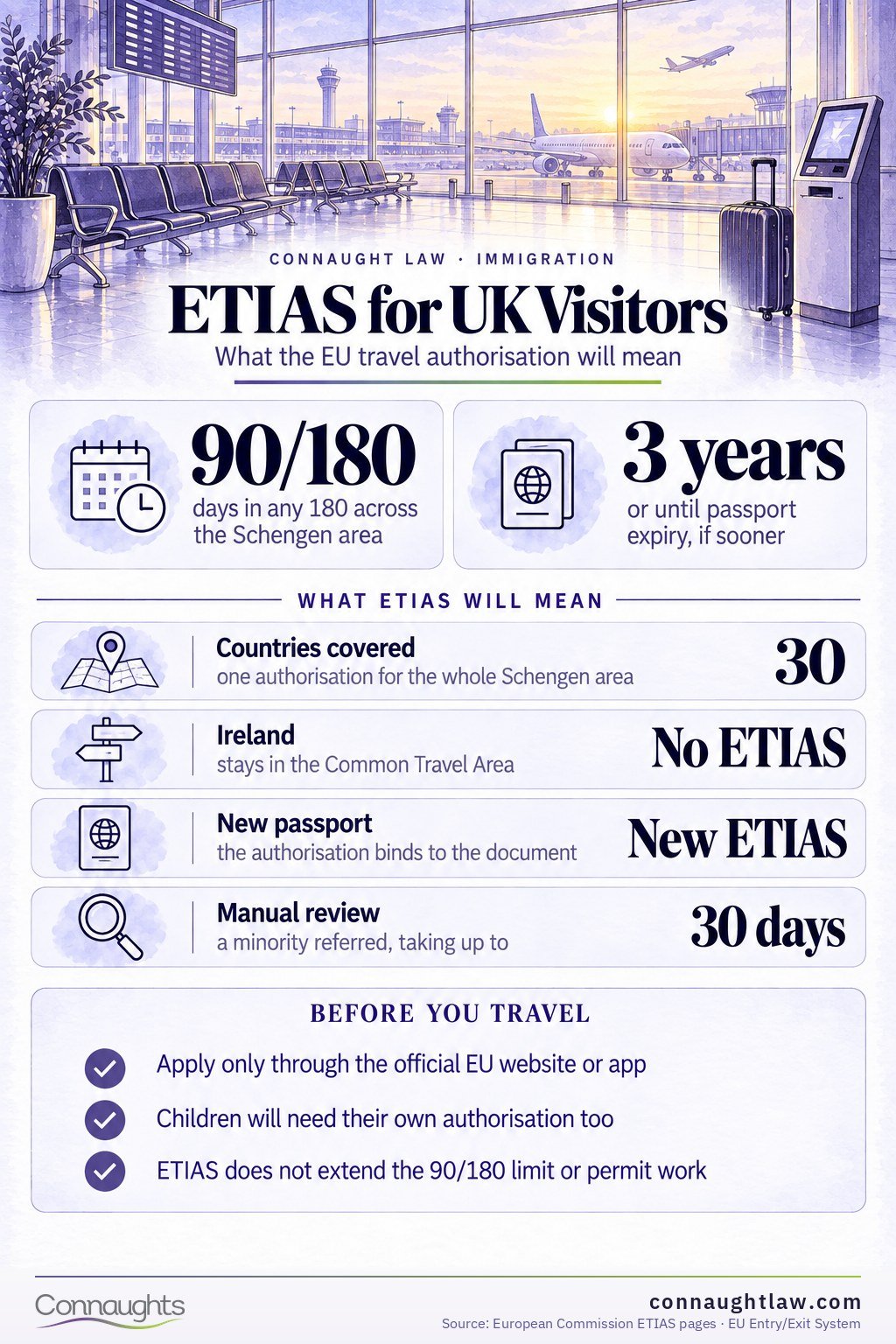
ETIAS will cover the 30 countries of the Schengen framework — the EU members minus Ireland, plus Iceland, Norway, Switzerland and Liechtenstein. One authorisation covers them all; the 90/180 clock runs across the whole area, not per country.
Where It Never Applies
Ireland remains in the Common Travel Area — no ETIAS, no EES, no passport requirement in principle for British citizens. Non-Schengen European states such as Albania or Serbia keep their own entry rules, and UK travel document holders — as opposed to passport holders — follow a different regime entirely, covered in our travel documents guide.
How Applying Will Work
The Online System
Applications will run through the official EU site and app only — a ten-minute form against your passport, with decisions mostly in minutes and a small minority referred for manual review taking up to 30 days. The lookalike-website industry is already established: anything charging more than the official fee, or "pre-registering" you today, is a middleman at best.
Information Required
Passport details, background questions — criminal convictions, past deportations, travel to conflict zones — and contact and itinerary basics. Answer truthfully and mechanically; the questions mirror the databases the system checks, and inconsistency is what triggers manual review.
Fee and Validity
ETIAS is not yet live and cannot be applied for. The fee is set at €20, authorisations will last up to three years or until passport expiry, and the EU will give several months' public notice before launch. Meanwhile EES biometric border checks have been fully operational since 10 April 2026.
The €20 Fee
The fee was set at €20 — tripled from the original €7 by the EU citing inflation and alignment with comparable schemes, per the Commission's ETIAS pages — payable once per authorisation, with under-18s and over-70s exempt from payment.
Validity and Multiple Entries
An authorisation is designed to last up to three years or until the passport expires, covering unlimited trips within the standing 90/180 limits. A new passport means a new ETIAS — the authorisation binds to the document, not the person.
EES vs ETIAS
The Border System Already Running
The Entry/Exit System began progressive operation on 12 October 2025 and became fully operational on 10 April 2026: passport stamps replaced by biometric registration — fingerprints and facial image — with entries and exits logged centrally. UK travellers have been living with the queues and kiosks for months; that part is no longer a future event.
How the Two Systems Mesh
The Division of Labour
EES records what happens at the border; ETIAS screens before travel begins. Once both run, the 90/180 rule becomes automatically enforced — the overstay that once depended on a border guard reading stamps is now arithmetic in a database, with ETIAS validity checked at boarding and EES doing the counting.
Business Travel
Corporate Travel Management
For employers, ETIAS is a compliance line item in the making: passport expiry now interacts with authorisation validity, refused authorisations need lead time to resolve, and the 90/180 ledger across a travelling team needs tracking that expense systems don't do. Building the process before launch beats improvising it after.
Frequent Travellers
The 90/180 ceiling — not ETIAS — is the binding constraint for consultants and cross-border commuters, and no authorisation extends it. Work beyond visitor activities has always needed national permits; ETIAS changes none of that, and travellers whose patterns strain the limits should plan status properly with our immigration team.
Exemptions
Diplomatic and Official Travel
Diplomatic and official passport holders follow their own instruments, and UK-EU arrangements for official travel sit outside ETIAS's consumer machinery.
Medical and Emergency Travel
No emergency exemption is planned — an authorisation will be required however urgent the trip, which is the practical argument for applying the day the system opens rather than the week before travel. Families with EU-resident relatives should also note the separate rules for family members of EU citizens, where our family team advises.
Planning
Timing When It Launches
The EU has committed to announcing the start date several months ahead, and has signalled transitional arrangements for the opening period rather than a hard cliff. The preparation that pays now: passports with generous validity, clean awareness of the 90/180 position, and a healthy scepticism of every non-official ETIAS website until the real one opens.
Family Travel
Every traveller will need an authorisation, children included — fee-exempt but not application-exempt. Family bookings should check each passport's expiry against the trip, because one short-dated child's passport is the classic last-minute failure.
Frequently askedQuestions about ETIAS
When does ETIAS start for UK citizens?
No confirmed date — the EU withdrew its late-2026 target and will announce the launch several months in advance. Until then, UK citizens travel to the Schengen area as now, with EES biometric checks at the border.
How much will ETIAS cost?
€20 per authorisation, raised from the originally legislated €7. Applicants under 18 or over 70 are exempt from the fee but still need the authorisation itself.
Is ETIAS a visa?
No — it is a travel authorisation for visa-free travellers, checked at boarding like the UK's ETA. It does not change the 90-days-in-180 limit, permit work, or guarantee entry; border officers keep the final decision.
How long will an ETIAS last?
Up to three years or until your passport expires, whichever comes first, covering unlimited short stays within the 90/180 rule. A renewed passport requires a fresh authorisation.
What is the difference between EES and ETIAS?
EES is the biometric border log — live since October 2025, fully operational since 10 April 2026. ETIAS is the pre-travel screening layer, still unlaunched. Together they replace stamps with automated enforcement of the stay limits.
Can I apply for ETIAS now to be ready?
No — no application exists yet, and any site taking your money today is a reseller or worse. When the system opens, use only the official EU website or app, and expect approval in minutes for most travellers.
Overstay worries, refused entries, work beyond the visitor line — the 90/180 world has sharp edges. Tell us your pattern and we'll map the lawful route.
Get Expert Advice