Is Divorce Right For You UK 2026: Complete Decision Guide

Is divorce right for you is a question the law cannot answer - but it can tell you exactly what each path involves, what it costs, and what it protects. Since no-fault divorce arrived in April 2022 the process itself is administrative: no blame, no contest, a £628 fee from 13 July 2026 and around seven months minimum. The real decision is about the marriage, the finances and the children. This guide works through the assessment honestly: the alternatives short of divorce, the financial realities, the evidence on children’s wellbeing, and how to tell a rough patch from a marriage that has genuinely ended.

Is Divorce Right for You? An Honest Framework

Solicitors see two costly mistakes in opposite directions: divorcing in anger during a crisis that counselling might have resolved, and staying a decade too long in a marriage that had already ended - accumulating financial entanglement, resentment and lost years. A structured decision protects against both.

The framework below deliberately separates four questions that usually arrive tangled together: is the relationship viable, what would separation cost, what do the children need, and am I ready to run this process? Answering them one at a time is the single most useful thing you can do before contacting anyone.

It also helps to know the scale of normality here: divorce touches roughly two in five UK marriages, and family lawyers meet people at this decision point every week. Nothing about asking the question marks your marriage as failed - and nothing about consulting a solicitor starts a divorce. Information-gathering is neutral.

Beware, too, of outsourcing the decision. Friends and family bring their own marriages into the advice; online forums reward dramatic narratives; and a new relationship makes every assessment unreliable. The useful outside voices are neutral professionals - counsellors for the relationship, solicitors for the consequences - who have no stake in either answer.

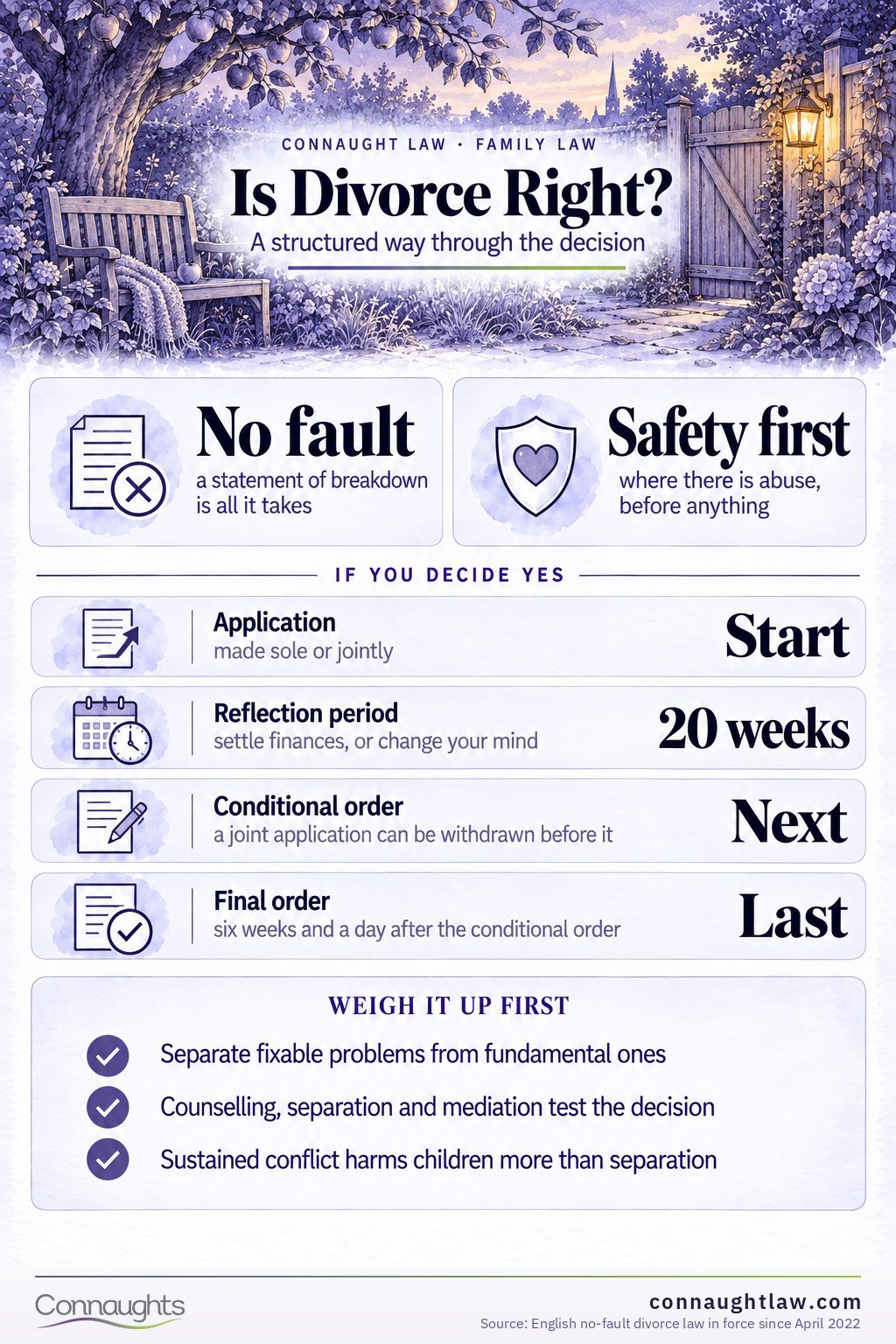
Is Divorce Right For You Infographic — The Practical, Financial And Emotional Questions To Weigh, And Alternatives Such As Counselling And Mediation, Before Starting A Divorce

Assessing Your Relationship Problems and Marriage Viability

Relationship research consistently distinguishes solvable conflict - money stress, division of labour, in-laws, parenting styles - from the corrosive patterns that predict separation: contempt, stonewalling, sustained emotional withdrawal, and problems neither partner any longer wants to fix. Frequency of argument matters less than whether repair still happens afterwards.

Timing distorts judgment. Bereavement, redundancy, new babies and health crises all mimic marital breakdown; decisions taken mid-crisis often read differently a year later. The practical test many counsellors use: is this marriage bad, or is this season bad - and has the marriage been bad in good seasons too?

Write the audit down privately: what the recurring problems are, how long each has run, what has been tried, what changed and what did not. Patterns visible on paper are harder to argue with in either direction - and if you later mediate or take advice, that private clarity shortens everything.

When the Answer Is Clearly Yes

Some situations end the analysis. Domestic abuse - physical, coercive, financial - is not a relationship problem to work on but a safety issue to leave, with protective orders and specialist support available immediately. Active addiction without treatment, and repeated infidelity without change, sit close behind. Ambivalence is for viable marriages; danger is not ambiguous.

If any of this describes your situation, support exists today: the National Domestic Abuse Helpline run by Refuge operates around the clock, non-molestation and occupation orders can be obtained urgently, and legal aid remains available for protective proceedings with evidence of abuse. The divorce question can wait until you are safe.

Exploring Alternatives to Divorce Before Deciding

Couples counselling has meaningful success rates when both partners engage - and diagnostic value even when it fails, because it converts “maybe” into an informed answer. Discernment counselling, designed specifically for couples where one leans out and one leans in, is a shorter, decision-focused variant worth knowing about.

Trial separation tests life apart without legal finality: agree its length, finances, living arrangements and what you are testing before you start, or it becomes drift. A separation agreement can document the interim deal; properly executed, it is enforceable and often becomes the blueprint for any later consent order.

Set review points inside a trial separation - at six weeks and at its end - to ask the only questions that matter: is life apart better or worse, for whom, and what would returning require to be different? Separations without review points quietly become permanent by inertia rather than decision, which serves nobody.

Judicial separation offers formal separation without ending the marriage - relevant for religious objections or preserving pension survivor benefits - though it is rarely used. What alternatives cannot do is protect you financially forever: claims and entanglements continue while the marriage does, which is why open-ended limbo is usually the worst of the options.

One structural note on alternatives: doing nothing is also a financial decision. While the marriage continues, your finances remain legally intertwined - new assets, inheritances and pension growth all accrue into the matrimonial picture, and a spouse’s debts and conduct can still reach shared property. Choosing the marriage should be a choice, made with the same information as choosing divorce.

Understanding the Financial Implications

Divorce splits one household’s resources across two. Expect the process to address the home (transfer, sale or deferred sale), pensions (sharing or offsetting - often the largest asset after the house), income (child maintenance by formula, spousal maintenance by needs), and a clean-break division of everything else. Our guide to who gets the house in a divorce covers the biggest single question.

Costs scale with conflict, not paperwork. The court fee is £628 from 13 July 2026; a consent order costs £62 to lodge; fixed-fee legal packages handle cooperative divorces affordably. Contested financial proceedings are where five-figure bills live - which is why mediation, supported by the £500 voucher for cases involving children, earns its place in almost every plan.

The Financial Questions to Answer Before Deciding

Can two households be funded on current incomes? What is the realistic housing outcome for each of you? What does the pension picture look like after sharing? Anyone weighing divorce should see these numbers - roughly, honestly - before deciding, because “I cannot afford to divorce” and “I cannot afford this marriage” are both sometimes true, and only the numbers say which.

Gather documents before any consultation: recent payslips or accounts, mortgage statement, an online valuation of the home, pension statements for both of you, and a rough monthly budget. An hour of preparation converts a general chat into specific advice - and reveals immediately whether your fears about affordability are real or inflated.

Two financial timing points deserve early advice whichever way you lean. Separating triggers capital gains tax windows for transferring assets tax-neutrally, so the settlement calendar has tax consequences. And where one spouse might remarry, financial claims must be made - or dismissed by consent order - before that wedding, or they can be lost entirely.

Prioritising Children’s Wellbeing in the Decision

The research consensus is more nuanced than either guilt or reassurance suggests: children are harmed most by sustained parental conflict, whether the marriage continues or not. High-conflict marriages that end often improve children’s outcomes; low-conflict marriages that end quietly can genuinely puzzle and destabilise children. The variable to manage is conflict, not marital status.

What protects children through separation is well established: warm, consistent parenting from both parents; financial stability; minimal exposure to disputes; and never being made messengers, confidants or prizes. A workable parenting plan and settled living arrangements do more for children than any particular division of assets.

Age changes what children need from the process, not whether they cope: younger children need routine and reassurance that both parents remain theirs; teenagers need honesty proportionate to their understanding and a voice in arrangements without responsibility for them. What no age group needs is discovering adult grievances - in person or through overheard calls.

Telling Children: Once the Decision Is Made

Children do best told together, by both parents, with a simple consistent account that assigns no blame and answers their real questions: where will I live, will I still see both of you, is this my fault (no), and what changes tomorrow. Rehearse it. The first conversation shapes how safe the whole process feels to them.

Practical stability speaks louder than any script afterwards: schools informed quietly so teachers can watch and support, routines protected through the transition, and both parents visible at the fixtures of childhood - matches, plays, parents’ evenings - even when being in the same room is hard. Children measure the divorce by what stays the same.

Understanding the No-Fault Divorce Process

If the answer is yes, the process is deliberately unfrightening: an online application - sole or joint - stating irretrievable breakdown, a 20-week reflection period, a conditional order, and a final order six weeks and a day later. Your spouse cannot contest it, and no reasons are given or examined. The full detail sits in our no-fault divorce guide.

The divorce decides nothing about money or children by itself. The financial consent order - approved after the conditional order - is what makes any settlement binding, and sequencing the final order after it protects pensions and home rights. Treat the divorce as the frame; the settlement is the picture.

Timescales deserve honesty in the decision too: allow roughly seven months minimum for the divorce and closer to a year with finances done properly, longer if contested. People deciding in January are usually rebuilding by Christmas; people expecting it finished by Easter are setting themselves up for frustration.

Reflection Built In: The 20-week period exists precisely for people asking this page’s question. Applying does not commit you to finishing: applications can be paused or withdrawn, and some couples use the period for a last, structured attempt at counselling while the practical groundwork proceeds.

Assessing Your Emotional Readiness

Readiness shows as sad clarity rather than hot anger: the decision survives good days, is about your own life rather than punishing your spouse, and persists once the practical picture is understood. Decisions announced during arguments, or driven by a third party’s timetable, tend not to be decisions at all.

Support matters through the process even for the person who chose it - grief over a marriage is normal and does not mean the choice was wrong. Counselling support alongside the legal process, through services such as Relate or private therapy, consistently makes the legal side cheaper and calmer, because emotional business stops being litigated.

Watch for pseudo-readiness: using divorce threats as a conflict tactic, timing the announcement to punish, or needing your spouse to agree the marriage failed before you allow yourself to leave. Each signals unfinished emotional work that will otherwise be done - expensively - through the legal process.

Finally, take advice early even if you are unsure - especially if you are unsure. A single consultation mapping your specific finances, timescales and options converts the decision from abstract dread into informed choice, and commits you to nothing.

However long you sit with the question, let it be a question you are actually working on - through counselling, through numbers, through advice - rather than background noise for another five years. Both staying well and leaving well are achievable; staying badly is the only outcome with no defenders.

Frequently Asked Questions

How do I know if divorce is the right decision?

Look for settled clarity rather than crisis-driven anger: the problems are longstanding rather than seasonal, repair no longer happens, professional help has been tried or refused, and the decision survives calm reflection and a realistic look at the finances. Abuse changes the analysis - safety comes first.

Should we try counselling before divorcing?

Usually yes, if both partners are safe and willing. Counselling either improves the marriage or clarifies honestly that it has ended - both outcomes beat years of ambivalence. Discernment counselling suits couples where one partner is already leaning out.

Is a trial separation a good idea before divorce?

It can be, with structure: agree duration, money, living and children arrangements in advance, ideally in a separation agreement. Unstructured separations drift. Remember that financial claims and entanglements continue until a court order ends them.

How much does a divorce cost in the UK in 2026?

The court fee is £628 from 13 July 2026, plus £62 to lodge a financial consent order. Cooperative divorces with fixed-fee legal help stay affordable; contested financial proceedings are what generate large bills. Mediation, with the £500 children-cases voucher, keeps most couples out of that territory.

Is it better to stay together for the children?

The evidence says children are damaged primarily by ongoing parental conflict, not by separation itself. A low-conflict separation with cooperative parenting typically serves children better than a high-conflict marriage. The goal, whichever way you decide, is reducing the conflict children experience.

Can I start a divorce and change my mind?

Yes. The 20-week reflection period exists for exactly this, and applications can be paused or withdrawn before the final order. Starting is not finishing - though anything already agreed or ordered financially should be reviewed if you reconcile.

Does it matter who applies for the divorce?

Legally very little under no-fault rules - there is no advantage in being applicant, no blame to allocate, and costs orders are rare. Joint applications set a cooperative tone. What matters strategically is the financial sequence, not who clicks first.

What should I do before telling my spouse I want a divorce?

Quietly assemble the picture: financial documents, an idea of housing options, initial legal advice, and - where there is any safety risk - a safety plan and specialist support. Deciding how and when to have the conversation is part of managing the process, not deception.

Expert Legal Support
Decision-Stage Advice

A clear map of your options, numbers and timescales - before you commit to anything.

Alternatives Respected

Separation agreements and judicial separation handled as seriously as divorce.

Children-First Planning

Arrangements and settlements built around stability for your children.

If you are weighing this decision, a confidential consultation with the family law team at Connaught Law will give you the full picture without any pressure to proceed.

Contact Our Family Team

Disclaimer:

The information in this blog is for general information purposes only and does not purport to be comprehensive or to provide legal advice. Whilst every effort is made to ensure the information and law is current as of the date of publication it should be stressed that, due to the passage of time, this does not necessarily reflect the present legal position. Connaught Law and authors accept no responsibility for loss that may arise from accessing or reliance on information contained in this blog. For formal advice on the current law please don't hesitate to contact Connaught Law. Legal advice is only provided pursuant to a written agreement, identified as such, and signed by the client and by or on behalf of Connaught Law.