
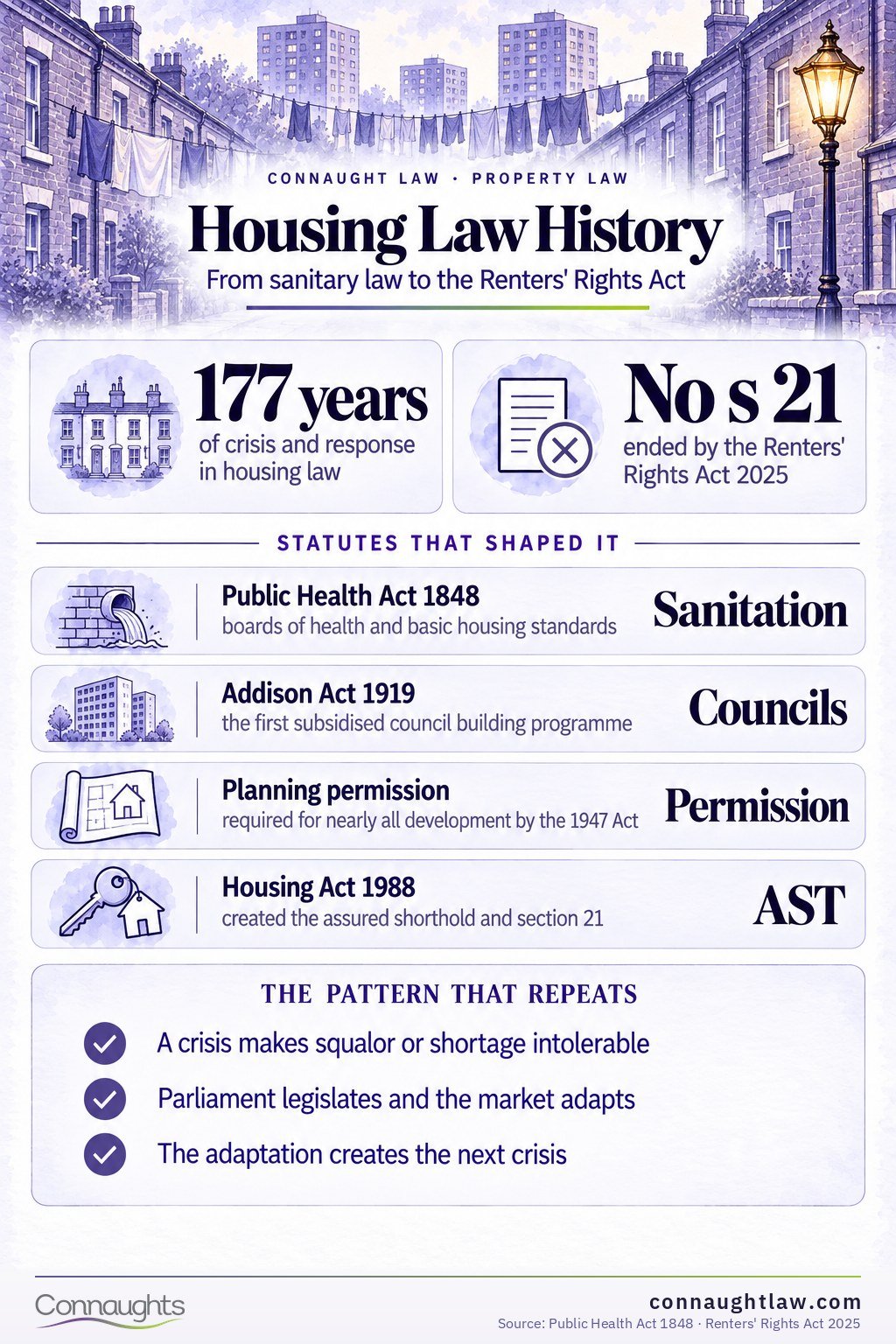
British housing law is 177 years of crisis and response: cholera built the first housing statutes, war built the council estates, inflation built Right to Buy, and Grenfell built the Building Safety Act. This timeline traces the whole arc from the Public Health Act 1848 to the Renters' Rights Act 2025 — the Acts, the numbers and the turning points — and shows why every "unprecedented" reform of the present has an ancestor.
On This Page

UK Housing History: The Pattern Behind 177 Years of Law
Read in one sitting, the timeline has a rhythm: a crisis makes squalor or shortage politically intolerable, Parliament legislates, the market adapts, and the adaptation creates the next crisis. From the 1848 Public Health Act, which confronted Victorian slum conditions, to the property law changes of 2025–26, the pattern has held through every government of every colour — and it is the single best predictor of where housing law goes next.
Every era's "permanent settlement" lasted about a generation: Victorian sanitary law, interwar subsidies, post-war planning, Right to Buy, buy-to-let deregulation. Each solved its predecessor's crisis and incubated its own. The current wave — building safety, leasehold reform, the Renters' Rights Act — is the response to the last settlement's failures, and on the historical clock it arrived on schedule.
Victorian Foundations: Sanitation Before Shelter (1848–1914)
Britain urbanised faster than it could house anyone: urban populations grew from around 2 million in 1800 to over 20 million by 1900, roughly 90% of housing was privately rented, and industrial workers packed into back-to-back terraces at densities reaching 250 houses per hectare. Cholera, not compassion, forced the state's hand — the 1848 Public Health Act was sanitary legislation that became, in retrospect, the first housing statute.
The Victorian sequence built the machinery still in use: inspection, standards, demolition powers, and finally direct provision. The 1890 Housing of the Working Classes Act — empowering councils to build homes for the first time — is the legal ancestor of every council estate in Britain.
Key Victorian Housing Milestones
| Year | Legislation | What It Did | What It Became |
|---|---|---|---|
| 1848 | Public Health Act | Boards of health, sanitary inspectors, basic housing standards | The foundation of housing regulation and public health protection |
| 1875 | Artisans' and Labourers' Dwellings Improvement Act | Let local authorities purchase and demolish slum areas | The principle of public intervention in housing |
| 1878 | Model Bye-Laws | Standardised building control nationwide | Uniform building standards and development control |
| 1890 | Housing of the Working Classes Act | Empowered councils to build housing directly | The precedent for every council building programme |
Homes for Heroes: The State Becomes a Landlord (1919–1945)
The First World War ended with a promise — homes fit for heroes — and the 1919 Housing and Town Planning Act (the Addison Act) turned it into the first subsidised council building programme, making housing a central government responsibility for the first time. The Wheatley Act of 1924 extended the subsidies, the 1930 Housing Act aimed them at slum clearance, and the 1935 Act introduced overcrowding standards.
The numbers were the point: roughly 500,000 council homes by 1933, nearly 500,000 private homes in the 1920s alone, and homeownership climbing from about 10% in 1914 to 25% by 1939 — the first great tenure shift, driven by building societies and suburban semis. The National House-Building Registration Council, founded in 1936, added the warranty layer buyers still rely on as the NHBC.
What the Interwar Programme Built
- 1919 Addison Act: council housing subsidised by central government — the founding bargain
- 1924 Wheatley Act: subsidies extended, output scaled
- 1930 Housing Act: slum clearance becomes the target
- 1935 Housing Act: overcrowding standards written into law
- 1936 NHBC: the new-build warranty system begins
Welfare State Building: The Biggest Programme in British History (1946–1979)
Post-war reconstruction produced housing output never matched since. The 1950s averaged over 300,000 completions a year, including more than 150,000 prefabs; the 1960s exceeded 400,000 annually, peaking at 425,830 homes in 1968 (MHCLG live tables on house building, table 244) — the highest figure in UK history; the 1970s still ran at 250,000–300,000 while the 1974 Housing Act built out the housing association sector. The 1946 New Towns Act planted Stevenage, Harlow and eventually Milton Keynes as complete planned communities.
The era's tower-block experiment carries the cautionary half of the lesson: high-rise renewal solved density arithmetic and created social isolation, maintenance failure and, at Ronan Point, structural catastrophe. The buildings came down; the pattern — a confident solution incubating the next problem — did not.
The 1947 Act: Planning Permission Is Born
The Town and Country Planning Act 1947 remains the foundation stone of British planning law: it nationalised development rights, required permission for virtually all development, and established green belts — the principle that land development serves public as well as private interests. Every planning argument in Britain today, from extensions to new towns, is conducted inside the framework that Act built. The 1965 Building Regulations completed the structure, replacing local bye-law patchwork with unified national technical standards.
Housing Output by Decade
| Decade | Annual Output | Policy Focus | Landmarks |
|---|---|---|---|
| 1950s | 300,000+ homes a year | Reconstruction and prefabs | 150,000+ prefab homes; new towns launched |
| 1960s | 400,000+ a year — peak 425,830 in 1968 | High-rise renewal and slum clearance | Highest output in UK history; tower block boom |
| 1970s | 250,000–300,000 a year | Housing associations and ownership growth | Housing Act 1974 creates the association sector |
Right to Buy: The Great Tenure Reversal (1980–1997)
The Housing Act 1980 gave council tenants the right to buy their homes at discounts that reached 50–70%, and over 1.5 million homes had been sold by 1995 — the largest transfer of public assets to private hands in British history, carrying homeownership to roughly 68% by 1997. The same era deregulated the other side of the market: the Housing Act 1988 created the assured shorthold tenancy and the section 21 notice, and the 1996 Act made the AST the default — the legal architecture of the modern private rented sector, which lasted until 1 May 2026.
- 1.5 million homes sold by 1995 at discounts of up to 50–70%
- Homeownership up from ~55% to ~68% between 1980 and 1997
- Social stock not replaced: the sold homes were never rebuilt — the arithmetic behind today's waiting lists
- 1988: the AST and section 21 — the framework the Renters' Rights Act has just retired
Boom, Crash and the Lesson of 1989
Deregulated credit — including the 1986 Building Societies Act that let mutuals become banks — fuelled the 1980s boom, and 15% interest rates ended it: prices fell around 20% between 1989 and 1993, introducing Britain to negative equity. It was the dress rehearsal for 2008, watched and then forgotten in a decade.
The Long Boom and the 2008 Crash (1997–2010)
A decade of cheap credit and rising prices ended in the global financial crisis, and the housing numbers tell it plainly: average prices fell from £190,032 in September 2007 to £154,452 by March 2009; monthly transactions collapsed from over 120,000 to 42,000; first-time buyer lending dropped from £14.4 billion to £4.2 billion in two years. Prices did not recover their 2007 peak until August 2014.
Measuring the Crash
After the 2008 Crash
| Measure | Pre-Crisis Peak | Crisis Low | Recovery |
|---|---|---|---|
| Average house price | £190,032 (Sep 2007) | £154,452 (Mar 2009) | Peak regained August 2014 |
| Monthly transactions | 120,000+ (2006–07) | 42,000 (Jan 2008) | Gradual, 2010–2014 |
| Construction investment | £24.9bn (Sep 2008) | £18.1bn (Sep 2009) | Slow through the 2010s |
| Mortgage approvals | 130,000+ monthly (2006) | 25,000 monthly (2008) | Partial by 2015 |
Austerity and Intervention (2010–2020)
The 2010s ran two policies at once: fiscal retreat and market stimulus. The bedroom tax (2012) and Right to Buy's extension to housing associations (2016) shrank the social side, while Help to Buy (2013) pushed first-time buyer lending to a record £21.7 billion. The private rented sector grew from 14% of households in 2008 to over 19% by 2018 — and its growth generated the regulatory turn that followed.
The Regulatory Turn on Renting
The decade's second half aimed squarely at landlords: the 3% stamp duty surcharge on additional homes (2016), the Homes (Fitness for Human Habitation) Act 2018, and the Tenant Fees Act 2019 banning most letting fees and capping deposits at five weeks. Each was a step toward the comprehensive rewrite that arrived with the Renters' Rights Act — the pattern of incremental correction ending in structural reform, exactly as it ran from 1875 to 1890.
Into the 2020s: Safety, Leasehold and the End of Section 21
The current reform wave has three drivers — Grenfell, the leasehold scandal, and the insecurity of the post-1988 rental settlement — and each has now produced its statute. The Building Safety Act 2022 rebuilt safety regulation and extended liability three decades back, as the Supreme Court confirmed in URS v BDW. The ground rent ban (2022) and the Leasehold and Freehold Reform Act 2024 began dismantling leasehold economics. And the Renters' Rights Act 2025 ended section 21 and the assured shorthold tenancy from 1 May 2026.
The Decade's Statutes, Status-Checked
Pandemic-Era Legislation
| Year | Legislation | Key Provisions | Status in Mid-2026 |
|---|---|---|---|
| 2022 | Leasehold Reform (Ground Rent) Act | Banned ground rents on new residential leases | Fully implemented, with exemptions |
| 2022 | Building Safety Act | Safety regulation and accountability framework; 30-year retrospective liability | Phased implementation ongoing; upheld in URS v BDW |
| 2024 | Leasehold and Freehold Reform Act | Two-year ownership rule abolished; valuation reforms enacted | Two-year rule in force since 31 January 2025; valuation reforms await commencement |
| 2025 | Renters' Rights Act | Abolished section 21; all tenancies periodic; new possession grounds | Royal Assent 27 October 2025; central reforms in force since 1 May 2026 |
Where We Stand: The Next Chapter Is Already Visible
The unresolved pressures are the familiar ones wearing new clothes: output far below the post-war benchmark, an affordability gap the 1960s would not recognise, and a decarbonisation programme — minimum EPC standards for rentals (E since 2020) set to tighten under current proposals, with the Future Homes Standard to raise new-build requirements — that amounts to a rebuilding obligation spread over decades. Digital transformation of conveyancing and the register accelerated through the pandemic years and continues. If the 177-year pattern holds, the next settlement will be built from these pressures — and it will look inevitable in retrospect, as they all do.
Frequently askedQuestions about British housing history
What are the most important milestones in UK housing history?
Five carry most of the weight: the Public Health Act 1848, the Addison Act 1919, the Town and Country Planning Act 1947, Right to Buy in 1980, and the 2020s trilogy of building safety, leasehold reform and the Renters' Rights Act. Each redefined who housing law was for.
How did Britain go from 90% renting to majority homeownership?
In three pushes: interwar building societies and suburban semis took ownership from 10% to 25% by 1939; post-war prosperity and mortgage growth continued the climb; and Right to Buy carried it to roughly 68% by 1997. The 2000s affordability squeeze then reversed the trend for a generation of renters.
What caused the major UK property crashes?
The same combination twice: credit expansion meeting an interest rate or banking shock. In 1989–93, 15% rates ended the deregulation boom with a ~20% fall and negative equity; in 2007–09, the banking collapse cut prices ~20%, transactions by two-thirds, and took until 2014 to regain the peak.
What did Right to Buy actually change?
Over 1.5 million council homes moved into private hands by 1995 at discounts up to 50–70%, lifting ownership from about 55% to 68% — while the sold stock was never replaced. Both halves of that sentence shape today's market: broader ownership, and the social housing shortage behind modern waiting lists.
Why was the post-war period the peak of housebuilding?
Because the state built at scale alongside the market: new towns, prefabs, council programmes and private construction together produced over 400,000 homes a year through the 1960s, peaking at 425,830 in 1968 — a figure no decade since has approached with the state largely out of the building business.
How do the current reforms fit the historical pattern?
Precisely on schedule. Grenfell produced the Building Safety Act as cholera produced the 1848 Act; the leasehold scandal is being answered as slum landlordism was; and the Renters' Rights Act retires the 1988 settlement after its customary generation. Crisis, statute, adaptation — the cycle that has run since 1848.
Tell us the age of the building, the tenure and what documents you hold. A century of housing law may be baked into your title — we will tell you which era's rules still bite and what to do about them.
Get Expert Advice