
A UK asylum claim runs through screening, a substantive interview and a decision, with a right of appeal to the First-tier Tribunal if it is refused. Where appeal rights are exhausted, paragraph 353 further submissions are the remaining route — and since April 2026 they generally have to be made in person. The initial grant rate is 39%, and the numbers behind that figure are published quarterly.
On This Page
How a Claim Is Decided
Asylum is claimed in the UK, not from abroad, and the claim is decided under Part 11 of the Immigration Rules against the Refugee Convention. If refugee status is refused, the Home Office considers humanitarian protection on the same facts, and then whether removal would breach Article 8 or another Convention right.
The sequence matters because each stage closes doors behind it. A refusal carries a right of appeal to the First-tier Tribunal; an appeal that fails exhausts appeal rights; and once they are exhausted the only route back is further submissions under paragraph 353, which are harder to make than a first claim and are decided against a different test.
Two provisions cut the sequence short. A claim certified as clearly unfounded under section 94 carries no in-country appeal, and since 28 June 2022 section 94(3A) means a certified claim carries no appeal at all. A claim ruled inadmissible on safe third country grounds is not substantively considered in the UK in the first place.
The Process, Step by Step
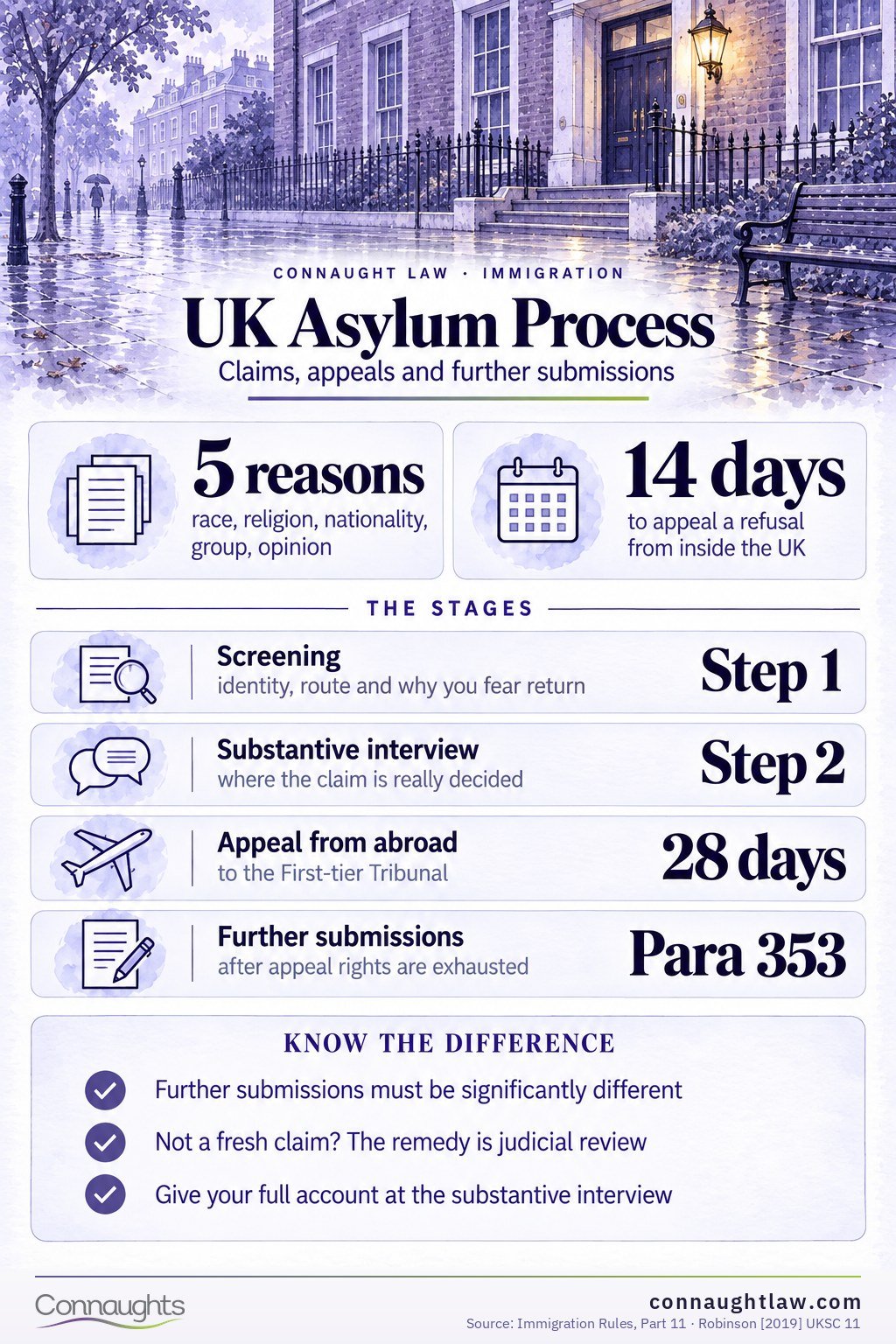
A claim is registered at the port of entry or, if you are already here, by contacting the asylum intake unit. Screening follows: identity, route of travel, and a short account of why you fear return. It is not the interview at which the claim is decided, but what is said at screening is put to you later if it differs from your substantive account.
The substantive interview is the claim. It is where the account has to be given in full, and where inconsistencies, omissions and dates are tested. Anyone who can arrange representation should do so before it rather than after a refusal — the interview record is the document the decision is written from, and it cannot be rewritten afterwards.
Before any of that, the Home Office may consider whether the claim is inadmissible because of a connection to a safe third country. An inadmissible claim is not refused on its merits; it is not considered at all, which is a different position with different remedies.
What You Have to Show
A well-founded fear of persecution for one of five Convention reasons — race, religion, nationality, membership of a particular social group, or political opinion — together with an inability or unwillingness to seek the protection of your own state, and no reasonable internal relocation alternative.
Where the Convention reason is absent but return would breach Article 2 or Article 3, humanitarian protection covers the gap: serious harm including the death penalty, torture or inhuman treatment, or a serious individual threat from indiscriminate violence in an armed conflict. It is decided on the same evidence, and a grant of humanitarian protection is not a lesser finding on credibility.
The standard of proof is lower than the civil standard — a reasonable degree of likelihood — but the burden sits with the claimant, and country evidence is where most claims are won or lost. Where status is later put at risk, our guide to refugee status revocation and appeals covers what can end it.
Appeals, Further Submissions and Fresh Claims
A refusal of a protection claim is a refusal of a human rights claim, so it carries a right of appeal to the First-tier Tribunal under section 82 of the Nationality, Immigration and Asylum Act 2002. The deadline is 14 days from the decision if you are in the UK and 28 days from departure or from receiving the decision if you are outside it, under rule 19 of the Tribunal Procedure Rules.
Appeals now carry fees. From 13 July 2026 the First-tier Tribunal charges £82 for a decision on the papers and £144 for a hearing, set by S.I. 2026/642 as amended by S.I. 2026/665. The fee is not a formality: 19% of First-tier Tribunal immigration and asylum disposals in the most recent quarter were struck out for non-payment, which is a larger cause of lost appeals than any substantive ground.
- They must be significantly different from the material already considered. Paragraph 353 asks whether the content had not already been considered and, taken with the previously considered material, creates a realistic prospect of success before an immigration judge.
- Since April 2026 they generally have to be made in person at a specified appointment, under the validity rules at paragraphs 353AA to 353AC. Submissions sent by post outside the exceptions can be rejected as invalid rather than refused.
- Rejection is not refusal. If the Home Office decides the submissions are not a fresh claim, there is no right of appeal — the Supreme Court settled that in Robinson in 2019 — and the challenge is judicial review.
- If they are accepted as a fresh claim and then refused, a fresh section 82 right of appeal arises, and the process starts again at the tribunal.
That distinction is the single most consequential thing on this page. A person told their further submissions are “not a fresh claim” has not been refused asylum again; they have been told there is nothing to appeal, and the clock that matters is the judicial review clock. Our guide to fresh claims works through the test, and our appeals team can tell you which of the two positions you are in.
Success Rates and How Long It Takes
The initial grant rate was 39% in the year ending March 2026, down from 49% the year before. The peak was 77% in the year ending September 2022, so the direction of travel over four years is unmistakable. These figures come from the Home Office’s immigration system statistics, published 21 May 2026.
Nationality matters more than any other single variable, and it moves. Sudan ran at 93% and Eritrea at 87% in the year ending March 2026. Syria fell to 9% from 98% a year earlier, after decisions were paused and then restarted following the fall of the Assad government. Bangladesh was 14%, Turkey 18% and India 1%. A grant rate is a description of a caseload, not a prediction about a case.
On appeal, 40% of asylum and protection appeals were allowed in January to March 2026, against 39% of all First-tier Tribunal immigration and asylum cases determined at a hearing or on the papers — Tribunal Statistics Quarterly, published 11 June 2026. The tribunal’s mean clearance time for asylum and protection appeals was 67 weeks, against 61 weeks across all its immigration work.
The Home Office does not publish a mean processing time for asylum decisions themselves, so any figure quoted for how long a decision takes is not coming from an official release. What is published is the queue, and it has fallen sharply.
The Current Numbers
Claims and Outcomes
| Measure | Latest | Comparison |
|---|---|---|
| People claiming asylum | 93,525 in the year ending March 2026 | 12% lower than the year before; the peak was 110,051 in the year ending September 2025 |
| Initial grant rate | 39% | 49% a year earlier; 77% at the peak in the year ending September 2022 |
| Awaiting an initial decision | 48,758 people, in 35,744 cases, at the end of March 2026 | 55% lower than a year earlier, and the lowest since September 2019 |
| Arrived by small boat | 42% of asylum seekers, 38,980 people | 52% arrived by illegal entry routes overall |
| Asylum and protection appeals allowed | 40% in January to March 2026 | Mean clearance time 67 weeks |
The backlog figure is the one most often quoted out of date. It has more than halved in a year, and a page still describing six-figure queues is describing 2024.
What Changed in 2026
Two changes are in force and one is not. From 2 March 2026, Statement of Changes HC 1691 cut the initial grant of protection permission from five years to 30 months for claims — and further submissions — made on or after that date. Five years is preserved for unaccompanied children and for claims made before 2 March 2026. A shorter grant means an earlier review and a longer road to settlement.
From 13 July 2026, tribunal fees apply as set out above. And since April 2026 further submissions must generally be made in person, which is the change most likely to catch someone who last dealt with the Home Office by post.
What is not in force is the Immigration and Asylum Bill. Introduced on 30 June 2026 and at committee stage in the Commons at the time of writing, it would replace refugee status and humanitarian protection with a single “protection status” and rewrite the Article 8 framework. It is a Bill. It is not law, it has not received Royal Assent, and no claim is decided under it.
One thing that has not changed is worth stating because the assumption persists: asylum support ends after a positive decision, and current policy calculates the end date at 42 days from the grant letter rather than the 28 days in the regulations. That gap is where a great many newly recognised refugees become homeless, and it is worth planning for from the day the decision arrives.
Frequently askedQuestions about the UK asylum process
What is the UK asylum success rate?
39% of initial decisions granted protection in the year ending March 2026, down from 49% the year before. On appeal, 40% of asylum and protection appeals were allowed in January to March 2026.
How long does a decision take?
The Home Office publishes no mean processing time. What it publishes is the queue: 48,758 people were awaiting an initial decision at the end of March 2026, 55% fewer than a year earlier. Tribunal appeals average 67 weeks.
What are further submissions?
New material put to the Home Office after appeal rights are exhausted, under paragraph 353. They must be significantly different from what was already considered and create a realistic prospect of success before an immigration judge.
Do I have to make further submissions in person?
Generally yes, since April 2026, at a specified appointment under the validity rules in paragraphs 353AA to 353AC. Submissions made outside those requirements can be rejected as invalid rather than refused.
Can I appeal if my further submissions are rejected?
Not if the Home Office decides they are not a fresh claim — Robinson [2019] UKSC 11 settled that, and the remedy is judicial review. If they are accepted as a fresh claim and then refused, a fresh right of appeal arises.
How long do I have to appeal a refusal?
14 days from the decision if you are in the UK, 28 days if you are outside it, under rule 19. A fee of £82 on the papers or £144 for a hearing applies from 13 July 2026, and unpaid appeals are struck out.
How long is protection status granted for?
30 months for claims and further submissions made on or after 2 March 2026. Five years still applies to unaccompanied children and to claims made before that date.
When does asylum support stop?
After a positive decision. The regulations prescribe 28 days, but current Home Office policy calculates the end date at 42 days from the grant letter. Plan for it from the day the decision arrives.
Tell us when your claim was refused, what has changed since and what you have been told about further submissions. We'll tell you whether it meets the paragraph 353 test and how it has to be made.
Get Expert Advice