
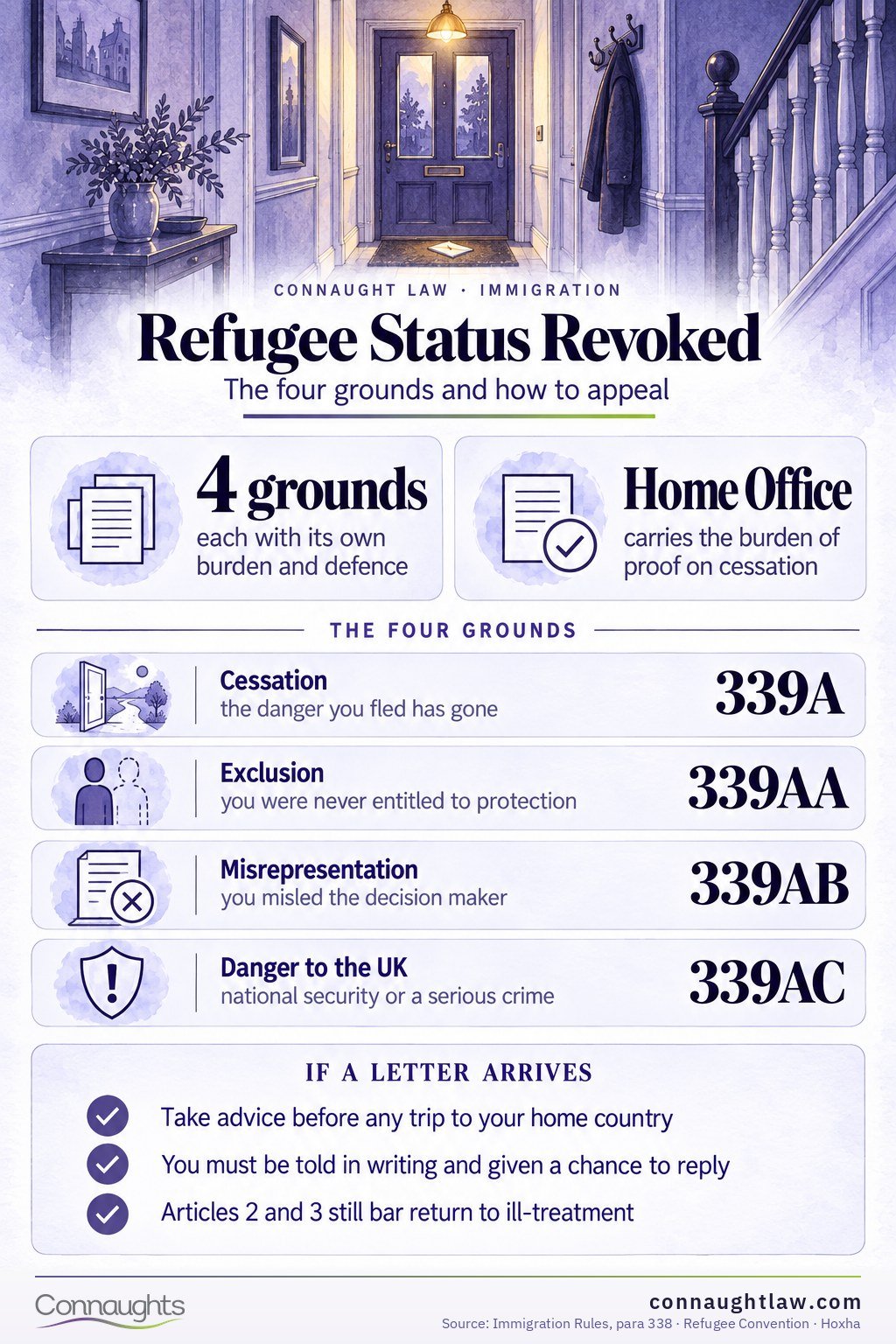
Refugee status is not permanent, and the Home Office does not need to prove you lied to take it away. It ends in four ways: the danger you fled has gone, you were never entitled to protection, you misled the decision-maker, or you are judged a danger to the UK. Each carries a different burden, a different defence, and a different answer to the question that matters most — whether you can still be removed.
On This Page

Protection That Can Be Taken Back
Yes. Paragraph 338 of the Immigration Rules says status must be revoked where any of four gateways applies: cessation, exclusion, misrepresentation, or danger to the UK. Revocation is a decision you can appeal to the Tribunal, and in most cases you appeal from inside the UK.
The Four Grounds
The architecture is simple once the labels are set aside. Part 11 of the Immigration Rules imposes a duty to revoke at paragraph 338, and four paragraphs supply the gateways. Paragraph 339A carries cessation — the six Article 1C grounds of the Refugee Convention. 339AA carries exclusion. 339AB carries misrepresentation. 339AC carries danger to the UK. Paragraph 338A has been deleted — citations to it are working from an old text.
Cessation is the common one and the least understood. It covers voluntary re-availment of your home country's protection, reacquiring a nationality you lost, gaining a new one, voluntarily re-establishing yourself in the country you fled, and the ground that decides most cases — that the circumstances which made you a refugee have ceased to exist.
- The change in the country must be significant and non-temporary — not an improvement that could reverse.
- The burden stays on the Home Office throughout. It is not for you to prove you are still at risk.
- Internal relocation can found cessation, but the Court of Appeal in MS (Somalia) applied a mirror-image test: the criteria for granting status govern its removal.
- A trip home is the single most common trigger — even a short one, even for a funeral.
Exclusion and Criminal Convictions
Two different mechanisms get confused here. Exclusion under 339AA says you never qualified — Article 1F war crimes, serious non-political crimes, acts contrary to the purposes of the United Nations. Danger under 339AC asks a present-tense question instead: are you a danger now, either to national security or, having been convicted of a particularly serious crime, to the community?
Section 72 of the Nationality, Immigration and Asylum Act 2002 defines "particularly serious crime". The figure is 12 months, not two years — it was cut by the Nationality and Borders Act 2022 and has applied since 28 June 2022. Since 2 February 2026 a further presumption applies to offences listed in Schedule 3 to the Sexual Offences Act 2003 regardless of the sentence length.
What D8 Settled
National-security revocations run through the Special Immigration Appeals Commission on closed material. In D8 v SSHD [2025] EWCA Civ 33 the Court of Appeal removed an argument that had looked promising: the Home Secretary does not have to weigh the danger against lesser protective measures, or treat revocation as a last resort, before acting under Article 33(2). SIAC had required that balancing and was held to have got it wrong.
The Supreme Court refused permission to appeal in June 2025, so D8 stands. One protection survives it untouched, and it is the one that matters most in practice: revoking status does not permit removal to a country where Articles 2 or 3 of the European Convention would be breached. D8 himself could not be returned to Iran.
How a Revocation Runs
The Stages
Paragraph 339BA is the procedural safeguard and it is worth knowing by name. Before revoking, the Home Office must tell you in writing that it is reconsidering your status and give you the chance to put your case — in writing, or at an interview. A revocation that skips this is vulnerable on process alone, before anyone argues the merits.
If status goes, paragraph 339B allows any limited or indefinite leave you hold to be curtailed or cancelled alongside it. That is a separate step and it does not follow automatically, which is why the two decisions should be read separately when the letter arrives.
Safe Return Reviews
The review point is where most cessation decisions begin. Historically refugees were granted five years' leave and reviewed at the settlement application. For claims lodged on or after 2 March 2026 the initial grant is 30 months, with five years retained only for unaccompanied children, and a safe return review runs at every further permission or settlement application against country conditions at the date it is considered.
A 30-month cycle means a refugee granted status today faces roughly twice as many country-conditions assessments before settlement as one granted in 2024. Keep evidence of continuing risk current rather than assembling it when a letter lands, and treat any travel to the region as a decision with consequences.
Appealing a Revocation
Revocation of protection status is an appealable decision in its own right under section 82(1)(c) of the 2002 Act. Where the decision is made while you are in the UK, the appeal is heard in-country. National-security cases go to SIAC with special advocates; everything else goes to the First-tier Tribunal.
Who Must Prove What
This is the most valuable point in the whole subject. On cessation the burden lies on the Home Office, and the standard is strict — the House of Lords in Hoxha set a restrictive approach to Article 1C that still governs. The Home Office must show the change of circumstances is fundamental and durable. It is a materially harder task than refusing a fresh claim, and revocation decisions are regularly built as though it were not.
- Current country evidence going to durability, not just present risk.
- The 339BA correspondence — what you were told, when, and what you were given the chance to answer.
- Where section 72 is engaged, the sentence and the danger assessment attacked separately.
- Articles 2 and 3 pleaded independently, since they survive even a lawful revocation.
Settlement and Citizenship
When Citizenship Ends It
Becoming British ends refugee status automatically, through cessation ground 339A(iii) — a new nationality whose protection you now enjoy. Paragraph 339BB switches off the 339BA safeguards in that situation, and in the case of someone who unequivocally renounces status. This is administrative rather than adverse, and it is the outcome the whole route is aimed at.
Getting there is harder than it was. Guidance in force since 10 February 2025 means an application that involves illegal entry is normally refused citizenship however long ago the entry occurred. We have not found a published carve-out for recognised refugees, and would not advise anyone to assume one exists; the honest position is that the point is unsettled and needs arguing on the individual facts.
What Has Actually Changed
The 2025 Act
The Border Security, Asylum and Immigration Act 2025 received Royal Assent on 2 December 2025, with most provisions in force from 5 January 2026. It repealed the Safety of Rwanda Act 2024 and substantial parts of the Illegal Migration Act 2023.
For revocation specifically its reach is narrow but sharp: section 51, in force 2 February 2026, is the amendment to section 72 described above. The Act did not rewrite the cessation and revocation paragraphs themselves — those changes have come through Rules statements and caseworker guidance instead, which is why the Rules are the text to check rather than the Act.
Family Reunion Is Closed
Refugee family reunion was suspended from 15:00 on 4 September 2025 and remains closed to new applications pending a review. Applications made before that cut-off continue under the old rules. New applicants are pushed to Appendix FM, which charges a fee and imposes a financial requirement that most recently recognised refugees cannot meet.
Shorter grants, more frequent safe return reviews and a closed reunion route land on the same households at once. A family separated in September 2025 now faces a sponsor whose own status is reviewed more often, and no protection route to bring them over. Our human rights and asylum team takes these as combined problems rather than separate ones.
Two related points sit outside this post. How a claim is decided in the first place is covered in our UK asylum process guide, and the document a refugee travels on — and where it is accepted — in our travel document guide. Both matter here, because a Home Office travel document used for the wrong journey is itself evidence of re-availment.
Frequently askedQuestions about revocation of refugee status
Can refugee status be revoked?
Yes. Paragraph 338 of the Immigration Rules requires revocation where cessation, exclusion, misrepresentation or danger to the UK applies. It is an appealable decision, normally heard in-country, and the Home Office carries the burden on cessation.
Does visiting my home country end my refugee status?
It can. Voluntarily re-availing yourself of your home country's protection is a cessation ground in its own right, and travel is the most common trigger. Take advice before booking, not afterwards — including for funerals and family emergencies.
What sentence puts refugee status at risk?
Twelve months or more brings you within the "particularly serious crime" presumption in section 72, cut from two years in June 2022. Since February 2026 certain sexual offences engage it regardless of sentence length.
Who has to prove the case?
On cessation, the Home Office. It must show the change in your country is fundamental and durable, to the strict standard set in Hoxha. Many revocation letters assume the burden runs the other way.
Can I be removed once status is revoked?
Not necessarily. Revocation and removal are separate questions, and Articles 2 and 3 of the European Convention continue to bar return to a country where you face death or ill-treatment — as they did in D8.
Does becoming British end my refugee status?
Yes, automatically, under cessation ground 339A(iii). The usual procedural safeguards are switched off by paragraph 339BB because nothing adverse is happening — you now hold the protection of a new nationality.
Send us the notice and the history of your grant. We'll tell you which ground is actually being run, where the burden sits, and what the appeal looks like.
Get Expert Advice