
The right to manage lets the leaseholders of a block take over its management through their own company, without buying the freehold and without proving the landlord at fault. Since 3 March 2025 it reaches buildings up to 50% commercial and no longer makes leaseholders pay the landlord’s costs, and two Supreme Court rulings have narrowed the procedural objections landlords can take. This guide follows a claim from first notice to handover.
On This Page
Right to Manage: Control Without Buying the Freehold
The right to manage sits in Chapter 1 of Part 2 of the Commonhold and Leasehold Reform Act 2002. Leaseholders form a company, serve two sets of statutory notices, and on the acquisition date that company steps into the landlord’s shoes for repairs, services, insurance and day-to-day management. No price is paid, no fault has to be shown, and the landlord’s room to resist is narrow.
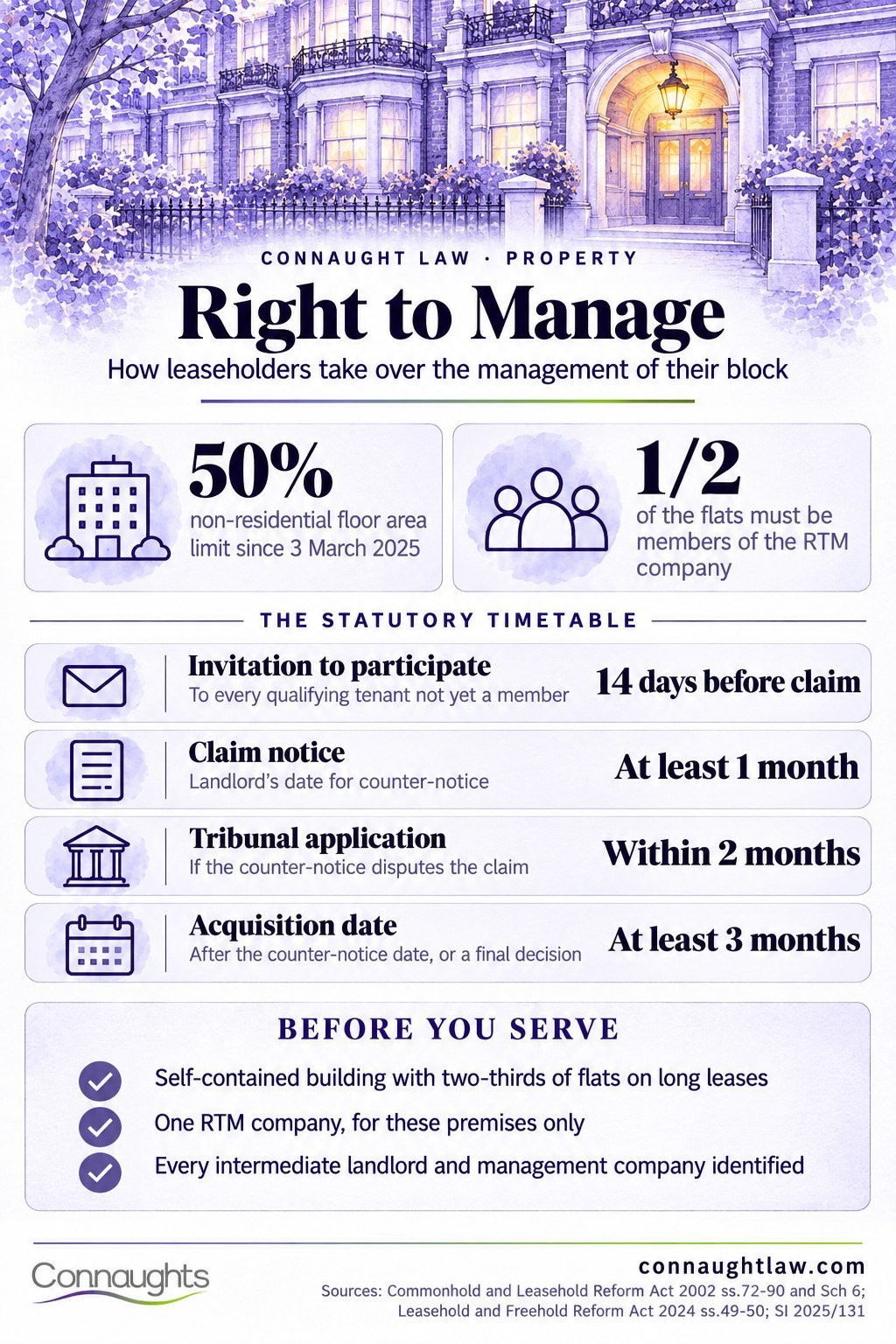
A leaseholder-owned company takes over the landlord’s management functions under the leases. You need a self-contained building with at least two flats, two-thirds of the flats on long leases, half the flats in the company, and no more than 50% non-residential floor space. Since 3 March 2025 a company that acts reasonably no longer pays the landlord’s costs.
RTM or Enfranchisement
What Transfers and What Stays
Management functions, defined in section 96 as functions “with respect to services, repairs, maintenance, improvements, insurance and management”, pass to the RTM company. So do most landlord approvals under the leases, with the company giving the landlord 30 days’ notice before consenting to an assignment, underletting or structural alteration. Re-entry and forfeiture stay with the landlord, as do the freehold, the reversion and the ground rent. Owning the building is a different right, covered in our collective enfranchisement guide.
Right to Manage and Collective Enfranchisement Compared
| Point | Right to manage | Collective enfranchisement |
|---|---|---|
| What you get | Management functions only | The freehold itself |
| Price | None | Premium, fixed by tribunal if disputed |
| Participation needed | Half the flats as members | Half the flats as participants |
| Non-residential limit | 50% (since 3 March 2025) | 25% under the rules in force |
| Landlord’s costs | Generally not payable | Reasonable costs still payable |
Who and What Qualifies
The Building and the Leaseholders
Section 72 requires a self-contained building, or a self-contained part of one, containing at least two flats held by qualifying tenants, who must hold at least two-thirds of all the flats. A qualifying tenant holds a long lease, granted for more than 21 years, that is not a business tenancy. The Act sets no minimum period of ownership and no residence test, so investor owners count.
A part of a building is self-contained only if it is a vertical division, could be redeveloped independently and has independent services. In The Courtyard RTM Company v Rockwell [2026] EWCA Civ 712 the Court of Appeal held the test is purely physical and that redevelopment is a question of fact and degree, “something well short of complete demolition”. 14 Park Crescent, part of a London W1 terrace, qualified; three Liverpool blocks failed because they were not a vertical division of the estate.
Buildings Left Out
Schedule 6 excludes premises where non-residential parts exceed 50% of the internal floor area (common parts are disregarded), converted buildings of four units or fewer with a resident landlord, blocks where a local housing authority is the immediate landlord of any qualifying tenant, and premises where the right to manage ended less than four years ago. The 50% figure replaced 25% on 3 March 2025, one of the reforms tracked in our Leasehold and Freehold Reform Act 2024 guide.
The Claim, Step by Step
The RTM Company
The claimant must be a private company limited by guarantee whose articles state that its object is to acquire and exercise the right to manage the premises. Only one RTM company can exist for any set of premises, and in Phoenix Place the Upper Tribunal held that companies set up to manage two separate blocks were not RTM companies at all, so their first notices had no legal effect.
Invitation, Then Claim
Every qualifying tenant who has not joined must first receive a notice of invitation to participate, in the form prescribed for England, and the claim notice cannot be given until at least 14 days later. On the date the claim notice is given, the company’s members must include qualifying tenants of at least half the flats, or both where there are only two. The claim notice goes to the landlord, any intermediate landlord, any management company party to the leases and any tribunal-appointed manager, with a copy to every qualifying tenant. It must give the landlord at least one month to serve a counter-notice and name an acquisition date at least three months after that.
Can a Landlord Object?
The Counter-Notice
A landlord may admit the claim or deny it, but a denial must allege that the company was not entitled “by reason of a specified provision” of the Chapter. The common grounds are that the building is not self-contained, too few flats are let on long leases, membership fell below half, the building is excluded by Schedule 6, or the company is not a valid RTM company. Poor management prospects are not a ground: the Supreme Court has said “the grounds of objection allowed by the CLRA scheme are very limited”.
Procedural Mistakes After A1 Properties
In A1 Properties (Sunderland) Ltd v Tudor Studios RTM Company Ltd [2024] UKSC 27 an intermediate landlord was never served with the claim notice, yet the claim stood. The test is whether the party affected lost “a significant opportunity” to have its opposition considered; landlords who were properly served cannot take a windfall from an omission affecting someone else, and the procedural rules are not “traps for the unwary”.
On 27 August 2026 the Supreme Court applied that reasoning in Avon Freeholds Ltd v Cresta Court E RTM Company Ltd [2026] UKSC 31. One qualifying tenant had not been sent an invitation notice; the landlord said the claim notice was void. The court disagreed and restored the decision in the company’s favour: the landlord suffered no prejudice and cannot base a counter-notice on that failure. A slip still matters where it costs the person affected a real chance to object.
Tribunal and Acquisition Date
Where a counter-notice disputes the claim, the RTM company must apply to the tribunal (in England, the First-tier Tribunal) within two months, or the claim notice is deemed withdrawn. If there is no dispute, the company takes over on the date in the claim notice. If the tribunal decides in its favour, or the landlord later agrees in writing, the acquisition date is three months after the decision becomes final or after the agreement.
Who Pays the Costs
The Rules Since 3 March 2025
Sections 88 and 89 used to make the RTM company and its members liable for the landlord’s reasonable costs of a claim. Section 50 of the Leasehold and Freehold Reform Act 2024 replaced them from 3 March 2025. The company and its members are now not liable for anyone else’s costs of a claim notice, except tribunal costs where the tribunal has power to order them, or where a claim is withdrawn or fails and the company acted unreasonably. In that case members are jointly and severally liable. The company also pays the reasonable cost of answering its own information requests, and the landlord cannot pass claim costs on through the variable service charge.
Claims Withdrawn Before the Change
The repeal did not wipe out liabilities that had already accrued. In City and Country Properties v BC Court RTM Company, a claim withdrawn in September 2024 still left the company, and all its current and former members, owing the landlord £2,107.20.
Life After the Acquisition Date
Handover
On the acquisition date the landlord must pay over any accrued uncommitted service charges, and must answer the company’s information requests within 28 days. Existing contractors are notified, the company now owes the leaseholders the landlord’s repairing and service obligations, and the landlord may join as a member. Lenders and buyers will ask about the company, which is why our guide to buying leasehold property treats RTM status as a due diligence point.
Running the Building
The company recovers costs only as the leases allow, and service charges can be challenged in the tribunal as before. In Carlow House an RTM company that took over during roof repairs won in the Upper Tribunal against leaseholders who said they did not have to contribute. Many blocks treat RTM as a first step: management now, then buying the freehold or individual lease extensions as funds allow, with the statutory lease extension process unchanged by a change of manager.
Frequently askedQuestions about the right to manage
What is the right to manage for leaseholders?
A statutory right for flat leaseholders, acting through their own RTM company, to take over the landlord’s management functions: services, repairs, maintenance, improvements, insurance and management. No price is paid, no fault has to be shown, and the landlord keeps the freehold and the ground rent.
How many leaseholders are needed for right to manage?
On the date of the claim notice, qualifying tenants of at least half the flats must be members of the RTM company, or both if there are only two. Separately, at least two-thirds of all flats must be held by qualifying tenants on long leases.
Can a landlord refuse a right to manage claim?
Only by a counter-notice alleging, under a specified provision of the Act, that the company was not entitled, for example that the building is not self-contained. The tribunal then decides. Procedural slips that cause the landlord no prejudice will not defeat a claim after the 2024 and 2026 Supreme Court decisions.
Do leaseholders pay the landlord’s costs for right to manage?
Not for claims under the rules in force since 3 March 2025, unless the tribunal orders costs in proceedings or the claim ends and the company acted unreasonably. Claims withdrawn before that date remain under the old rules, which made the company and members liable.
Can a building with shops qualify for right to manage?
Yes, if the non-residential parts do not exceed 50% of the internal floor area, ignoring common parts. That limit applies to right to manage claims since 3 March 2025; collective enfranchisement still uses 25%, so a mixed-use block may qualify for one right and not the other.
How long does right to manage take?
With no dispute, at least four months from the claim notice: one month or more for a counter-notice, then three months or more to the acquisition date, after a 14-day invitation period. A disputed claim adds the tribunal application and three months after a final decision.
Tell us the number of flats, the lease terms and any commercial space. We will check the building qualifies, set up the RTM company, serve notices that stand up to a counter-notice and take the claim through to handover.
Get Expert Advice