
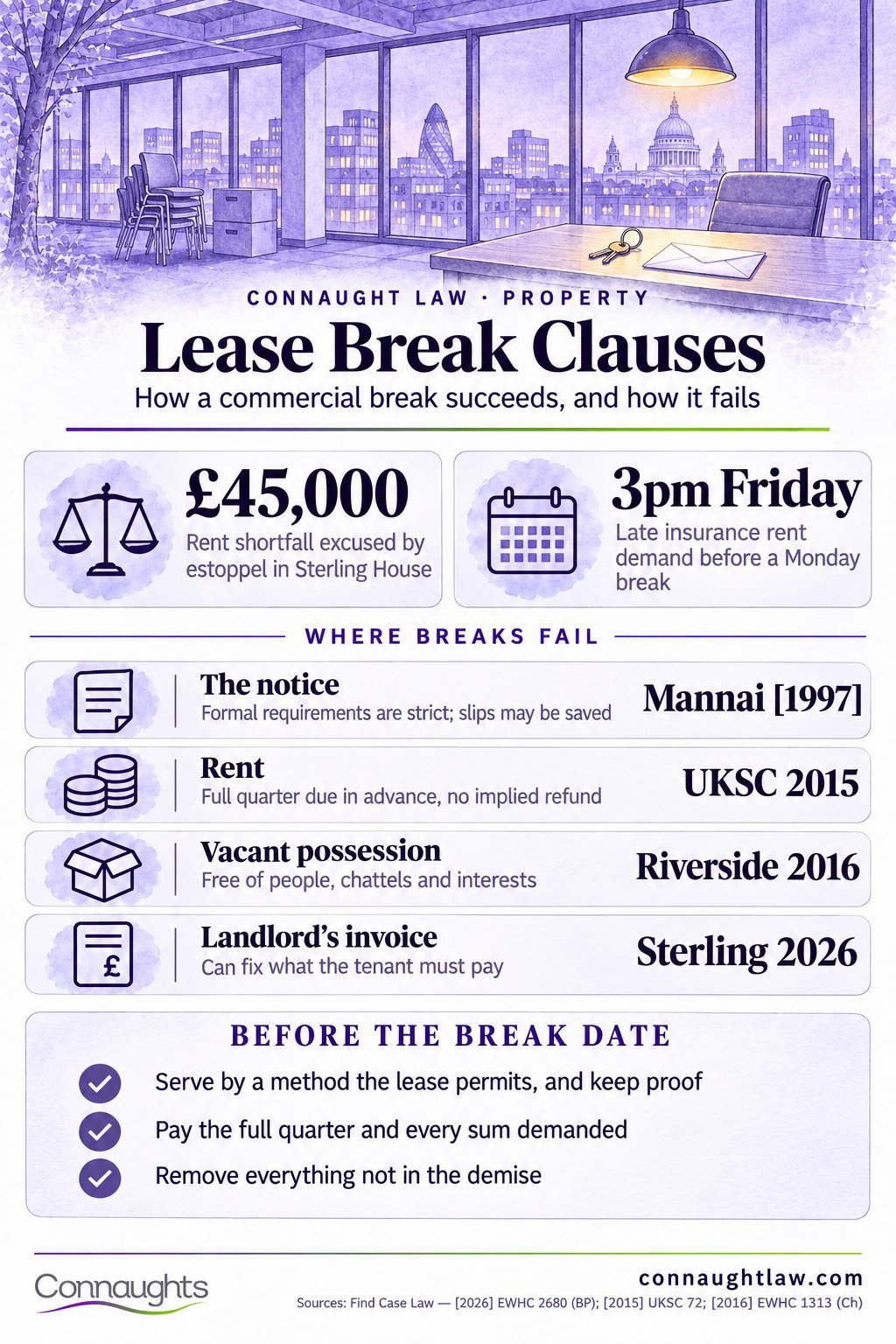
A break clause is an option, and the courts hold the tenant to its exact terms: the right notice, from the right party, served the right way, with every condition met on the break date. Most failed breaks fail on rent, vacant possession or service. The October 2026 Sterling House judgment adds a warning for landlords: an invoice can fix what the tenant must pay. This guide covers both sides.
On This Page

The Option That Has to Be Exercised Perfectly
A break clause lets one party end a commercial lease before its term expires. It is valuable because it is rare: without one, a tenant who wants out early needs the landlord’s agreement to a surrender or a buyer for an assignment. Because the lease continues, rent and all, if the break fails, landlords have every incentive to look for a defect, and the case law shows how often they find one. Our commercial lease agreement guide covers negotiating a break; this guide is about using one.
A notice that meets the clause’s formal requirements, served by and on the right parties, by a permitted method, within the notice window; then strict compliance with every condition on the break date, usually full payment of rent due and vacant possession. A landlord’s own statements about sums due can, in the right facts, prevent it relying on a shortfall.
Types of Break Right
Tenant, Landlord and Mutual Breaks
A tenant’s break gives the occupier an exit; a landlord’s break usually serves redevelopment or re-letting plans; a mutual break gives both. Some clauses fix a single break date, others allow a break on any date after a stated point on a set period of notice. The drafting decides everything: who may serve, the notice period, the form and the conditions.
Landlord Breaks and the 1954 Act
For a tenancy protected by the Landlord and Tenant Act 1954, a landlord’s break notice ends the contractual term but not the tenancy. Section 24 provides that such a tenancy does not come to an end unless terminated in accordance with Part II, so the landlord also needs the statutory procedure, and the tenant may seek a new lease. A tenant’s notice to quit is expressly preserved, which is why a tenant’s break can end a protected tenancy.
Why Breaks Are Construed Strictly
A break right is an option, and the courts treat its conditions as conditions precedent: met in full on time, or not at all. The leading authority on the notice itself is Mannai Investment Co Ltd v Eagle Star Life Assurance Co Ltd [1997] AC 749, where the House of Lords upheld notices that gave a break date one day early because a reasonable recipient would have understood what was meant. The Court of Appeal has since explained Mannai’s limits: if a notice fails a substantive condition on which validity depends, interpretation does not help.
Form Versus Information
Lord Hoffmann drew the line memorably: if the clause had required “blue paper”, a notice on pink paper would fail however clear the tenant’s intention. Wrong dates and typographical slips can be rescued by the reasonable recipient test; a missing formal requirement, or a method the lease does not permit, usually cannot. Treat every requirement as if it were the blue paper.
The Conditions That Cause Most Failures
Common Break Conditions and How They Fail
| Condition | Usual trap | Illustration |
|---|---|---|
| Rent paid up to the break date | Quarter’s rent falls due before the break date and is paid only in part | M&S v BNP Paribas [2015] UKSC 72; Sterling House [2026] EWHC 2680 (BP) |
| Vacant possession | Chattels, people or interests left behind | Riverside Park v NHS Property Services [2016] EWHC 1313 (Ch) |
| Vacant possession of the premises | Arguing that stripped-out items had to be returned | Capitol Park Leeds v Global Radio [2021] EWCA Civ 995 |
| Compliance with covenants | Repair or reinstatement work unfinished on the break date | Turns on the wording: “material” compliance is softer than absolute compliance |
Paying the Rent: The Quarter-Day Trap
Where rent is payable quarterly in advance and the break date falls mid-quarter, the full quarter’s rent is due on the quarter day before it. In Marks and Spencer plc v BNP Paribas [2015] UKSC 72, decided on 2 December 2015, the Supreme Court refused to imply a term requiring the landlord to refund the rent for the days after the break. Unless the lease says otherwise, the tenant pays the whole quarter and does not get the balance back.
Giving Vacant Possession
In Riverside Park Ltd v NHS Property Services Ltd [2016] EWHC 1313 (Ch) the tenant left partitioning, kitchen units, floor coverings and blinds. The court held them to be chattels, not part of the premises, so vacant possession was not given and the break was ineffective; the judge accepted the result might seem harsh. In Capitol Park Leeds plc v Global Radio Services Ltd [2021] EWCA Civ 995 the Court of Appeal went the other way on different facts: vacant possession means returning the premises free of people, chattels and interests, and a tenant that had stripped out items before the break date still broke validly.
Complying with Covenants
A condition requiring compliance with tenant covenants can sink a break over dilapidations or reinstatement. Where the clause is absolute, any breach may be enough; negotiate for “material” compliance or, better, delete the condition. Once the lease is signed, the only safe course is to finish the works well before the break date or agree a settlement in writing.
Serving the Break Notice
Who Serves, and on Whom
The notice must come from the party the clause names, normally the current tenant, not a parent company or group company that happens to pay the rent. It must go to the current landlord: check the title at HM Land Registry if the reversion may have changed hands, and serve any person the lease names, such as the landlord’s solicitors, only if the clause allows it.
How and When to Serve
Use a method the lease permits. Many leases incorporate section 196 of the Law of Property Act 1925, which treats a notice left at the last known place of abode or business, or sent by registered post or recorded delivery and not returned, as sufficiently served. Do not rely on email unless the lease expressly permits it. Count the notice period from deemed service, serve early in the window, and keep proof: a process server’s statement, a recorded delivery receipt and a copy of exactly what was sent.
The Sterling House Decision
In Sterling House Ltd v International Baccalaureate Organisation (UK) Ltd [2026] EWHC 2680 (BP), handed down on 20 October 2026, HHJ Jarman KC dealt with a tenant’s break on 23 February 2026. The lease required annual rent quarterly in advance and insurance rent on demand, and the break failed if either was outstanding. Strictly, it was: the tenant had paid annual rent only up to the break date, leaving about £45,000 unpaid, and an insurance rent demand of about £2,300 was hand-delivered at 3pm on the Friday before the Monday break date.
The Invoice Estoppel
The tenant’s facilities manager had asked the landlord’s managing agents for the rent invoice, explaining it was handing back the building, and chased when no reply came. The agents sent an invoice for rent from 22 December 2025 to 23 February 2026, which was paid. The court held the invoice was a clear representation of what the landlord wanted paid before handover, relied on reasonably, and that it would be unconscionable to go back on it. The landlord was estopped from relying on the unpaid balance, and the Marks and Spencer principle itself was not in dispute.
The Late Insurance Rent Demand
The Friday afternoon demand did not give a reasonable time to pay by midnight on the Monday. Applying the “mechanics of payment” test, the court found the tenant’s reasonable opportunity extended to when it actually paid, by faster payment, two days after the break date. The claim was dismissed and the lease ended. The case turned on its facts: the request was made well in advance and the invoice was unambiguous about the period.
Checklists for Tenants and Landlords
- Read the clause months ahead: the notice window, form, method and every condition.
- Pay the full quarter’s rent and every other sum demanded, and ask in writing for confirmation of all sums due, including insurance rent and service charge.
- Pay any late demand immediately, under protest if necessary, and recover overpayments afterwards.
- Remove everything not in the demise and vacate fully; return keys and record the handover.
- Serve by a permitted method, early, and keep proof of service.
- Answer requests about sums due accurately, or decline to answer; do not send a short invoice and say nothing.
- Raise insurance rent and other on-demand sums promptly, not at the last minute.
- Do not accept rent or act in a way that suggests the break has failed, or succeeded, without advice.
- Check the notice’s validity as soon as it arrives, and inspect before the break date.
When a break is disputed, our commercial litigation team and property law solicitors act for landlords and tenants. Sector-specific traps, such as kitchen extraction and fit-out in hospitality premises, are covered in our restaurant leasing guide.
Frequently askedQuestions about lease break clauses
Do I have to pay the full quarter’s rent if my break date is mid-quarter?
Usually yes. If rent is payable quarterly in advance, the whole quarter falls due on the quarter day, and the Supreme Court in Marks and Spencer v BNP Paribas refused to imply a right to a refund for the period after the break. Only express wording changes that.
What does vacant possession mean in a break clause?
Returning the premises free of people, chattels and legal interests. Leaving furniture, partitioning treated as chattels, or occupiers behind can defeat the break, as Riverside Park shows. Removing items that form part of the premises is a different question, decided on the lease wording.
Can a break notice be served by email?
Only if the lease permits it. Breaks are construed strictly, so a method the clause does not allow risks invalidity even if the landlord reads the email. Use the lease’s notice provisions, often incorporating section 196 of the Law of Property Act 1925, and keep proof of service.
Can a mistake in a break notice be corrected?
A wrong date or slip may be saved if a reasonable recipient would understand what was intended, following Mannai v Eagle Star. A failure to meet a formal requirement, such as a method the lease does not permit, generally cannot be cured. A fresh notice is possible only while the window is still open.
Can a landlord’s invoice stop it saying the break failed?
It can. In Sterling House the agents invoiced rent only to the break date after the tenant asked what was due; the court held the landlord estopped from relying on the shortfall. Estoppel needs a clear representation, reasonable reliance and unconscionability, so it is fact-sensitive.
Does a landlord’s break end a 1954 Act tenancy?
Not on its own. Section 24 keeps a protected tenancy running until it is ended under Part II of the Act, so the landlord must also follow the statutory procedure, and the tenant may apply for a new lease. A contracted-out lease ends on the break.
Send us the lease, any licences and the rent account. We will check the notice requirements and conditions, set out what must be paid and vacated by the break date, and tell you where the break is exposed, whichever side you are on.
Get Expert Advice