
Your First Home is the government’s new equity loan for first-time buyers of new-build homes in England, announced in the Budget on 28 October 2026. Put down 2.5%, borrow 20% from the state interest-free for five years, and take a repayment mortgage for the rest. Applications open in February 2027. This guide sets out the rules published so far, the gaps, and what to do before you reserve a plot.
On This Page
Your First Home: A 20% State Loan Towards a New Build
The scheme was announced in the Budget on 28 October 2026, with Ministry of Housing, Communities and Local Government guidance published the same day and a full table of local price caps added on 3 November 2026. It is backed by £4.7 billion over five years and is aimed, in the Budget’s words, at around 70,000 households in England. Much of the detail a buyer’s solicitor will need — the loan documents, the full eligibility rules, the repayment terms — is promised before applications open but has not been published yet.
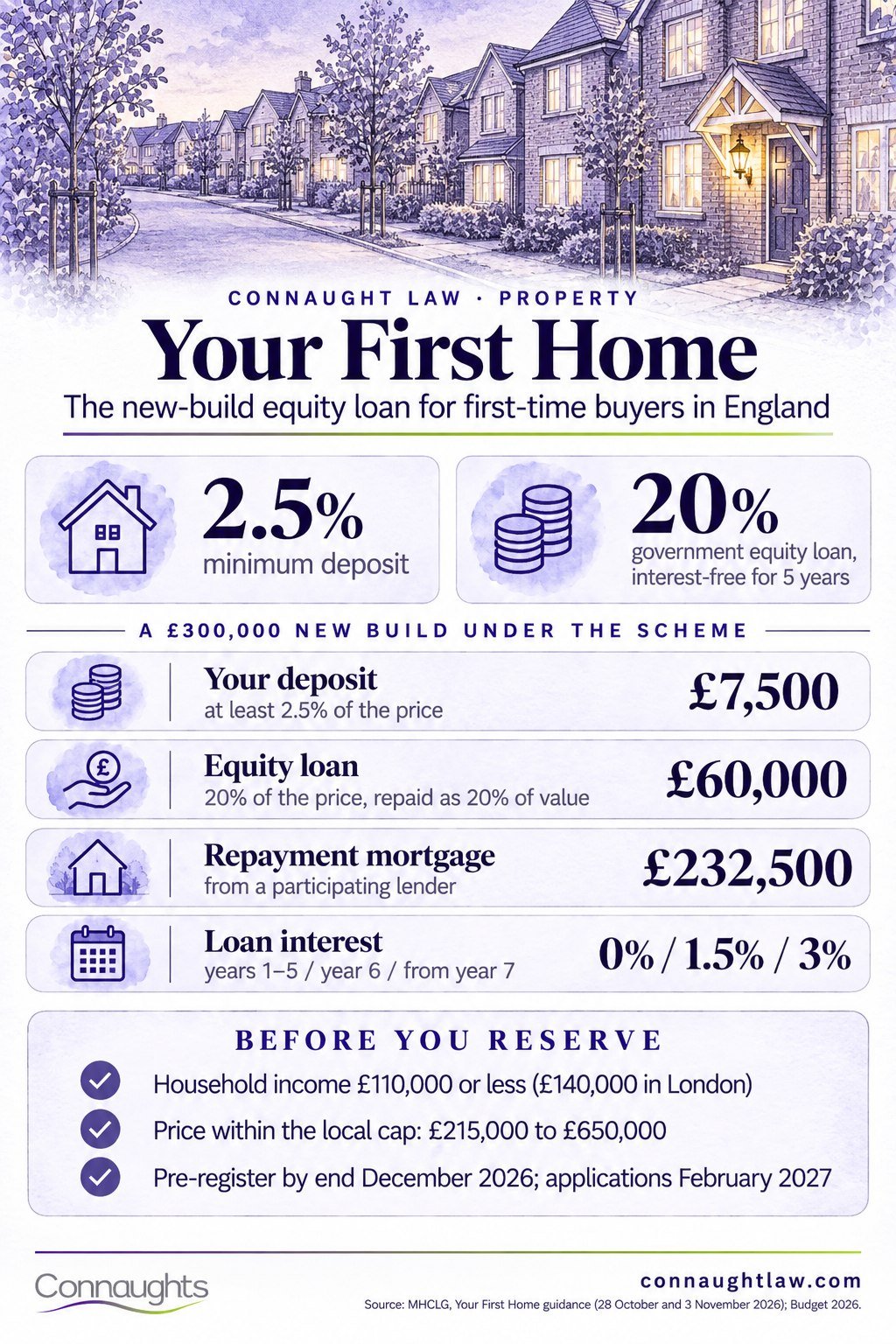
First-time buyers in England can buy a new-build home from a participating developer with a deposit of at least 2.5%, a government equity loan of 20% of the price, and a repayment mortgage from a participating lender. The loan is interest-free for five years. Household income must be £110,000 or less (£140,000 in London) and the price within the local cap. Pre-registration opens by the end of December 2026, applications in February 2027, first sales in April 2027.
How the Scheme Works
Deposit, Loan and Mortgage
The official guidance builds every purchase from three pieces: your deposit of at least 2.5%, an equity loan worth 20% of the purchase price, and a repayment mortgage covering the balance. The Budget adds that the maximum deposit will be 15%. On the government’s own £300,000 example, the buyer puts in £7,500, the equity loan provides £60,000 and the mortgage is £232,500 — against the £15,000 deposit and £285,000 mortgage a standard 95% loan would need.
Who Owns the Home
You do, from the day you complete. The guidance is explicit that the government will not be a joint owner or your landlord — the clearest legal difference from shared ownership, where you buy a share and rent the rest. Participating lenders still run their own affordability and credit checks, so the loan does not guarantee a mortgage offer.
Who Qualifies, and Which Homes
The Buyer Conditions
To use the scheme, buyers will normally need to be first-time buyers; to buy a new-build home in England within the local price cap; to live in it as their main home; to have a total household income of £110,000 or less outside London or £140,000 or less in London; and to obtain a mortgage from a participating lender. The word “normally” matters: the guidance says the full eligibility rules will be published before applications open, so treat these five conditions as the frame rather than the final test.
Price Caps by Area
Each local authority area has its own cap, set by reference to local median prices. The published table runs from £215,000 in North Lincolnshire to £650,000 in London boroughs such as Camden, Hackney and Westminster; boroughs such as Barnet, Croydon and Ealing sit at £500,000. Outside London, Manchester is £355,000, Birmingham £315,000 and Leeds £305,000. Only homes sold by developers who have signed the scheme’s participation agreement qualify.
Interest and Repayment
Interest After Year Five
The loan carries no interest in years one to five, 1.5% in year six and 3% from year seven. Those payments are separate from your mortgage and do not reduce what you owe. On the £300,000 example, at a 5% mortgage rate over 30 years, the government puts the monthly cost at £1,248 for the first five years, £1,323 in year six and £1,398 from year seven, against £1,530 on a standard 95% mortgage. How interest will be collected is still to be published.
Repaying a Share of the Value, Not the Sum
The loan tracks the property. Borrow 20% of the price and you normally repay 20% of the home’s value at the time, on an independent valuation: the guidance’s £300,000 home later valued at £320,000 means repaying £64,000; valued at £280,000, £56,000. Repayment normally happens on sale, and you may repay some or all of it earlier. Minimum repayment amounts, valuation requirements, fees and the mechanics on a sale or remortgage are all promised in later guidance.
Dates, and What Is Still Unknown
The Timetable
By the end of December 2026: customer pre-registration, guidance and the first developer registrations. February 2027: the first applications. April 2027: the first sales. Pre-registration does not commit you to buying through the scheme, but it tells you whether you are likely to be eligible and confirms the cap for your area.
What Is Not Yet Published
- The full eligibility rules, terms and conditions.
- The list of participating developers and lenders.
- How the equity loan will be documented and secured against the home.
- How interest is collected, and the repayment, valuation and fee rules.
- The legal basis: the Budget says the Ministry will legislate “as soon as Parliamentary time allows”, with Homes England delivering the scheme first and the National Housing Bank taking it over later.
How It Sits Beside Other Schemes
First-Time Buyer Help Compared
| Route | What you get | Price or income limit |
|---|---|---|
| Your First Home | 20% equity loan, interest-free for 5 years; you own 100% | Local cap £215,000–£650,000; income £110,000 (£140,000 London) |
| Lifetime ISA | 25% bonus on savings, up to £1,000 a year | £450,000; above that, a 20% withdrawal charge |
| Shared ownership | Buy a 10%–75% share, rent the rest; always leasehold | Income £80,000 (£90,000 London) |
| SDLT first-time buyer relief | No tax to £300,000; 5% from £300,001 to £500,000 | Lost entirely above £500,000 |
The Lifetime ISA
Nothing published so far rules out using Lifetime ISA savings towards the deposit, but the scheme’s full rules are not out, so check both before relying on it. The ISA’s own conditions still apply: the account must have been open twelve months before you buy, the purchase must be with a mortgage, and a conveyancer receives the funds. The Budget made two changes: from 29 October 2026 the charge for using the ISA on a home above £450,000 fell from 25% to 20% — relevant where Your First Home caps exceed £450,000 — and a First Time Buyer ISA will replace the Lifetime ISA for new savers from April 2029.
Shared Ownership and Stamp Duty
Shared ownership suits a different budget: you buy a share, pay rent on the rest and hold a lease, with lower income limits. The scheme guidance says nothing about stamp duty, and the ordinary rules apply: First-time buyer relief turns on the price you pay, not on how it is funded, so a home in an inner London borough priced above £500,000 — inside the £650,000 cap — gets no relief at all. Run the figure through our stamp duty calculator before you reserve.
What a Buyer Should Do Now
Before You Reserve a Plot
Pre-register when it opens, confirm the cap for the local authority where the plot sits, and check your household income against the limit. Do not reserve on the assumption that a plot will qualify: first sales are not expected until April 2027, and only participating developers can sell through the scheme. The guidance itself urges independent financial and legal advice before committing — and the wider legal steps for a first purchase are set out in our first-time buyer conveyancing guide.
The Conveyancing Points
Every Your First Home purchase is a new build, so the developer’s contract, the 28-day exchange pressure, longstop dates and warranty checks covered in our new build conveyancing guide all apply. On top sit the scheme layers: a mortgage offer from a participating lender, the equity loan documentation once published, and — for flats — the lease and service charges reviewed in our leasehold buyer’s guide. The guidance also flags estate charges, which on new-build freeholds deserve a hard look. If part of your 2.5% is a gift, read our gifted deposit guide early. Our property solicitors, part of our wider real estate team, can review the reservation form and contract pack, and the conveyancing calculator gives a cost estimate for a London purchase.
Frequently askedQuestions about the Your First Home scheme
What is the Your First Home scheme?
A government equity loan for first-time buyers of new-build homes in England. You put down at least 2.5%, the government lends 20% of the price, and a participating lender provides a repayment mortgage for the rest. The loan is interest-free for five years and you own the home from completion.
When can I apply for Your First Home?
Pre-registration is due to open by the end of December 2026, applications in February 2027, and the first sales are expected in April 2027. Pre-registration does not commit you to buying but indicates your eligibility and the price cap in your area.
What is the income limit for Your First Home?
Total annual household income of £110,000 or less outside London, or £140,000 or less in London. These are the conditions buyers will “normally” need to meet; the government says full eligibility rules will be published before applications open.
What is the Your First Home price cap in London?
£650,000 in London boroughs such as Camden, Hackney and Westminster, and £500,000 in boroughs such as Barnet, Croydon and Ealing. Every local authority in England has its own cap; the lowest published is £215,000 in North Lincolnshire.
Do I have to pay interest on the Your First Home loan?
Not for the first five years. Interest is 1.5% in year six and 3% from year seven, payable separately from your mortgage, and the payments do not reduce the loan. How interest will be collected is still to be published.
How much do I repay on the equity loan?
The same percentage of the home’s value at the time you repay, on an independent valuation. Borrow 20% of £300,000 and sell at £320,000, and you repay £64,000; sell at £280,000 and you repay £56,000. Repayment normally happens when you sell.
Send us the development, the plot price and the local authority area. We will check the price against the cap, review the developer’s reservation terms and contract, and tell you what to settle before the scheme opens.
Get Expert Advice