Whistleblowing law protects workers who report wrongdoing from being punished for it, from their first day in a job and with no cap on compensation for a whistleblowing dismissal. Since April 2026 it covers reports of sexual harassment, and claims about acts from 1 October 2026 have six months to be brought. A government consultation open until 8 January 2027 asks whether to go further. This guide sets out the law today and the proposals.
On This Page
Whistleblowing at Work: The Law Today and the Reforms Proposed
The framework was added to the Employment Rights Act 1996 by the Public Interest Disclosure Act 1998, in Part IVA with the detriment and dismissal rights in sections 47B and 103A. It applies in England, Wales and Scotland. For employees it is one of the strongest protections in employment law; for employers it is one of the most expensive to get wrong. Our UK employment law guide places it among the other rights, and our employment team acts for workers and employers.
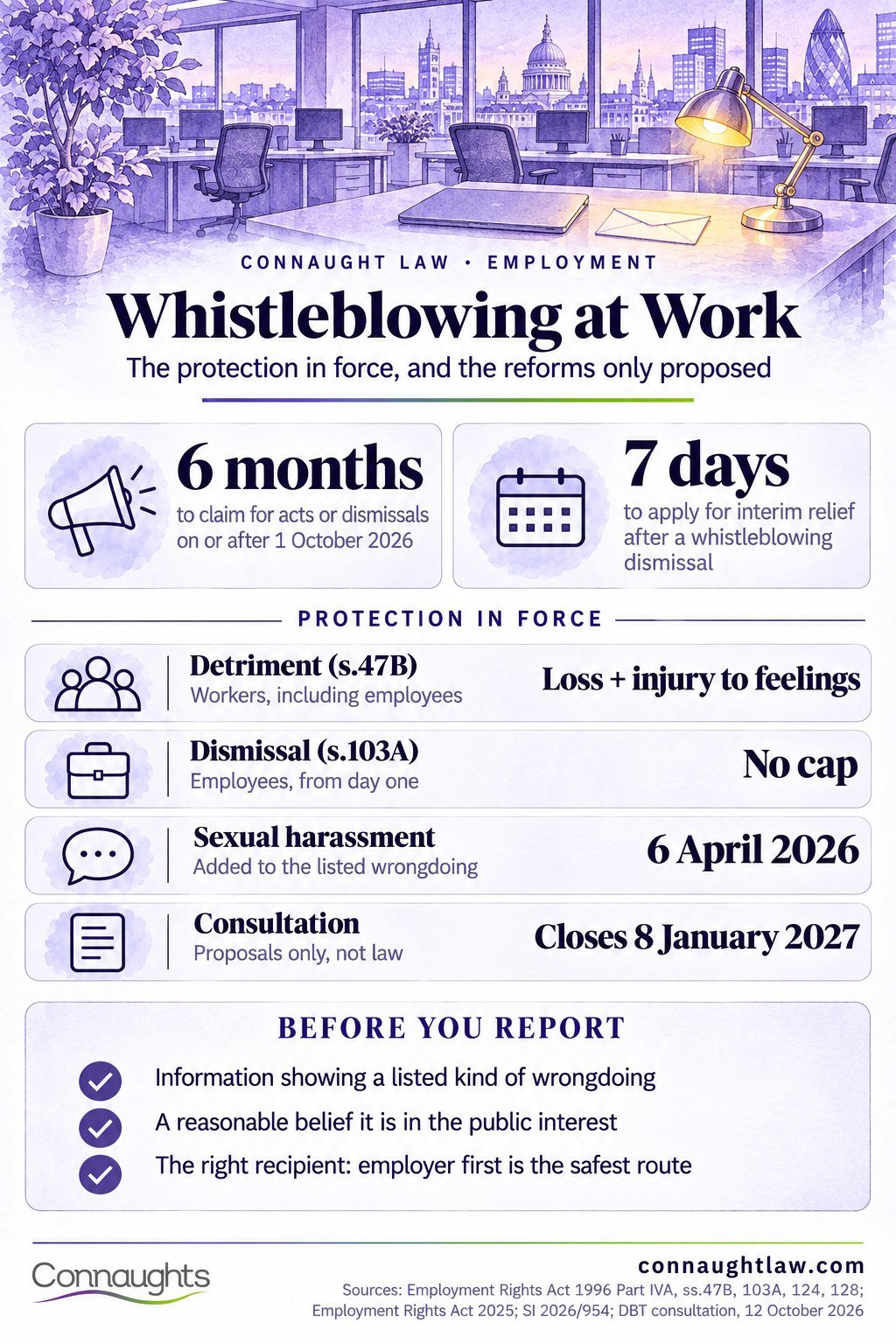
You are protected if you are a worker, you disclose information you reasonably believe tends to show wrongdoing of a listed kind, you reasonably believe the disclosure is in the public interest, and you make it to the right person. Your employer must not subject you to a detriment for it, and dismissing an employee mainly for it is automatically unfair, with no cap on compensation.
What Counts as a Protected Disclosure
The Listed Kinds of Wrongdoing
Under section 43B the disclosure must be of information which, in your reasonable belief, tends to show that one of these has happened, is happening or is likely to happen: a criminal offence; a failure to comply with a legal obligation; a miscarriage of justice; danger to anyone’s health or safety; sexual harassment; damage to the environment; or deliberate concealment of any of these. It does not matter whether the wrongdoing is in the UK or abroad. You need a reasonable belief, not proof: a disclosure can be protected even if you turn out to be wrong.
Sexual Harassment and the Public Interest Test
Sexual harassment was added by section 23 of the Employment Rights Act 2025 from 6 April 2026, meaning unwanted conduct of a sexual nature as defined in the Equality Act 2010. Since 2013 you must also reasonably believe the disclosure is in the public interest. The Act does not define that phrase. Tribunals look at factors such as how many people are affected, the seriousness of the wrongdoing and who the wrongdoer is, following Chesterton Global v Nurmohamed [2017] EWCA Civ 979. A complaint only about your own pay or bonus is unlikely to pass.
Who Is Protected, and Who to Tell
Workers, Not Only Employees
Protection covers employees and the wider group of “workers”, including agency workers, platform workers who meet the worker test (see our gig economy worker rights guide), trainees, self-employed NHS practitioners, LLP members and judicial office holders. It applies from day one, with no qualifying period. Volunteers, job applicants outside the NHS and, generally, non-executive directors are not covered, which is one of the questions the consultation asks.
Employer, Regulator or Wider
The safest route is internal: to your employer, or to another person responsible for the wrongdoing, or to a lawyer when taking legal advice. A disclosure to a “prescribed person” (the government’s list of prescribed people and bodies names more than 90 regulators and others) is protected only if you also reasonably believe the information is substantially true and within that body’s remit. Going wider, to the police or the media, requires more again: no personal gain, one of the statutory conditions (such as a reasonable fear of detriment, or having already raised it), and that it was reasonable in all the circumstances.
Detriment and Dismissal Claims
The Two Claims
Section 47B gives every worker the right not to suffer a detriment, such as demotion, exclusion, a retaliatory suspension or harassment, because of a protected disclosure. Detriment by a colleague counts as the employer’s own act unless the employer took all reasonable steps to prevent it, and so does detriment by an agent acting with the employer’s authority. An employee dismissed mainly for whistleblowing is automatically unfairly dismissed under section 103A, and section 124(1A) removes the cap on the compensatory award. Resigning in response to retaliation can found a constructive dismissal claim.
Whistleblowing Claims at a Glance
| Claim | Who can bring it | Remedy | Deadline |
|---|---|---|---|
| Detriment (s.47B) | Workers, including employees | Financial loss and injury to feelings | Six months from the act |
| Dismissal (s.103A) | Employees, from day one | Uncapped compensation, reinstatement or re-engagement | Six months from dismissal |
| Interim relief (s.128) | Dismissed employees | Reinstatement, re-engagement or pay until the hearing | Seven days from dismissal |
Time Limits, Acas and Interim Relief
For acts and dismissals on or after 1 October 2026 the limit is six months, under Schedule 12 to the Employment Rights Act 2025 and SI 2026/954; earlier acts keep the old three-month limit. Acas early conciliation must be started first, and it can extend the deadline. Interim relief is different: the application must reach the tribunal within seven days of dismissal, and the bar is high, since you must show you are likely to establish that the disclosure was the principal reason. Compensation, explained in our guide to tribunal awards, can be cut by up to 25% where the disclosure was not made in good faith.
Settlement Agreements and NDAs
Gagging Clauses Are Void
Section 43J makes void any term in an agreement between a worker and employer, settlement agreements included, so far as it tries to stop the worker making a protected disclosure. A confidentiality clause can still cover the terms of a deal, but it cannot stop a protected disclosure, such as a report to a prescribed regulator. A valid settlement agreement needs written terms and advice from a relevant independent adviser before you sign.
Harassment and Discrimination NDAs
The Employment Rights Act 2025 also inserts a new section 202A, voiding terms that stop a worker speaking about harassment or discrimination at work, or about how the employer responded. So far it is in force only for specified purposes; the full ban is not yet in force, so check the position before relying on it.
What the Consultation Proposes
Scope and Dates
The Department for Business, Innovation, Science and Trade published A consultation on whistleblowing on 12 October 2026, with the Serious Fraud Office and the Home Office. It closes at 11.59pm on 8 January 2027, and a government response is due in 2027. Nothing in it is law.
- Employer duty: either better guidance, or a statutory duty on public sector employers and private employers with 50 or more staff to keep whistleblowing procedures and follow up disclosures, possibly on the Irish model with civil penalties.
- Disclosure routes: whether to drop the “substantially true” test for prescribed persons, and whether to add a trade union route.
- Interim relief: whether to extend the seven-day deadline to 14 days.
- Scope: who else to protect, and whether the categories cover AI risks and misuse of public funds. The public interest test stays.
- Navigation: an AI-assisted tool to find the right prescribed person. The government’s initial view is against an Office of the Whistleblower.
The SFO Reward Scheme
The government supports a Serious Fraud Office scheme, recommended by Jonathan Fisher KC, to pay people whose significant and original information leads to a corporate conviction or Deferred Prosecution Agreement. Rewards would be a percentage of the penalty, paid only after the case ends, possibly with no cap. Eligibility would not depend on being a worker, and new offences for false reports and for intimidating whistleblowers are proposed. Employers should review their policies now rather than wait for the response.
Frequently askedQuestions about whistleblowing at work
What counts as whistleblowing at work?
Disclosing information you reasonably believe shows a crime, a breach of a legal obligation, a miscarriage of justice, a health and safety danger, sexual harassment, environmental damage or a cover-up of any of these, in the public interest, to your employer or another permitted recipient.
Is a personal grievance a protected disclosure?
Usually not on its own. You must reasonably believe the disclosure is in the public interest, so a complaint only about your own pay or contract will often fail. A grievance that also raises wider wrongdoing, such as a breach affecting colleagues or customers, can qualify.
Do I need two years’ service to claim for whistleblowing?
No. Whistleblowing protection applies from your first day. Employees dismissed mainly for a protected disclosure can claim automatic unfair dismissal with no qualifying period, and workers who are not employees can bring detriment claims from day one too.
How long do I have to bring a whistleblowing claim?
Six months from the act or dismissal if it happened on or after 1 October 2026, three months if earlier, after starting Acas early conciliation. For interim relief after a dismissal, the application must be made within seven days. Late claims are allowed only where claiming in time was not reasonably practicable.
Is whistleblowing compensation capped?
Not for an automatically unfair dismissal under section 103A: the usual cap on the compensatory award does not apply. Detriment awards cover financial loss and injury to feelings. Either can be reduced by up to 25% if the disclosure was not made in good faith.
Will whistleblowers be paid for reporting fraud?
Not yet. The consultation proposes a Serious Fraud Office scheme paying a percentage of the penalty where information leads to a corporate conviction or Deferred Prosecution Agreement. Jonathan Fisher KC recommended legislation to create it; the consultation closes on 8 January 2027 and no scheme exists today.
Tell us what was reported, to whom and what has happened since. We advise workers on protecting a claim within the time limits, and employers on handling disclosures and their policies before the consultation outcome.
Get Expert Advice