
The Commonhold and Leasehold Reform Bill entered the Commons on 19 November 2026. It would ban leasehold for most new flats, cap existing ground rents at £250 a year, replace forfeiture with a court-led enforcement scheme and let the leaseholders of half the flats in a block convert it to commonhold. None of it is law yet. This guide sets out what the Bill would change, for whom, and on what timetable.
On This Page
The Commonhold Bill: What Would Change, and When
The government describes the Bill as the beginning of the end for leasehold in England and Wales. It is Bill 189 of the 2026–27 session, given its first reading in the Commons on 19 November 2026 and awaiting second reading. What follows is taken from the government’s own Guide to the Commonhold and Leasehold Reform Bill and the documents published with it. The detail sits in the clauses of the Bill, and it may change as the Bill passes through Parliament.
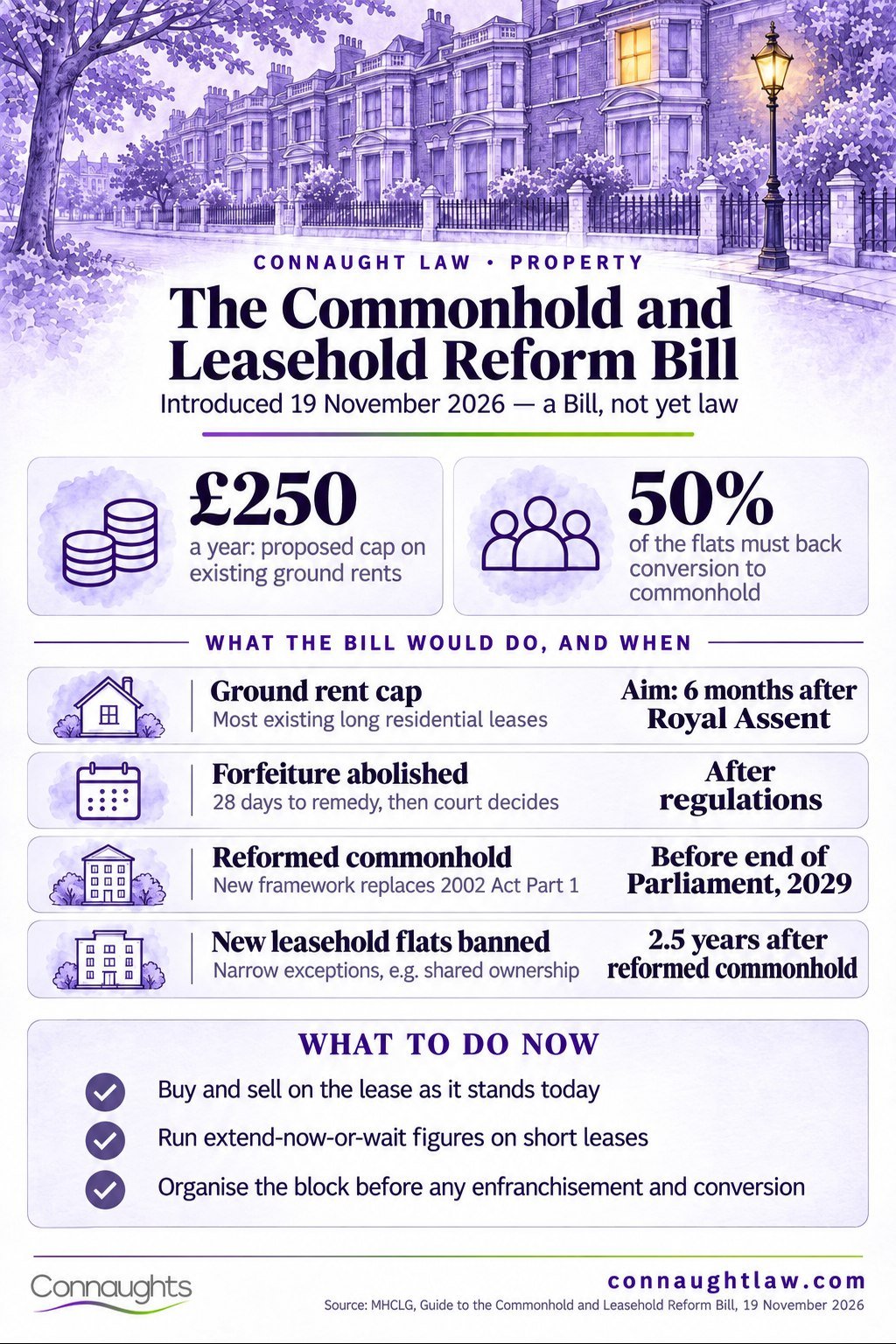
Proposal. The Bill must pass both Houses and receive Royal Assent, and most measures then need regulations. The government aims to bring in the £250 ground rent cap six months after Royal Assent. It expects the reformed commonhold model to be usable before the end of the Parliament in 2029. The ban on new leasehold flats would follow two and a half years after that.
The Bill in Outline
What Commonhold Is
Commonhold is freehold ownership of a flat (a “unit”) combined with membership of a commonhold association, a company that owns and runs the common parts. A commonhold community statement (CCS) sets out the rules. There is no lease that runs down, no ground rent and no third-party landlord. Commonhold has existed since the Commonhold and Leasehold Reform Act 2002, but the guide records that fewer than 20 commonholds, with fewer than 200 units between them, have been set up. The Bill would replace Part 1 of the 2002 Act with a new framework: sections for mixed-use buildings, permitted shared ownership leases, mandatory reserve funds and insurance, a member-approved budget and, as a last resort, a court order for sale against an owner who does not pay.
Six Parts, Three Audiences
Part 1 reforms commonhold. Part 2 bans leasehold for new flats. Part 3 corrects the Leasehold and Freehold Reform Act 2024. Part 4 caps ground rents and administration charges and strengthens broadband requests. Part 5 abolishes forfeiture. Part 6 curbs estate rentcharge enforcement on freehold estates. Developers feel Parts 1 and 2; existing leaseholders feel Parts 3 to 5. The government’s announcement puts the number of leasehold homes in England and Wales at an estimated 5.1 million.
The Ban on New Leasehold Flats
What the Ban Catches
Once Part 2 is in force, the guide says, the marketing and grant of long leases of new flats will be prohibited. That covers new blocks, houses newly converted into flats, offices or shops redeveloped with flats, build-to-rent blocks whose owners later sell flats, and refurbished buildings with no existing long residential leases. Existing leasehold flats are outside the ban. Landlords can still grant new or replacement leases of them, including lease extensions.
The Exceptions
Some leases will be permitted inside a commonhold: shared ownership leases, home reversion plans, lease-based home purchase plans used for Islamic finance, non-assignable lifetime leases and Grenfell Assisted Home Ownership leases. Leasehold may also continue outside commonhold for community land trusts, qualifying housing-with-care for older people, flats on National Trust, Crown or agricultural land, Right to Buy and Right to Acquire leases, and certain other schemes. Developments with a planning application made, or consent granted, before the ban starts may still be sold as leasehold.
Checks, Penalties and Redress
An exempt flat must be marketed as leasehold with the reason stated. The buyer must receive a warning notice with evidence before exchange, and the lease must carry a prescribed statement that HM Land Registry will check. Trading standards may impose penalties of £500 to £30,000 per breach. A buyer sold a lease in breach of the ban will usually be able to acquire the flat as a commonhold unit, or require the building to convert, at no cost to them.
What Changes for Existing Leaseholders
The £250 Ground Rent Cap
The Bill amends the Leasehold Reform (Ground Rent) Act 2022 to cap ground rent at £250 a year in long leases (over 21 years) of single dwellings granted before that Act took effect, reducing to a peppercorn after 40 years. The guide estimates 770,000 to 900,000 leaseholders currently pay more than £250. Business leases, community-led housing and home finance plans are exempt, and leases granted for no premium are outside the 2022 Act altogether. The treatment of “quid pro quo” leases, where a higher rent was agreed for a lower price, is still under consideration after a consultation that closed on 27 August 2026. Trading standards will enforce the cap, and a leaseholder who is overcharged can apply to the tribunal.
Forfeiture Replaced
Forfeiture, under which a landlord can end a lease for breach and the leaseholder loses the flat and its equity, would be abolished for long residential leases, existing and new. In its place: notice of the proposed action, at least 28 days to put the breach right, and court proceedings within 6 months of the breach being admitted or finally determined. The court then chooses a proportionate remedy. In the most serious cases this could be a sale, with the leaseholder keeping whatever is left after the debts and costs are paid. Ground rent arrears, and other money breaches below a threshold to be set between £500 and £5,000, fall outside the scheme and are recovered as ordinary debts.
If You Do Nothing
Nothing obliges an existing leaseholder to convert. The guide is explicit that conversion “will remain voluntary” and that leasehold will be part of the market for many years. A leaseholder who takes no step keeps the lease, gains the ground rent cap, the forfeiture replacement and, once the 2024 Act is commenced, cheaper extension rights, and benefits from the protections explained in our guide to the new leasehold service charge rules.
Converting an Existing Block
From 100% to 50%
Converting a block today needs the agreement of every leaseholder, their lenders and the freeholder, which in practice almost never happens. Clause 4 of the Bill would lower the consent threshold to the qualifying leaseholders of at least half the flats in the building, matching collective enfranchisement. Leaseholders who do not already own the freehold will still have to buy it, but a streamlined route will let them prove consent once and register the commonhold straight after the acquisition. In a two-flat building both owners must agree. The government’s response to the select committee declined to make commonhold the automatic result of every enfranchisement, leaving the choice with the leaseholders.
Leaseholders Who Say No
Non-consenting leaseholders stay on their leases but join the commonhold association, vote on the budget and pay contributions. They lose the right to a lease extension and the right to challenge a service charge. Instead they gain the right to buy the freehold of their unit, compensating the former freeholder, or to direct its sale as a commonhold unit. Over time the remaining leases are phased out. For blocks that want control without ownership, the right to manage remains available and is unaffected.
How the Bill Fits With the 2024 Act
Already in Force
Parts of the Leasehold and Freehold Reform Act 2024 are already working. Building safety protections began on 24 July and 31 October 2024. The two-year ownership wait for extensions and freehold claims went on 31 January 2025, and the right to manage reforms on 3 March 2025. Service charge, information and litigation-costs measures start in stages from 1 April 2027 under separate regulations.
Still Waiting
The valuation reforms are not in force: the 990-year standard extension, the end of marriage value and the 0.1% cap on ground rent in the price. Part 3 of the Bill closes a valuation loophole and corrects other flaws. The government says it will commence the enfranchisement reforms “as soon as possible” after Royal Assent, alongside regulations being prepared in parallel. Until then, every statutory lease extension is still priced under the old rules.
Timetable and What to Do Now
The Bill’s Measures and Their Expected Timing
| Measure | Who it affects | Government’s stated timing |
|---|---|---|
| £250 ground rent cap | Existing leaseholders | Aim: 6 months after Royal Assent |
| Broadband request rights | Leaseholders in blocks | 2 months after Royal Assent |
| 2024 Act enfranchisement reforms | Leaseholders extending or buying | As soon as possible after Royal Assent |
| Forfeiture replaced | All long residential leases | After regulations, no date given |
| Reformed commonhold available | Developers, converting blocks | Before the end of the Parliament in 2029 |
| Ban on new leasehold flats | Developers, buyers of new flats | Two and a half years after reformed commonhold |
Buyers and Sellers
For buyers, the rules have not changed. A flat bought this winter is bought on its lease as it stands, so the checks in our leasehold buyer’s guide still apply. Sellers should not market on the promise of a cap or a cheaper extension that is not yet law. The disclosure points in our guide to selling a leasehold flat remain the ones that matter.
Leaseholders and Developers
Leaseholders with short leases face a decision that turns on numbers: extend now under the old valuation, or wait for reforms with no commencement date. Our lease extension solicitors can run that comparison. Blocks thinking about the freehold can start organising now through our collective enfranchisement team, since conversion will begin with enfranchisement. Developers with schemes still at the pre-application stage should check whether a planning application made before the ban would keep leasehold available, and track the Bill on the Parliament website.
Frequently askedQuestions about the Commonhold and Leasehold Reform Bill
Is leasehold being abolished in the UK?
Not for existing homes. The Bill, introduced on 19 November 2026 and covering England and Wales, would ban leasehold for most new flats once reformed commonhold has been available for two and a half years. Existing leasehold flats stay leasehold unless their owners choose to convert.
When will the £250 ground rent cap start?
Not before the Bill becomes law. The government aims to commence the cap six months after Royal Assent, and its announcement refers to 2028. The cap would apply to most long residential leases granted before the Ground Rent Act 2022 took effect, falling to a peppercorn after 40 years.
What is commonhold and how is it different from leasehold?
Commonhold gives you the freehold of your flat for ever, with no ground rent and no landlord. A commonhold association owned by the flat owners runs the building under a community statement. A leasehold flat is a lease for a fixed term, with a freeholder controlling the building.
Can my block convert to commonhold?
Today, only with the agreement of every leaseholder and their lenders. Under the Bill, the qualifying leaseholders of at least half the flats in the building could convert, buying the freehold first through collective enfranchisement where needed. Leaseholders who do not agree would keep modified leases and join the commonhold association.
Will forfeiture be abolished for leaseholders?
The Bill would abolish it for long residential leases, existing and new. Landlords would have to give notice, allow at least 28 days to remedy the breach and then apply to court for a proportionate remedy. A sale would leave the leaseholder with any equity left over. Regulations are needed first.
Should I wait for the Bill before extending my lease?
It depends on your lease. The cheaper valuation rules in the 2024 Act start only after this Bill’s Royal Assent, and no date is fixed. With a lease near or below 80 years, the cost of waiting can outweigh the saving, so run both calculations before deciding.
Send us your lease, the ground rent clause and the make-up of your block. Our property law solicitors will tell you what the Bill would change for you, what is already in force, and whether to act now or wait.
Get Expert Advice