
Five sets of regulations laid in November 2026 bring the service charge provisions of the Leasehold and Freehold Reform Act 2024 into effect in England. From 1 April 2027 leaseholders get a right to information and protection from landlords’ legal costs. Standard demands, annual reports and new insurance rules follow on 1 November 2027, and social landlords a year later. This guide explains what changes, for whom and when.
On This Page

The New Service Charge Regime for Leasehold Homes
Part 4 of the Leasehold and Freehold Reform Act 2024 rewrote the service charge sections of the Landlord and Tenant Act 1985. It needed regulations before it could work. Those regulations now exist, some made and some in draft, and a commencement order made on 25 October 2026 fixes the dates. They apply to leases of dwellings in England only.
1 April 2027: a right to service charge, insurance and building information going back six years, a new 18-month notice, and an end to landlords automatically recovering legal costs through the service charge. 1 November 2027: standard demand forms, annual reports and accounts for private landlords, insurance disclosure and, if the draft regulations are approved, an end to percentage commissions. 1 November 2028: standard demands and reports extend to councils and housing associations.
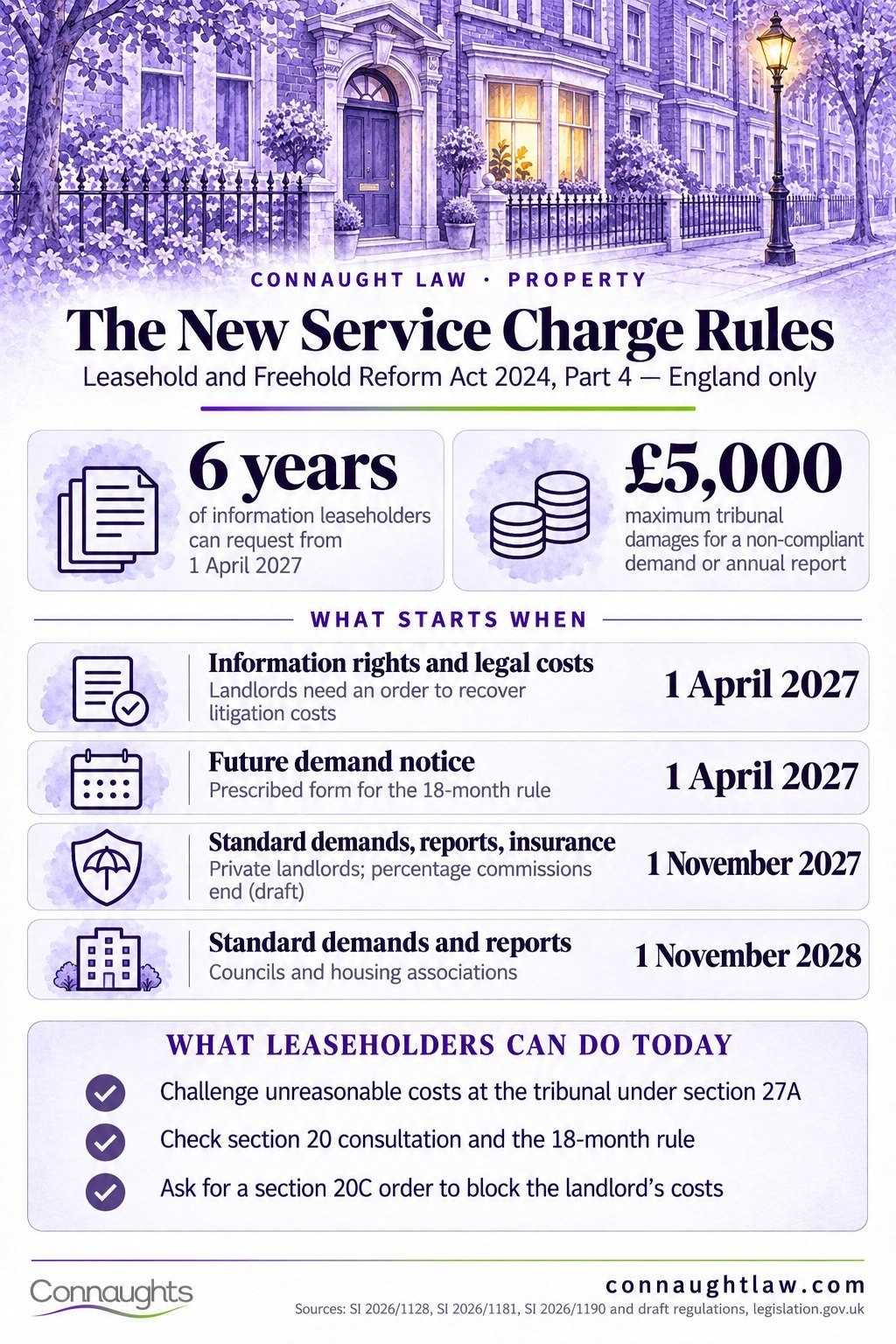
What Changes, and for Whom
Five Instruments, One Timetable
The government’s announcement of 11 November 2026 refers to five sets of regulations. Two are made: the Service and Administration Charges (England) Regulations 2026 (SI 2026/1190) and the Building Insurance Information (England) Regulations 2026 (SI 2026/1181). Three are drafts that need approval by both Houses: on litigation costs, permitted insurance payments and qualified accountants. A sixth set, on how the litigation-costs reforms will work, is promised before the end of 2026. The government says it expects that set to commence on 1 April 2027.
Who Must Comply
The duties fall on the “landlord”. For service charge purposes, section 30 of the 1985 Act defines that as anyone with a right to enforce payment of a service charge. That captures freeholders, intermediate landlords, resident management companies and RTM companies; the insurance rules also regulate what managing agents may be paid. Social landlords (councils, housing associations and their joint ventures) get an extra 12 months for the new demand forms, accounts and reports.
Demands, Accounts and Annual Reports
The Standard Demand
From 1 November 2027 (1 November 2028 for social landlords), a landlord may not demand a service charge unless the demand is in the prescribed form, contains the prescribed information and is served in the prescribed way. Councils have their own version of the form. Until the demand complies, the new section 21C provides, any lease provision on non-payment or late payment does not apply to that charge. Extra information may be added only if it does not obscure or contradict the form.
Annual Reports and Certified Accounts
For accounting periods ending on or after the same dates, landlords must provide an annual report in a set form, with a separate version for fixed service charges with event fees. Variable charges also need a written statement of account in a set form, with a report by a qualified accountant. That is an audit standard where the lease requires an audit, and an agreed-upon procedures review otherwise. Social landlords provide an expenditure report instead. A tenant whose landlord fails to provide a compliant demand or report can apply to the tribunal. The tribunal can order compliance within 14 days and damages of up to £5,000, which cannot be charged back through the service charge.
The 18-Month Notice, Formalised
From 1 April 2027, the notice that keeps costs recoverable beyond 18 months becomes a “future demand notice” in a prescribed form, giving an expected demand date. If the demand will come later, the landlord can serve a revised notice before that date. Unless the lease says otherwise, documents may be sent electronically only where the leaseholder has agreed in writing.
The Right to Information
What You Can Ask For
From 1 April 2027 a long leaseholder or shared owner can ask in writing for specified information about any accounting period that ended within the previous six years. Schedule 5 to SI 2026/1190 covers insurance policies and claims, accounts, budgets, demands, apportionment, reserve funds, invoices and contracts. It also covers building records: fire risk assessments, EWS1 forms, surveys, major works documents, section 20 consultation papers and the identity of any managing agent or RTM company. Where the landlord does not hold the information, it must ask whoever does.
How Fast the Landlord Must Answer
The time limit depends on the oldest period requested: 30 days for a period that ended in the last 12 months, 60 days for one that ended within three years, and 90 days for one that ended within six. A landlord may refuse only if the information is commercially sensitive and cannot reasonably be redacted, or the request is vexatious. The service charge history our leasehold buyer’s guide tells buyers to check becomes something an owner can demand, and sellers can build the pack in our selling guide from documents they are entitled to.
Building Insurance and Commissions
What Leaseholders Must Be Told
From 1 November 2027, where the service charge includes insurance, SI 2026/1181 requires the landlord to provide a disclosure document. It names the insurer and any broker and explains how to claim. It also gives the number of insurers approached and quotes obtained, the landlord’s reasons for choosing the policy, and a summary of the risks covered, the exclusions, the excess and the main features.
The End of Percentage Commissions
Under the draft Permitted Insurance Payments Regulations, also due on 1 November 2027, a payment to a landlord, managing agent or third party for arranging or managing insurance is recoverable only if it is not part of the premium, not calculated as a percentage of it, and itemised in a written demand. It must also relate to steps reasonably necessary under the lease. The landlord must consider the leaseholders’ best interests, manage conflicts of interest and test the market at least once in the three years before taking out a policy. Any fee must be fair for the service provided.
Who Pays the Legal Costs
No Automatic Recovery
From 1 April 2027, new section 20CA of the 1985 Act provides that a landlord’s costs of proceedings with a leaseholder are not relevant costs for a variable service charge. A parallel rule covers administration charges. The landlord must apply to the court or tribunal, which may allow recovery where it is just and equitable. No such order can be made for enfranchisement, lease extension or right to manage proceedings. Lease terms to the contrary have no effect. Under new section 30J, leaseholders can apply for an order that the landlord pay their litigation costs, for matters to be specified in regulations. The changes apply only to proceedings issued on or after 1 April 2027.
Exceptions for Leaseholder-Run Landlords
The draft Litigation Costs Regulations protect landlords that have no other money. For RTM companies, leaseholder-owned management companies, tribunal-appointed managers and special measures managers, the bar is suspended until the proceedings end. Costs the court or tribunal does not allow must then be repaid within 28 days. The clock runs from its decision on recovery or, if the landlord never applies, from three months after the proceedings end. Separately, landlord litigation costs of £1,100 or less, excluding disbursements, can be recovered through an administration charge without an order. Blocks that took over under the right to manage should budget on that basis.
What Leaseholders Can Do Today
Service Charge Rights Now and From 2027
| Right | Today | What changes |
|---|---|---|
| Reasonableness (s.19) | Costs recoverable only if reasonably incurred | Unchanged |
| Consultation (s.20) | Works over £250, or long-term agreements over £100 a year, per leaseholder | Unchanged |
| 18-month rule (s.20B) | Written notice within 18 months | Prescribed future demand notice, 1 April 2027 |
| Tribunal (s.27A) | Decides payability, paid or not | Unchanged |
| Landlord’s legal costs | Tenant applies under s.20C to block them | Landlord must apply under s.20CA, 1 April 2027 |
Challenging a Charge Now
Section 19 limits charges to costs reasonably incurred, on work of a reasonable standard. Section 20 caps recovery for the works and agreements in the table unless the landlord consulted or the tribunal dispensed with consultation. Under section 20B, costs incurred more than 18 months before the demand are irrecoverable unless the leaseholder was notified in writing within that period. Section 27A of the Landlord and Tenant Act 1985 lets the tribunal decide what is payable, whether or not you have paid. Payment alone does not count as agreement. Lease wording matters too: in one recent appeal, a late estimate meant no advance payment was due.
Costs Orders Until April 2027
Until the new rules start, a leaseholder in tribunal proceedings should apply under section 20C, and under paragraph 5A of Schedule 11 to the 2002 Act, to stop the landlord charging its costs back. The Upper Tribunal recently upheld that relief in an East London case. Where the dispute is really about who runs the building, read this alongside our guide to the 2024 Act and the Commonhold and Leasehold Reform Bill, which would let the leaseholders of half the flats convert their block to commonhold.
Frequently askedQuestions about the new service charge rules
When do the new service charge rules come into force?
In stages, in England only. Information rights, future demand notices and the litigation-costs rules start on 1 April 2027. Standard demands, annual reports, accounts, insurance disclosure and the commission rules start on 1 November 2027 for private landlords. Councils and housing associations follow on 1 November 2028.
Can a landlord charge legal costs to leaseholders through the service charge?
Under the current rules, yes, if the lease allows it and the tribunal makes no section 20C order. For proceedings issued from 1 April 2027, only with a court or tribunal order. Leaseholder-run landlords such as RTM companies get a suspension, and costs up to £1,100 can go through administration charges.
Do I have to pay a service charge demand that is not in the new form?
Once the form applies, from 1 November 2027 for private landlords, a landlord may not demand payment in any other form, and lease provisions on late or non-payment do not apply to that charge. The landlord can serve a compliant demand, and the tribunal can order it to do so.
What is the 18-month rule for service charges?
Under section 20B of the Landlord and Tenant Act 1985, costs incurred more than 18 months before the demand cannot be recovered, unless the leaseholder was told in writing within 18 months that they had been incurred and would be charged. From 1 April 2027 that notice must follow a prescribed form.
Can managing agents still take insurance commission?
Not as a percentage of the premium, once the draft regulations are approved and in force on 1 November 2027. A landlord, agent or third party can recover a fair fee for work reasonably necessary under the lease, itemised in a written demand and not built into the premium.
How do I challenge a service charge in the tribunal?
Apply to the First-tier Tribunal (Property Chamber) under section 27A of the 1985 Act for a decision on whether the charge is payable and how much. You can apply even after paying. Ask at the same time for a section 20C order so the landlord cannot recover its costs.
Send us the lease, the latest demand and the accounts. Our property law solicitors will check what is recoverable now and what the 2027 rules change. We can then make the information request or the tribunal application that fits your case.
Get Expert Advice