
A new Pre-Action Protocol for Housing Conditions Claims (England) replaces the current one on 30 November 2026. The steps and the 20-working-day clock are familiar, but the new text writes Awaab’s Law into the letter of claim, puts ADR and urgent cases up front, and tells landlords that the protocol is never a reason to delay works. This guide sets out what changes, for tenants and landlords alike.
On This Page
A New Rulebook for Disrepair Claims from 30 November 2026
Before a tenant sues over damp, leaks, broken heating or a dangerous hazard, the court expects both sides to have followed a pre-action protocol: a set of letters, disclosure, inspection and negotiation designed to get the work done and the compensation agreed without a hearing. On 30 October 2026 the Master of the Rolls, Sir Geoffrey Vos, approved a full substitution of the Pre-Action Protocol for Housing Conditions Claims (England), in force on 30 November 2026. The process is the same shape. What changes is what it says about hazards, social landlords’ statutory deadlines, urgency and ADR, and those changes matter to both sides.
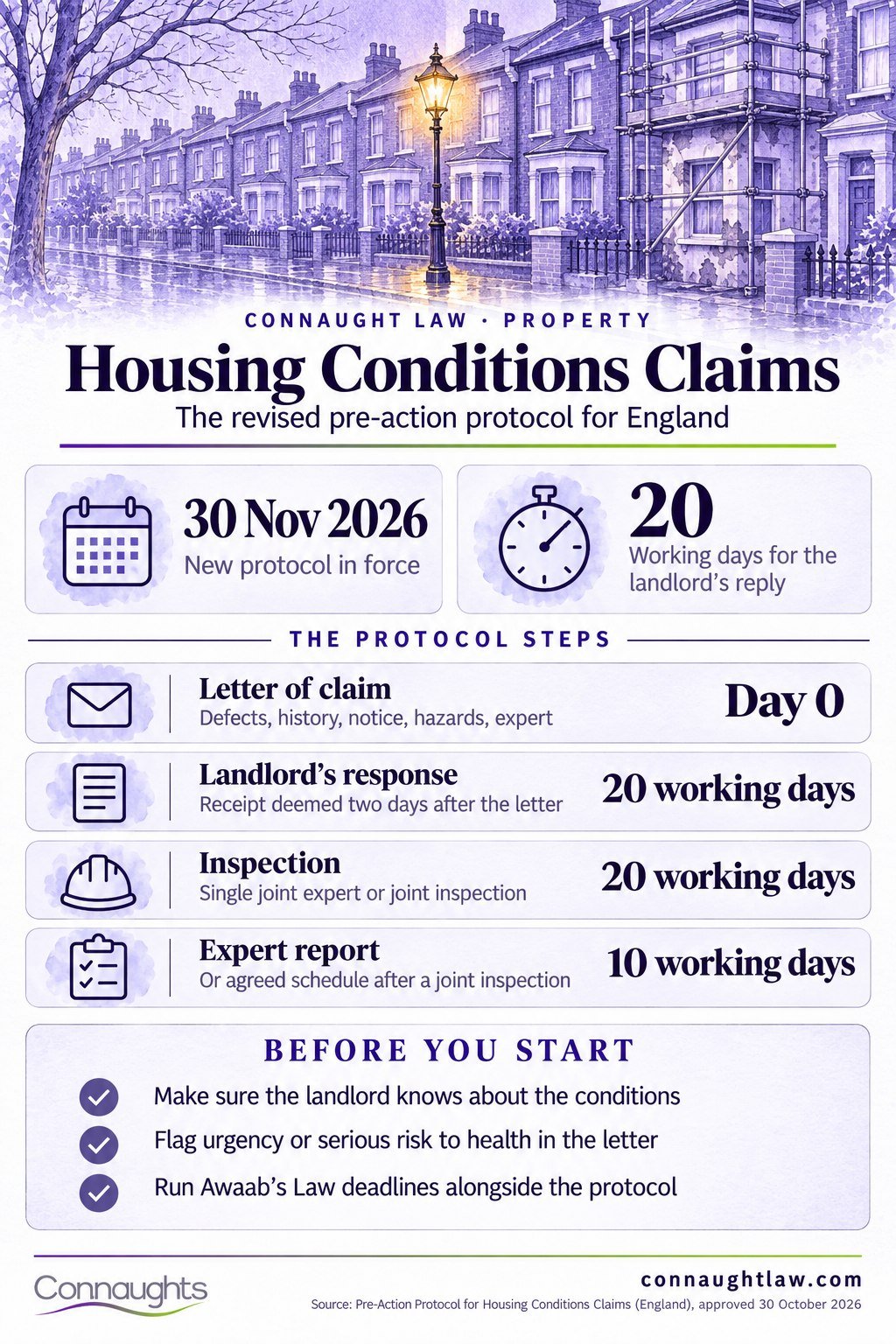
From 30 November 2026, tenants and others bringing housing conditions claims in England follow a substituted protocol. It now covers claims under sections 9A, 10A and 11 of the Landlord and Tenant Act 1985, adds Awaab’s Law content to the letter of claim, keeps the 20-working-day landlord response, and states that it never excuses delay in legal duties.
Who Can Use the Protocol
The Claims It Covers
The protocol applies to residential property in England and to any civil claim about the condition of the premises, including the existence or possible existence of a hazard. It names the three covenants implied by the Landlord and Tenant Act 1985 (section 9A fitness, section 10A hazards, section 11 repair), section 4 of the Defective Premises Act 1972, nuisance, negligence and the tenancy’s own terms. Claims under section 82 of the Environmental Protection Act 1990, heard by magistrates, are outside it.
Who Counts as a “Tenant”
Tenants, lessees, members of the tenant’s family and anyone else with a housing conditions claim. A personal injury element needing more than a GP’s letter follows the Personal Injury Pre-Action Protocol instead.
Counterclaims Sit Outside It
Where disrepair is raised as a counterclaim or set-off, typically in a landlord’s possession claim for rent arrears, the protocol does not apply, although both sides are still expected to exchange information and try to settle early. How that defence works is covered in our guide to tenant defences and counterclaims in possession claims.
What Changes on 30 November 2026
The Civil Procedure Rule Committee’s 5 June 2026 minutes record the aims: a clearer structure, reflecting the Hazards in Social Housing (Prescribed Requirements) (England) Regulations 2025 (Awaab’s Law), more emphasis on ADR, and highlighting urgent exceptions. Set against the current text, the main differences are these.
Current and Revised Protocol Compared
| Issue | Current protocol | From 30 November 2026 |
|---|---|---|
| Statutory claims named | Sections 9A and 11 | Sections 9A, 10A and 11; hazards expressly included |
| Urgent cases | Early expert allowed for urgency | Also: full or partial compliance may be inappropriate where there is serious risk to health or welfare, or statutory time limits apply |
| Landlord’s duties | Not addressed | Protocol is no reason or excuse to delay any legal duty |
| ADR | Consider ADR; complaints and arbitration listed | ADR at any stage; court can order it; litigation a last resort |
| Letter of claim | Defects, history, notice, effects | Adds Awaab’s Law breaches, hazard category and urgency |
| Access | Reasonable access under the tenancy | Parties must co-operate so the property is made safe as soon as possible |
Awaab’s Law in the Letter of Claim
Where the 2025 Regulations are relied on, the letter of claim must say why the tenant believes the landlord has not met its duties (investigation, written summary, works, updates, safety advice) and whether the home is affected by an “emergency hazard” or a “significant hazard”. The specimen letters now carry separate sections for Awaab’s Law breaches, for failures to give information, and for ordinary disrepair.
The Steps and the Time Limits
Step One: The Letter of Claim
The landlord must know about the conditions, since notice may be a precondition of liability; the letter of claim can itself be that notice, and in urgent cases a short notification can go first. The letter sets out the defects (a room-by-room schedule is provided), their history, previous notice, the effect on the household, special damages and the proposed expert, and asks for the tenancy agreement, tenancy file, notice records, inspection reports and computerised records.
Step Two: The Landlord’s Response
A corporate landlord should name a point of contact. The reply is due within 20 working days of receipt, with receipt deemed two days after the date of the letter, and sooner where there is urgency. The new text adds that this does not change any period the 2025 Regulations or other legislation sets for investigations, works or information. It covers disclosure, the expert proposal and investigations; liability, a dated schedule of works and any offers can follow within 20 working days of the expert’s report.
Step Three: Expert and Inspection
Expert evidence is limited to what is reasonably required, and the court’s permission is needed to use a report. If the landlord does not object within 20 working days, the tenant’s proposed expert becomes a single joint expert, with costs shared equally. Failing that, the parties should try a joint inspection. Either way, the inspection should happen within 20 working days of the landlord’s response, and the report or agreed schedule should follow within 10 working days.
If the Protocol Is Ignored
A landlord who does not respond within 20 working days, or at all, is in breach, and the tenant is then free to issue proceedings. The court can order a party that unreasonably failed to comply to pay costs or face other sanctions, and weighs compliance when deciding costs. The protocol’s time limits are long stops: they can be varied by agreement, but the court will expect an explanation.
Urgent Cases and Limitation
Compliance may not be appropriate at all where there is a serious risk to health or welfare without urgent court action, or where following it would undermine statutory time limits. A tenant can instruct an expert early to seek an interim injunction or preserve evidence. Where limitation is close, the tenant should ask the landlord not to rely on it; if proceedings must be issued first, the parties should ask the court to stay them while the protocol runs.
Costs on Settlement
If the claim settles on terms that justify bringing it, the landlord pays the tenant’s reasonable costs (Form N260 can set them out). Disputes that do not settle move to court, where our litigation team acts for both landlords and tenants.
The Law Behind the Claim
Section 11 Repair and Section 9A Fitness
Section 11 of the Landlord and Tenant Act 1985 implies a landlord’s covenant in short residential leases to keep the structure and exterior in repair, and to keep the installations for water, gas, electricity, sanitation, space heating and hot water in repair and proper working order. The standard has regard to the property’s age, character, prospective life and locality. Section 9A adds a covenant that the dwelling is fit for human habitation at the start of the lease and stays so, with exceptions including unfitness caused by the tenant’s own breach of covenant and things the tenant is entitled to remove.
Section 10A and Awaab’s Law
Section 10A implies a covenant that the landlord will comply with prescribed requirements to deal with hazards within set periods. It currently applies only to social housing let by registered providers, and the prescribed requirements are in the 2025 Regulations, in force since 27 October 2025. The landlord has a defence if it used all reasonable endeavours to avoid the breach.
Extension to Private Renting: Not Yet Law
Section 60 of the Renters’ Rights Act 2025 rewrites section 10A so it can reach private tenancies, but legislation.gov.uk shows that section as prospective: it is not yet in force. The government’s consultation on how to extend Awaab’s Law to private tenancies and licences opened on 9 October 2026 and closes on 18 December 2026, as our news report on the consultation explains. For now, private landlords face section 11, section 9A and the contract. The wider Renters’ Rights Act timetable is in our section 21 abolition guide.
What Landlords and Tenants Should Do Now
- Report the problem in writing first and keep a copy; notice may be a precondition of the landlord’s liability.
- Photograph and video defects before and after any works.
- Say clearly in the letter of claim if the situation is urgent, and why.
- Allow reasonable access for inspection and works: the protocol requires it.
- Diarise the 20-working-day response from deemed receipt, two days after the letter’s date.
- Run statutory hazard timetables alongside the protocol; one does not pause the other.
- Answer the expert proposal on time, or the tenant’s expert becomes the single joint expert.
- Use complaints procedures, the Housing Ombudsman or mediation early; the court may ask for evidence of what was considered.
Landlords who also face possession issues should keep the two tracks distinct: arrears recovery under our rent arrears eviction guide can meet a disrepair counterclaim. Our property evictions team and property law solicitors handle both, and our ADR practice covers the negotiated route the protocol now favours.
Frequently askedQuestions about housing conditions claims
When does the new housing conditions pre-action protocol come into force?
On 30 November 2026. The Master of the Rolls approved the substituted Pre-Action Protocol for Housing Conditions Claims (England) on 30 October 2026. It replaces the current protocol in full, so letters of claim sent from that date should follow the new text and its specimen letters.
How long does a landlord have to respond to a disrepair letter of claim?
Normally 20 working days from receipt, with receipt deemed two days after the date of the letter, and a shorter reasonable period where the case is urgent. Statutory deadlines, including those under Awaab’s Law, run separately and are not extended by the protocol.
Does Awaab’s Law apply to private landlords?
Not yet. Section 10A currently covers social housing let by registered providers. The Renters’ Rights Act 2025 contains the power to extend it, but that section is not in force, and the government’s consultation on applying it to private tenancies closes on 18 December 2026.
Do I have to follow the protocol if my home is dangerous?
Not necessarily. The protocol says full or partial compliance may not be appropriate where there is a serious risk to health or welfare without urgent court intervention. A tenant may instruct an expert early, seek an interim injunction, or act to preserve evidence.
Who pays for the expert in a housing disrepair claim?
If a single joint expert is instructed, each side pays half of the inspection and report. If each side instructs its own expert, each pays its own. The court later decides whether separate experts were reasonable and whether those costs can be recovered.
Does the protocol apply to a disrepair counterclaim?
No. Claims that begin as counterclaims or set-offs in other proceedings, usually a landlord’s possession claim for arrears, are outside the protocol. The parties are still expected to exchange information sensibly and to try to settle at an early stage.
Send us the letter, the tenancy agreement and the repair history. We will check it against the new protocol, set out the deadlines that apply on both sides, and tell you where the claim or the defence is strong and where it is exposed.
Get Expert Advice