
Right to Buy is about to change. The Social Housing Bill, now in its final Commons stages, will raise the qualifying period from three years to ten, cut discounts to between 5% and 15% of value, and take new-build social homes out of the scheme for 35 years. An RTB1 served before Royal Assent will, the government says, be dealt with under today’s rules. Below: the law in force, the reforms and the purchase.
On This Page
Right to Buy in 2026: Two Rulebooks, One Deadline
Right to Buy lets most secure council tenants in England buy their home at a discount under Part V of the Housing Act 1985. Maximum cash discounts were cut on 21 November 2024. A larger reform, consulted on over the winter of 2024–25 and confirmed in July 2025, is now going through Parliament as the Social Housing Bill, and on 3 November 2026 the government published information for tenants on what the Bill will do. None of it is law yet.
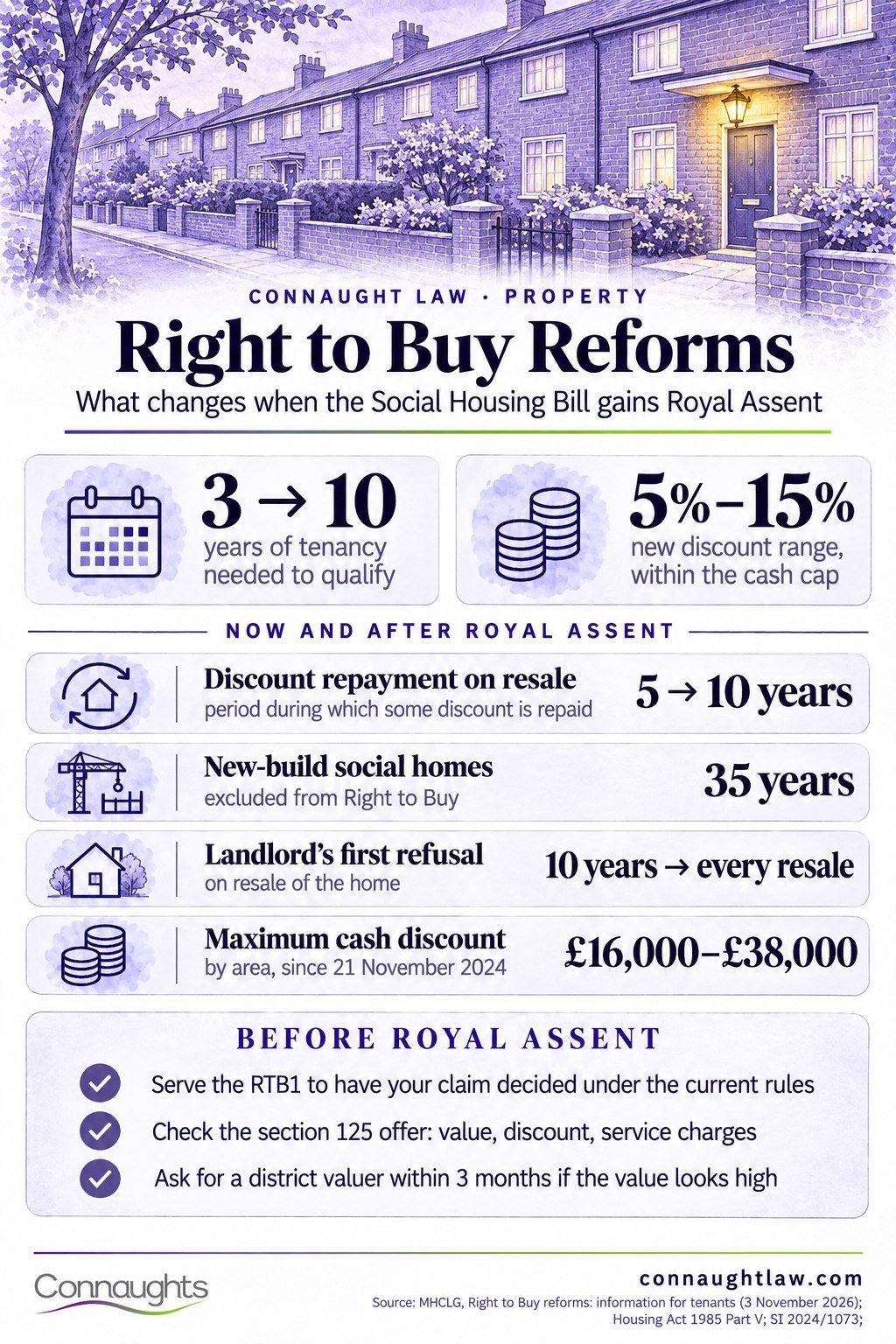
Today: three years as a public sector tenant, discounts of 35% (houses) or 50% (flats) rising with tenancy length, capped at 70% of value or a regional cash limit of £16,000 to £38,000. After the Social Housing Bill gains Royal Assent: ten years, discounts of 5% to 15% of value within the cash cap, and a ten-year discount repayment period. The government says an RTB1 served before Royal Assent will be considered under the existing rules.
Who Qualifies Now
The Current Conditions
Under the GOV.UK guidance, you can apply if the home is your only or main home, it is self-contained, you are a secure tenant, and you have had a public sector landlord — a council, housing association or NHS trust, for example — for three years, which need not be in a row. Joint claims can include up to three family members who have lived with you for twelve months. Tenants whose council home was transferred to a housing association while they lived there may have the Preserved Right to Buy.
Discounts Since November 2024
Houses get 35% after three to five years, plus 1% for each further year; flats get 50%, plus 2% a year. The discount is capped at the lower of 70% of value or the regional maximum fixed by the Limits on Discount Order 2024 for claims served from 21 November 2024: £16,000 in most of London (£38,000 in Barking and Dagenham and Havering), £22,000 in the North East, up to £38,000 in the South East. The same Order set a 30-year “cost floor”: landlord spending on building or maintaining the home in that period reduces the discount, and removes it if spending exceeds the home’s value.
What the Social Housing Bill Changes
Right to Buy: Now and After the Bill
| Rule | In force now | After Royal Assent |
|---|---|---|
| Qualifying period | 3 years | 10 years |
| Discount | 35% houses, 50% flats, rising; max 70% or cash cap | 5% at 10 years, +1% a year; max 15% or cash cap |
| New-build social homes | Discount limited by 30-year cost floor | Excluded for 35 years |
| Discount repayment on resale | Within 5 years | Within 10 years |
| Landlord’s right of first refusal | 10 years | Every resale |
| Landlord’s offer notice | 8 weeks freehold, 12 weeks leasehold | 12 weeks houses, 16 weeks flats and leasehold houses |
A Longer Wait, a Smaller Discount
The minimum period rises to ten years of qualifying tenancy: someone with eight years when the rules start needs two more. Discounts for houses and flats alike start at 5% of value at ten years, rise 1% a year, and stop at 15% or the cash cap, whichever is lower — so a twelve-year tenant gets 7%. Right to Acquire, for housing association tenants, follows the eligibility changes, but its £9,000 to £16,000 discounts stay as they are.
Homes and People Taken Out
Newly built social homes will be exempt for 35 years — a home completed in 2027 would not be buyable until 2062. Homes in National Parks, Areas of Outstanding Natural Beauty and designated rural areas will be excluded, as will council homes let at market rent. Anyone who has used the scheme before is barred unless they left that home because of domestic abuse or the breakdown of a marriage or civil partnership; anyone who owns a residential property, in the UK or elsewhere, is barred unless they left a home because of domestic abuse. The government also plans to let landlords pause the statutory timescales for up to six months during a fraud investigation. Our news report covers the Preserved Right to Buy and Right to Acquire changes.
When the Reforms Start
In Force Versus Proposed
In force: the November 2024 cash caps and the 30-year cost floor. Proposed: everything in the Social Housing Bill. The Bill began in the House of Lords in May 2026, completed Commons committee stage on 3 November 2026, and was awaiting Commons report stage when this guide was written. The government’s own factsheets say the date of Royal Assent “is currently unknown”, and the measures take effect once it is given.
The RTB1 Deadline
The factsheets are clear on transition: to have an application considered under the existing rules, the tenant must serve the RTB1 notice — or the RTA1 form for Right to Acquire — before the Bill gains Royal Assent. For a tenant with between three and ten years, that is the decision point. The notice can be withdrawn at any time, but it is a claim to buy: serve it knowing the mortgage and costs are realistic.
How a Right to Buy Purchase Works
The RTB1 and the Landlord’s Reply
The claim is a written notice under section 122 of the Housing Act 1985 — in practice the RTB1 form. The landlord must admit or deny the right within four weeks, or eight where part of your qualifying period was with another landlord, giving reasons for any refusal. If the landlord is late at any stage, the RTB6 and RTB8 delay notices mean rent paid while you wait could come off the price. From there the steps — searches, mortgage offer, completion and registration — follow the pattern in our first-time buyer conveyancing guide.
The Section 125 Offer
Once the right is established, the landlord serves its offer notice under section 125: within eight weeks for a freehold, twelve for a lease. It must state the value, the discount and how both were worked out, the proposed terms of the transfer or lease, any known structural defects and, for a flat, service charge estimates. You then have twelve weeks to say whether you will proceed. If you think the value is too high, you have three months from the offer to ask for a determination by the district valuer — the moment to have a property solicitor read the notice line by line.
Buying a Council Flat
The Lease and the Service Charge Cap
A council flat is sold on a long lease — normally not less than 125 years where the council’s own interest allows — so the lease review in our leasehold buyer’s guide applies in full. Right to Buy adds one protection: for the first five years, repair charges are capped at the estimates in the section 125 notice plus an inflation allowance. After that the cap falls away, so ask the council what major works are planned for the block before you commit.
Buying a Council House
A house is normally transferred freehold, with the landlord’s offer due within eight weeks rather than twelve. The checks then mirror any freehold purchase — boundaries, rights of way, planning history — with the discount covenant and the right of first refusal written into the transfer.
Selling, Remortgaging and Lenders
Repaying the Discount
Sell within five years and you repay part of the discount: all of it in the first year, then 80%, 60%, 40% and 20%, measured against the home’s value when you sell. The obligation is a covenant in the transfer or lease and, under sections 155 and 156, a charge on the property. After the reforms the period becomes ten years: 100% in year one, 90% in year two, falling 10% a year. For ten years you must also first offer the home to the former landlord, which has eight weeks to agree; after the reforms that applies on every resale. Letting is not restricted: the consultation response rejected covenants against renting out, though a flat’s lease may have its own terms. Resale steps are in our guide to selling leasehold property.
Mortgage Lenders and the Discount Charge
The statutory charge ranks immediately after a mortgage from an approved lending institution used to buy, so mainstream lending is not blocked. Later borrowing is different: a further advance ranks ahead of the discount charge only if the landlord consents, which it must do for approved purposes — a step any remortgage in the first five years has to build in. Rural homes can carry resale limits to local buyers, which GOV.UK warns may make a mortgage harder. Applications funded by third-party “backers” deserve caution: the government has said it will explore how to crack down on them. Our real estate team acts on Right to Buy purchases from notice to completion.
Frequently askedQuestions about Right to Buy
Is Right to Buy changing in 2026?
The Social Housing Bill will change it, but not until Royal Assent, which had not been given in mid-November 2026. The reforms raise the qualifying period to ten years, set discounts at 5% to 15% of value and exempt new-build social homes for 35 years.
How long do you have to be a council tenant to buy your home?
Three years with a public sector landlord under the current rules, which need not be consecutive or with the same landlord. Once the Social Housing Bill gains Royal Assent the minimum becomes ten years, unless an RTB1 was served before that date.
What is the maximum Right to Buy discount in London?
£16,000 in most London boroughs and £38,000 in Barking and Dagenham and Havering, for claims served from 21 November 2024. The discount is the lower of that figure, 70% of value and the percentage your tenancy length earns.
Do I have to pay back my Right to Buy discount if I sell?
Yes, if you sell within five years under the current rules: 100% in year one, then 80%, 60%, 40% and 20%, measured against the value when you sell. For purchases under the reformed rules the period will be ten years.
Can I still apply under the old Right to Buy rules?
According to the government, yes — if your RTB1 notice is served on your landlord before the Social Housing Bill gains Royal Assent, your application will be considered under the existing rules. The date of Royal Assent is not yet known.
Can I buy a council flat under Right to Buy?
Yes. Flats are sold on a long lease, usually 125 years, with service charge estimates in the landlord’s offer and a five-year cap on repair charges tied to them. After the reforms, flats and houses will share the same 5% to 15% discount scale.
Tell us how long you have been a public sector tenant, whether the home is a house or flat, and where you are in the process. We will check the timing against the reforms, review the section 125 offer and run the purchase through to completion.
Get Expert Advice