
Since 25 November 2026, Domestic Abuse Protection Notices and Orders have been available everywhere in England and Wales, not just in the pilot areas. A notice gives immediate police protection; an order gives longer protection from any form of domestic abuse, including coercive control. This guide explains who can apply and to which court, what an order can require, the test the court applies, what breach means, and how these orders sit beside non-molestation and occupation orders.
On This Page
One Order for Every Form of Abuse
Part 3 of the Domestic Abuse Act 2021 created a single protective framework: a police notice for the first hours, and a court order for as long as protection is needed. After two years of piloting in selected areas, the Domestic Abuse Act 2021 (Commencement No. 10) Regulations 2026 brought it into force across England and Wales on 25 November 2026. If you are in immediate danger, call 999 and ask for the police; if you cannot speak on a mobile, press 55 when prompted.
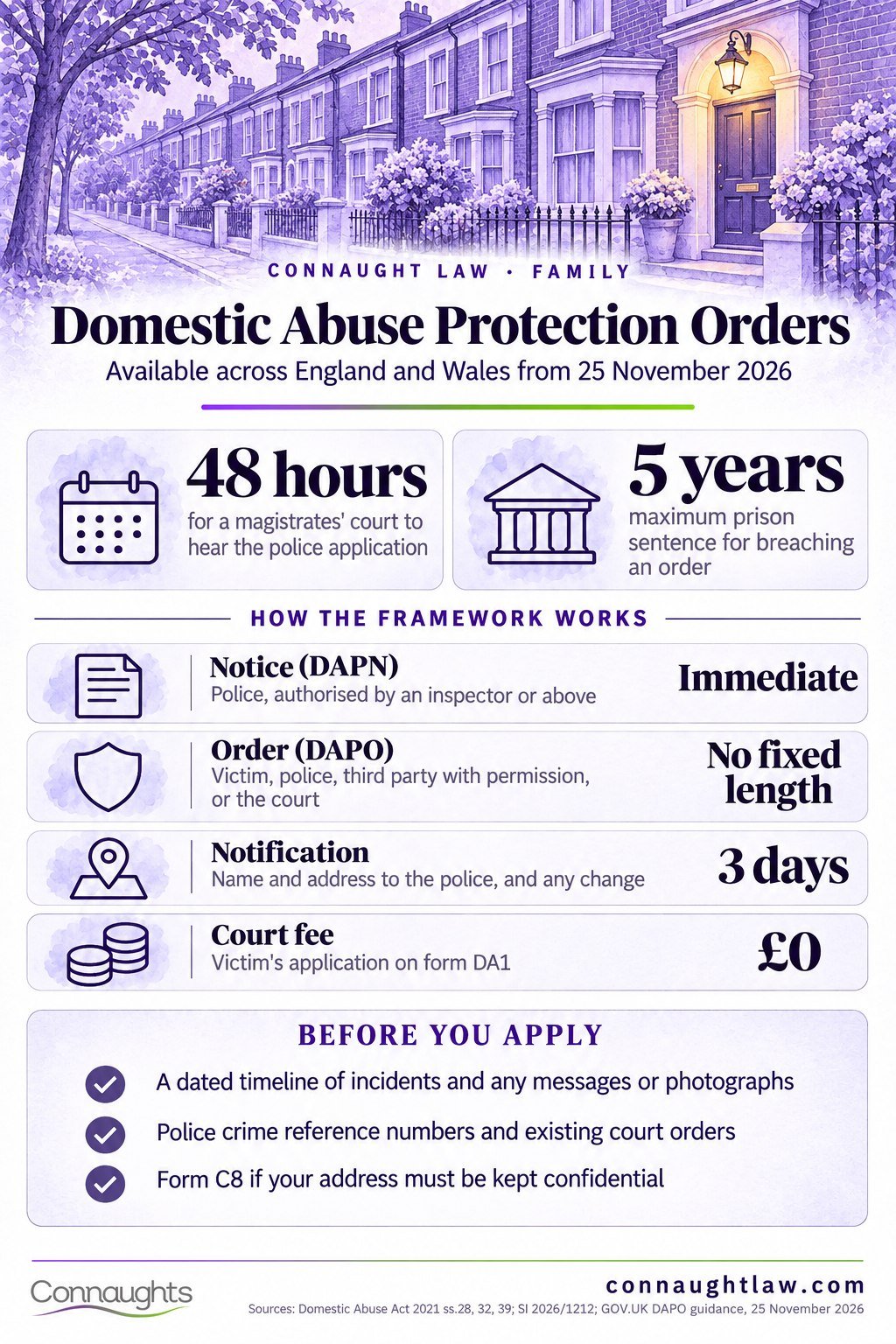
A Domestic Abuse Protection Order can stop an abuser contacting you, keep them away from your home and other places, decide whether they can stay in the home, and require them to give the police their name and address. You can apply yourself in the family court on form DA1, with no court fee; the police and, with permission, other people can apply too. Breach is a criminal offence carrying up to five years’ imprisonment.
Notice or Order
The Notice: Immediate Police Protection
A Domestic Abuse Protection Notice (DAPN) is issued by the police, authorised by an officer of at least the rank of inspector. It can be given where there are reasonable grounds to believe that a person aged 18 or over has been abusive towards someone aged 16 or over to whom they are personally connected — a current or former spouse, civil partner or partner, or a relative, for example. The notice sets out rules the person must follow at once, such as staying away from your home.
A notice is a bridge: once the police issue one, they must apply for an order, and the application must be heard by a magistrates’ court within 48 hours; the notice stays in force until the court has considered it. Failing to follow a notice can lead to arrest.
The Order: Longer-Term Protection
A Domestic Abuse Protection Order (DAPO) is the court order that usually follows a notice, but it can also be made without one. It covers every form of abuse in the Act’s definition — physical or sexual abuse, violent or threatening behaviour, controlling or coercive behaviour, economic abuse, and psychological or emotional abuse — so a physical injury is not required. It protects only people aged 16 or over; a younger child needing protection can be covered by a non-molestation or occupation order.
Who Can Apply, and Where
Victims, the Police and Third Parties
Under section 28 of the Act, an application can be made by the person who needs protection, by the police, or by anyone else with the court’s permission. That third route lets a family member, friend, specialist domestic abuse worker or social worker apply on your behalf, using form DA2 to ask permission alongside the DA1 application. The police must consider your views before acting, and if they apply you cannot be compelled to attend the hearing unless you have submitted evidence.
Family, Civil and Criminal Courts
Applications by victims and third parties go to the family court; police applications go to the magistrates’ court. If you and the other person are already parties to family or civil proceedings — a children dispute, for example — you can apply within those proceedings, and a county court case is the place to apply if that is where your civil claim is. Courts can also make an order on their own initiative in family, criminal and certain civil proceedings, after considering your views, even where the case is not about domestic abuse; in a criminal case that power applies whether the defendant is convicted or acquitted. Where abuse allegations shape arrangements for children, the court’s approach is explained in our guide to fact-finding hearings.
What an Order Can Require
Prohibitions and the Home
The court can include whatever it considers necessary and proportionate to protect you. Prohibitions commonly stop contact by phone, text, email or social media, and keep the person a specified distance from your home, workplace or other named places. An order can also decide whether the respondent may stay in, or return to, a shared home. Every order carries mandatory notification: the person must give the police their name and address within three days of the order, and report any change within three days.
Positive Requirements and Electronic Monitoring
An order can also require positive action. Practical requirements, such as removing content about you from social media or returning keys to a property, are available in every court. Programme-based requirements, such as a behaviour change programme, are for now available only where the police apply or the order is made in criminal proceedings. The Act allows electronic monitoring, but the government’s guidance confirms it is not yet available for these orders.
How Long an Order Lasts
There is no minimum or maximum duration. Under section 38 an order lasts for a fixed period, until a specified event, or until a further order, and different requirements can run for different periods. If an order is ending and you still feel unsafe, you, the police or a third party can apply to extend it on form DA3.
The Test the Court Applies
Section 32 sets two conditions. Condition A: the court is satisfied on the balance of probabilities that the person has been abusive towards someone aged 16 or over to whom they are personally connected. Condition B: the order is necessary and proportionate to protect that person from domestic abuse, or the risk of it. The abuse can have happened abroad or before the Act came into force, and the statutory guidance points to patterns of behaviour and the risk of escalation, not just a single incident. No order can be made against someone under 18.
In an urgent case the court can make an order without the other person being told first, where that is just and convenient. Your witness statement must explain why notice was not given, and the other person must then have a chance to respond at a hearing as soon as possible.
What Happens on a Breach
A Criminal Offence
Breaking any requirement of an order without reasonable excuse is an offence under section 39. On conviction in the Crown Court the maximum is five years’ imprisonment, a fine, or both; a conditional discharge is not available. The police investigate every reported breach, whichever court made the order and whoever applied for it, so report it to them and keep the crime reference number. Breach can alternatively be dealt with as contempt of court, but the same conduct cannot be punished both ways. Enforcing other family orders works differently, as our guide to breaching family court orders explains.
DAPOs and the Family Law Act Orders
Which Order Fits
Non-molestation and occupation orders under the Family Law Act 1996 remain available; the statutory guidance says so expressly. The police’s older Domestic Violence Protection Notices and Orders are being kept for a six-month transition, with the government intending to repeal them after that.
The Orders Compared
| Point | DAPO | Non-molestation order | Occupation order |
|---|---|---|---|
| Who applies | Victim, police, third party with permission, or court of its own motion | Victim | Victim |
| Courts | Family, civil and criminal | Family court | Family court |
| Covers | Contact, distance, the home and positive requirements | Contact and harassment | Who lives in or enters the home |
| Breach | Criminal offence, up to 5 years | Criminal offence, up to 5 years | Not a criminal offence; contempt |
| Protects | People aged 16 or over | Applicant and relevant children | Applicant and relevant children |
Where children are involved, protective orders and child arrangements have to fit together, and our family law team considers both at once. If your visa depends on the relationship, read our guide to domestic abuse and immigration rights before you leave, and the wider picture is in our VAWG overview.
Applying, Costs and What to Bring
Forms and Fees
To apply in the family court you complete form DA1 and a supporting witness statement. If you do not want the other person to see your or your child’s address, leave it out of the application and use form C8. You must not serve the papers yourself; without a solicitor, form D89 asks a court official to do it. There are no court fees for applying, or for applying to vary or discharge an order. The government’s guidance for victims, published on 25 November 2026, sets out each route, and the police follow the statutory guidance updated the same day.
What to Bring to a Solicitor
Bring what you have, without putting yourself at risk to gather more: a short timeline of incidents with dates, messages, emails and voicemails, photographs, any police crime reference numbers, GP or support-worker records, details of any existing court orders or proceedings, and the other person’s address if known. Children, a shared home and your immigration status each change the strategy. Our domestic abuse solicitors can tell you which order, or which combination, gives the strongest protection.
Frequently askedQuestions about domestic abuse protection orders
Are domestic abuse protection orders available everywhere in England and Wales?
Yes. Part 3 of the Domestic Abuse Act 2021 came into force across England and Wales on 25 November 2026, ending the pilot that began in November 2024 in selected areas. You can now apply to your nearest family court wherever you live, and every police force can issue notices.
What is the difference between a DAPN and a DAPO?
A DAPN is a notice the police issue for immediate protection. They must then apply for a DAPO, which a magistrates’ court hears within 48 hours. The DAPO is the court order that gives longer protection, and it can also be made without a notice having been issued.
Can someone else apply for a DAPO on my behalf?
Yes. The police can apply, and a family member, friend, support worker or social worker can apply to the family court with the court’s permission, using forms DA1 and DA2. The police must consider your views first, and the court can make an order even without your consent.
How much does it cost to apply for a domestic abuse protection order?
There is no court fee for a victim applying for a DAPO, and no fee to apply to vary or discharge one. Your own costs are your solicitor’s fees, if you instruct one; you can also apply yourself using form DA1 and a witness statement.
What happens if someone breaks a domestic abuse protection order?
Breach without reasonable excuse is a criminal offence. The police investigate whichever court made the order, and on conviction in the Crown Court the maximum sentence is five years’ imprisonment, a fine, or both. Report every breach and keep the crime reference number you are given.
Can I still get a non-molestation order instead of a DAPO?
Yes. Non-molestation and occupation orders under the Family Law Act 1996 remain available alongside DAPOs, and they are the route for protecting a child under 16. Which order fits depends on who needs protection, the home and any existing proceedings.
Tell us what has been happening, who is at risk and whether there are children or court proceedings already. We will advise which order fits and whether an urgent application without notice is justified.
Get Expert Advice