
The phrase people search for is good news, and there has been some — but not the kind the internet promises. No compensation scheme exists. No general vindication has been announced. What has happened is narrower and more useful: the courts have settled how these cases are decided, the Home Office has published what it will do when an allegation fails, and a damages claim brought by people accused after ETS tests is now working its way through the High Court.
On This Page

Where TOEIC Cases Stand in 2026
The single most important thing to understand is that the law did not move in claimants' favour. In DK and RK the Upper Tribunal held that the evidence the Home Office tenders in ETS cases is enough to require an answer from anyone whose test is attributed to a proxy. The Court of Appeal held in Chowdhury v SSHD [2025] EWCA Civ 36 that a tribunal errs if it fails to engage with that decision, and it was still being recorded as the governing position in Rahim in July 2026. Anyone telling you the ETS evidence has been discredited is describing a case that was lost.
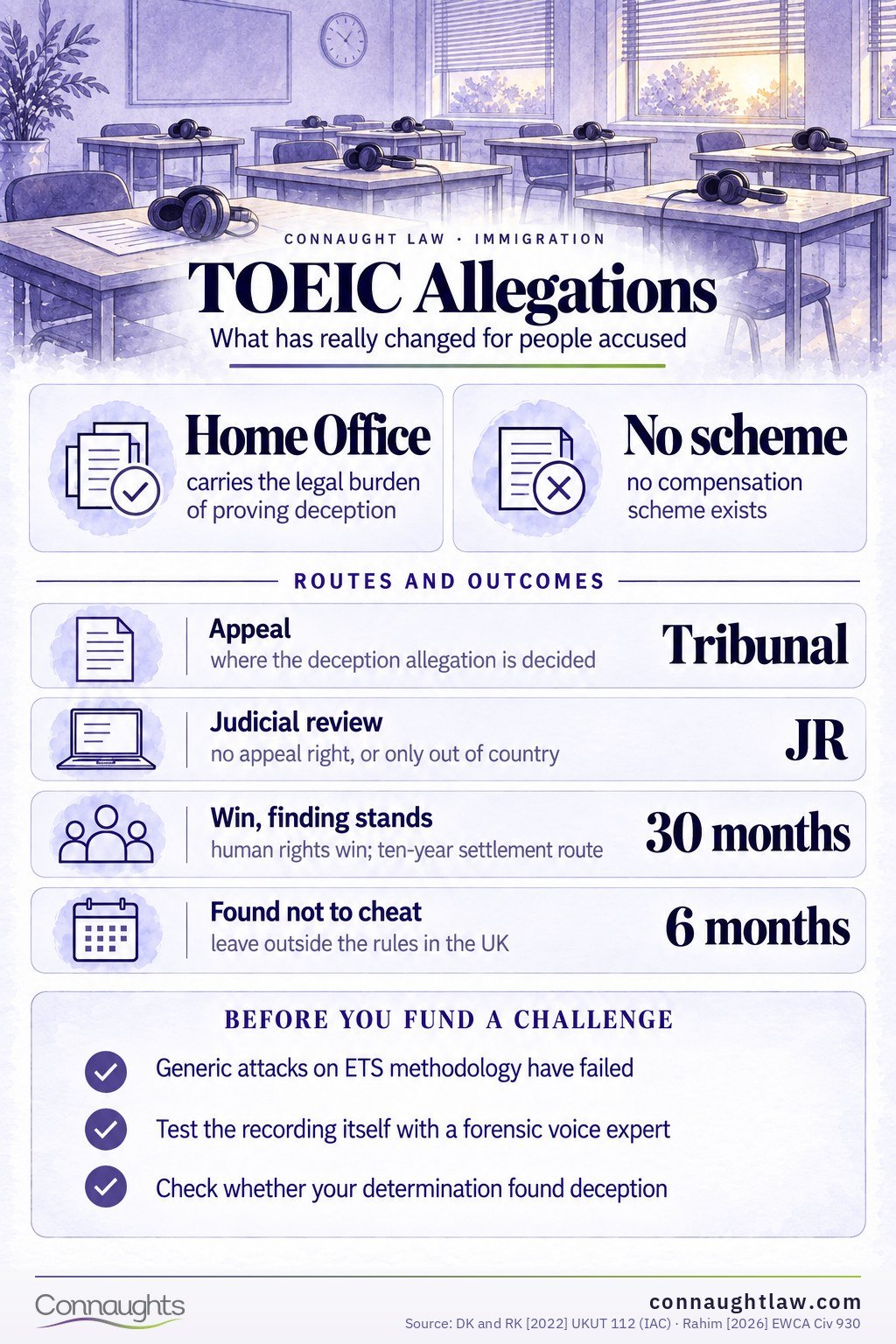
That is not the same as saying the allegations are proved. The legal burden of proving deception rests on the Secretary of State throughout, on the balance of probabilities, and it never shifts. What DK and RK settled is that the generic and individual ETS material discharges the evidential burden — which means the case turns on what you can put in answer, not on whether the Home Office has said enough to start.
Quick answer — what has and has not changed
The standard of proof has not changed and the burden still sits with the Home Office. What has changed is that the ETS evidence is now accepted as sufficient to require a response, so a case is won or lost on the individual's own evidence rather than on attacking the system.
The Burden of Proof, Stage by Stage
The framework has three stages, and the burdens do not switch between them. The Secretary of State carries the legal burden of proving dishonesty on the balance of probabilities. She discharges an evidential burden by producing the generic evidence about the ETS testing operation together with the individual records attributing your test to a proxy. You then have to produce credible evidence in answer.
The Upper Tribunal put it this way in DK and RK [2022] UKUT 112 (IAC): "The burden of proving the fraud or dishonesty is on the Secretary of State and the standard of proof is the balance of probabilities … The burdens of proof do not switch between parties but are those assigned by law." The same decision was blunt about what will not work: mere assertions of ignorance or honesty are very unlikely to displace the account shown by the documents.
The Court of Appeal restated that position in Rahim [2026] EWCA Civ 930, recording that where the ETS evidence is not contradicted by credible evidence in an individual case it is amply sufficient to prove the fact on the balance of probabilities. That appeal was dismissed on a separate point, but in Chowdhury the year before the First-tier Tribunal was held to have erred by failing to engage with DK and RK at all. A determination that does not grapple with the Home Office's evidence is vulnerable whichever way it goes.
What Expert Evidence Can and Cannot Do
An expert cannot prove you did not cheat. What a properly instructed forensic speech expert can do is compare your voice with the recording ETS holds for the test attributed to you, and give an opinion on whether they are the same speaker. That is a question about your individual file, and it is the ground on which these cases are still occasionally won.
Expert evidence aimed at the system rather than the recording has a poor record. In Varkey and Joseph the Upper Tribunal held that the general conclusions in DK and RK were not in any way undermined, and distinguished the Post Office litigation on the footing that, unlike there, there is no evidence that there were bugs or glitches. Attacks on the reliability of the ETS methodology in the abstract have been run, considered and rejected.
System or recording — where a challenge still bites
Generic attacks on ETS's methodology have been tried and have failed. A challenge that engages with the specific recording held against you, and with the circumstances of the day you sat the test, is a different exercise and is the one worth funding.
One point of vocabulary matters here, because it is the thing most often misunderstood. A solicitor does not give expert evidence. Our role is to obtain the ETS material for your case, judge whether the recording is worth putting to an expert, instruct the right one, and put the resulting report before the tribunal in admissible form. A legal representative advertising itself as an expert witness in TOEIC cases is describing something it cannot be.
Routes That Remain Open After a Refusal
Which route is available depends on what decision was made and when. A refusal of a human rights claim usually carries a right of appeal to the First-tier Tribunal, and that is where the deception allegation is tried. Where there is no appeal right, or where the only appeal offered is from outside the United Kingdom, judicial review is the remedy — the Court of Appeal held in Ahsan that an out-of-country appeal would not satisfy the procedural requirements of article 8.
Three doors — and what each one asks of you
- Appeal to the First-tier Tribunal — available against refusal of a human rights or protection claim, and the forum in which the deception allegation is actually decided. Who can appeal and how.
- Judicial review — the route where no appeal right exists, or where the appeal offered is out-of-country. It tests the lawfulness of the decision, not the merits. Grounds, time limits and cost.
- Further submissions — where a human rights or protection claim has been refused and appeal rights are exhausted, paragraph 353 asks whether new material creates a realistic prospect of success. How the test is applied.
Outcomes are published rather than guessed at. The Home Office's ETS caseworker guidance records that where an appeal succeeds on human rights grounds but the deception finding stands, the grant is thirty months under the exceptions in Appendix FM — and suitability remains unmet, which places the person on the ten-year route to settlement rather than the five. Where a judge finds the person did not cheat, the grant is six months' leave outside the rules in the United Kingdom, or a free entry clearance application for those outside it.
Appeal Outcomes and What They Actually Mean
The most reliable published figures come from the National Audit Office, which investigated the Home Office's response and reported in May 2019. Around 12,500 appeals involving people matched to invalid or questionable TOEIC certificates were heard between April 2014 and March 2019. Individuals won 3,600 of the First-tier appeals, roughly two in five.
A win is not the same as a finding of innocence, and that distinction is why so much of what is written about these cases misleads. The National Audit Office recorded that the Department did not track why appeals were lost, and that in most cases appeals were made on human rights grounds. An appeal allowed under article 8 decides that removal would be disproportionate. It does not decide that the test was genuine.
Published Outcomes to March 2019
| Measure | Figure | What it counts |
|---|---|---|
| Appeals heard | Around 12,500 | Appeals involving people matched to invalid or questionable certificates, April 2014 to March 2019 |
| Appeals won by the individual | 3,600 | First-tier appeals; the Department did not record the reasons, and most were brought on human rights grounds |
| Holding some form of leave | 4,157 | People with invalid cases who held leave to remain as at March 2019 |
| Indefinite leave to remain | 532 | Within that group |
| British citizens | 477 | Within that group |
| Had left the United Kingdom | At least 11,356 | Including 7,206 voluntary returns and 2,468 enforced removals |
No more recent official set has been published. The Home Office told the High Court in 2026 that between January 2012 and December 2020 there were 16,663 appeals by individuals recorded as having sat an ETS test, but said it could not say how many of those concerned fraud allegations. Where a figure is not published, this firm does not estimate one.
Damages Litigation Now Before the High Court
A multi-claimant action is proceeding in the King's Bench Division. The claimants seek damages for breach of the Data Protection Acts of 1998 and 2018, the UK GDPR and article 8, arising from how their data was handled and how the allegations were made against them. In June 2026 the court decided a group of preliminary issues in Hossain and others v Home Office [2026] EWHC 1413 (KB).
Two of those rulings matter to anyone considering joining. The court held that DK and RK and Varkey do not amount to a change in the law capable of displacing an issue estoppel created by an earlier successful First-tier appeal. It also held that the Upper Tribunal's findings are not admissible at trial as evidence of the facts found, applying the rule in Hollington v Hewthorn as restated by the Supreme Court in Evans v Barclays Bank.
Preliminary issues only — what the June ruling settled
Hossain decided points of law about what evidence and which earlier findings can be used at trial. It did not award damages, find the Home Office liable, or create an entitlement for anyone who was accused.
Before You Count on a Damages Claim
There is no compensation scheme. No official source records the Home Office establishing one, and none records it formally refusing to. What is published is that in September 2019 the Public Accounts Committee recommended that the Home Office, within three months, "create and promote a fair and trustworthy means of helping all individuals who may have been wrongly accused to come forward and clear their names, including ensuring that all evidence from ETS is made available to them".
One figure is worth knowing because of how often it is misdescribed. The Home Office reached a financial settlement with ETS Global BV in 2018 for £1.6 million. That money was paid to the Department, not to the people accused, and the Committee set it against an estimated £21 million the Department spent responding to the cheating. It was not compensation for individuals and was never distributed as such.
Whether a damages claim is realistic in an individual case turns on what happened to that person: whether an earlier appeal was won and on what basis, what was done with their data, what loss followed, and when they knew enough to bring a claim. Limitation is the point most often overlooked, and the existence of a group action does not answer it for you.
What a Deception Finding Costs You Later
A deception finding does not stay in the decision it was made in. Since November 2025 the relevant rules sit in Part Suitability, which replaced Part 9 of the Immigration Rules. SUI 9.1 requires refusal where the decision maker is satisfied the applicant used deception in the application. SUI 10.1 and 10.2 reach false representations more widely, and apply whether or not the representation was made to the applicant's knowledge.
Beyond the refusal — where a finding follows you
- Later applications — SUI 9.1 makes refusal mandatory where deception in the application is established. The rules that replaced Part 9.
- Re-entry — deception in a previous application engages SUI 11.4(d), which triggers the mandatory refusal periods set by SUI 12.1. How long each ban runs.
- Certification — the Home Office certifies article 8 claims as clearly unfounded where a court or tribunal has already made an ETS deception finding, but its instructions say it should not where no such finding exists. What certification removes.
- Citizenship — casework instructions state that an ETS deception finding should be considered relevant to the assessment of good character.
Settlement applications carry a separate trap. Time spent on immigration bail has not counted towards lawful presence since 13 April 2023. For applications made before that date, the guidance states that where a bail period was followed by a grant of permission to stay, that period can count towards lawful presence on a long residence application — so the date an application was made can decide whether the route is open at all.
How We Approach a TOEIC Case
We start with the file rather than the story. That means obtaining the ETS material held against you, the decision and any determination, and establishing precisely what was alleged, when, and what has already been decided about it. Where an earlier appeal was won, what that appeal decided may matter more than anything else — both to a further immigration application and to any damages claim.
We will also tell you where a case is weak. Given DK and RK and the two Court of Appeal decisions that have applied it, most challenges resting only on the client's own account of sitting the test will fail, and it is not in anyone's interest to fund one. Where the recording is worth testing, or where there is a human rights case that stands on its own feet, we say so and act on it.
Frequently askedQuestions about TOEIC allegations and expert evidence
Can an expert witness prove I did not cheat?
An expert can compare your voice with the recording held against you and give an opinion on whether it is the same speaker. That is evidence, not proof, and it is weighed against the Home Office's material. Its value depends entirely on what the recording shows.
Is there a compensation scheme for people wrongly accused?
No scheme exists and none has been announced. A multi-claimant damages action is proceeding in the High Court, which is a different thing: it requires an individual claim, individual evidence of loss, and it carries the ordinary risks of litigation.
Does winning an appeal mean I have been cleared of cheating?
Not necessarily. Most successful appeals in these cases were allowed on human rights grounds, which decides that removal would be disproportionate rather than that the test was genuine. Whether a determination contains a finding on the deception issue matters greatly later, so read it carefully.
Can I still challenge an allegation made years ago?
Sometimes. Where a decision is old and appeal rights are exhausted, the route is usually further submissions or a fresh application rather than an appeal. What is possible depends on what decision exists, what was decided, and what new evidence you have.
Will a TOEIC allegation affect a citizenship application?
It can. Home Office casework instructions treat an established ETS deception finding as relevant to good character. Where no court or tribunal has made such a finding, the position is different, which is why what your determination actually says is worth checking.
What should I send a solicitor first?
The decision letter, any tribunal determination, and anything you have from the Home Office about the test itself. Those three documents establish what was alleged and what has already been decided, which is what determines your options.
Send us the decision, any determination and what the Home Office has said about your test. We'll tell you which route is open and whether it is worth running.
Get Expert Advice