
A dependant visa lets your partner and children live in the UK on the strength of your own visa, and whether you can use one now depends heavily on your route. Skilled workers, Global Talent holders and Innovator Founders can usually bring family; most students cannot; new care workers cannot. This guide compares the main routes, sets out the fees, surcharge and maintenance per dependant, and explains what happens on extension, separation and settlement.
On This Page

Your Visa, Their Permission
A dependant’s permission is tied to yours. It usually ends on the same date as the main applicant’s, rises and falls with it, and is granted under the same appendix of the Immigration Rules. That is what separates it from a family visa. A spouse or partner visa under Appendix FM is for the partner of a British or Irish citizen, a settled person or someone with protection status, among others, with its own financial and English tests, covered in our guide to the spouse visa requirements. If your partner is here on a work or study visa, the dependant route is the one that applies.
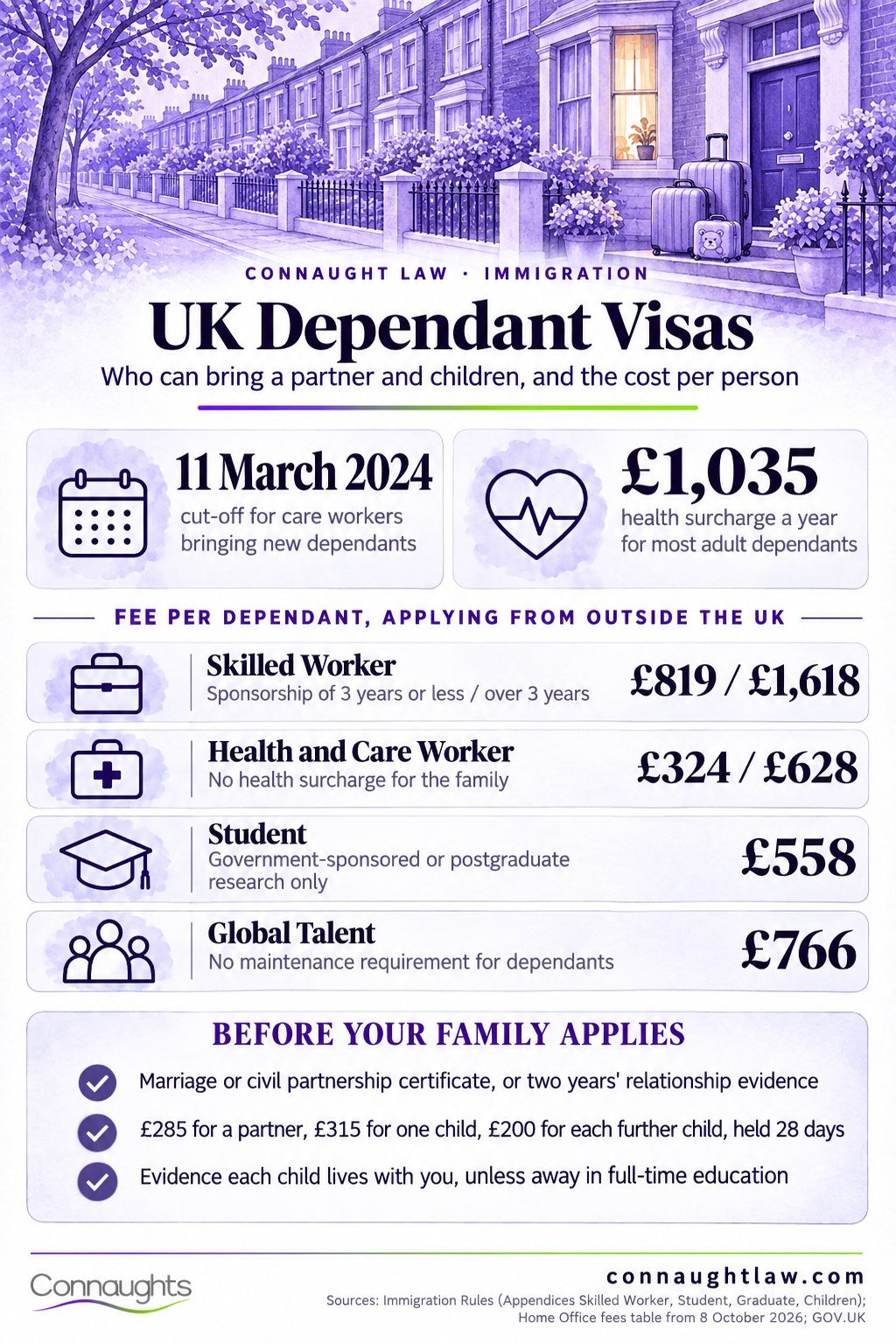
Skilled Worker, Global Talent and Innovator Founder holders can usually bring a partner and children under 18. Care workers who were not continuously sponsored before 11 March 2024 cannot bring new dependants, and the same applies to “medium skilled” jobs from 22 July 2025. Students can only if they are government-sponsored or on a postgraduate research course. Graduate visa holders can keep, but not add, dependants, apart from a child born in the UK.
Who Counts as a Dependant
Partners and the Two-Year Rule
A dependant partner is a husband, wife, civil partner or unmarried partner, aged 18 or over. Appendix Relationship with Partner requires unmarried couples to have been in a relationship similar to marriage for at least two years before the application. You do not always need to have lived together: GOV.UK accepts couples apart for work, study or cultural reasons if they can show ongoing commitment. In every case the relationship must be genuine and subsisting, and the couple must have met in person.
Children Under and Over 18
Appendix Children requires a child to be under 18 when they apply, unless their last grant was as a dependent child, so a child who turns 18 here can extend. An adult child applying for the first time cannot. The child must not be married or in a civil partnership, must live with you unless away in full-time education, and both parents must normally be applying or already have permission, unless one has sole responsibility or is the sole surviving parent.
Route by Route
Skilled Workers and Care Workers
The Skilled Worker route allows dependants, with two exceptions. Care workers and senior care workers (SOC 6135 and 6136) can bring a partner or children only if they have been continuously employed in those roles on a Skilled Worker or Health and Care Worker visa since before 11 March 2024. Workers in jobs listed as “medium skilled” face the same rule from 22 July 2025. In both cases a child born in the UK can still be added, and there are narrow in-country exceptions for sole parents and for children whose other parent is also sponsored, set out on the GOV.UK partner and children page. The Health and Care Worker visa follows the same restrictions.
Students and Graduates
Under Appendix Student, a student can bring dependants only if they are government-sponsored on a full-time course of six months or longer, or a full-time postgraduate student on a course of nine months or longer which, for courses starting on or after 1 January 2024, must be a PhD, another doctorate or a research-based higher degree. Taught master’s students starting since then cannot bring family; our student visa team advises on the research-degree exception. Under Appendix Graduate, only partners and children who were already your dependants as a student can stay with you, plus a child born in the UK; the Graduate visa itself drops from two years to 18 months for non-doctoral graduates applying on or after 1 January 2027.
Global Talent and Innovator Founder
Both routes allow a partner and children with no sponsorship link. Global Talent sets no maintenance requirement for dependants; Innovator Founder asks the same family funds as Skilled Worker. Our business immigration team handles founder and sponsored-worker family applications together.
Fees, Surcharge and Maintenance
Dependants by Route
| Route | New dependants? | Visa fee per dependant | Health surcharge a year |
|---|---|---|---|
| Skilled Worker | Yes, with limits for medium-skilled jobs from 22 July 2025 | £819 (up to 3 years) or £1,618 from outside the UK; £943 or £1,865 inside | £1,035 adult, £776 child |
| Health and Care Worker | Yes, except care workers sponsored since 11 March 2024 | £324 or £628 | None |
| Student | Only government-sponsored or postgraduate research | £558 | £776 |
| Graduate | No; existing dependants and UK-born children only | £937 (in the UK) | £1,035 adult, £776 child |
| Global Talent | Yes | £766 | £1,035 adult, £776 child |
| Innovator Founder | Yes | £1,357 from outside the UK; £1,693 inside | £1,035 adult, £776 child |
How the Fees Work
On sponsored routes a dependant pays the fee band matching the main applicant’s sponsorship, even if they join later, and a job on the Immigration Salary List lowers it to £628 or £1,235. The Home Office fees table sets each fee; the health surcharge is £1,035 a year for most adults and £776 for students, their dependants and under-18s, paid up front for the whole grant. Health and Care Worker families pay none.
Maintenance Funds
Skilled Worker, Health and Care and Innovator Founder families must show £285 for a partner, £315 for the first child and £200 for each additional child, on top of the main applicant’s £1,270, held for 28 consecutive days. The requirement falls away once everyone has been in the UK with permission for 12 months, or where a sponsor certifies it will cover the first month. A student’s dependants need £845 a month in London or £680 elsewhere, for up to nine months each.
What Dependants Can Do
On the Skilled Worker, Global Talent, Innovator Founder and Graduate routes, dependants can work, including self-employment, except as a professional sportsperson or coach, and can study, subject to the ATAS condition for sensitive subjects. Student dependants can usually work too, with limited exceptions for some continuing-course cases. No dependant has access to public funds, so most benefits are off limits.
A child born here while you hold a visa is not automatically British: under section 1 of the British Nationality Act 1981 a UK-born child is British only if a parent is British or settled at the time of birth. Otherwise the child needs a dependant application, which every route, including the restricted ones, allows for a child born in the UK.
Extending, Switching and Separation
Extending and Switching In Line
When you extend or switch, your family’s permission continues to its original end date, and each of them applies to extend, with you or at any time before it expires, including children who have turned 18. Family members cannot switch into dependant status from a visit visa, short-term study, Parent of a Child Student, seasonal or domestic worker visa, immigration bail or permission outside the Rules. A partner on a Student visa can switch only after finishing the course or 24 months of PhD study.
Separation, or the Main Visa Ending
Dependant permission depends on the relationship and on the main applicant. Part Suitability allows the Home Office to cancel permission held by someone who no longer meets the requirements, and to cancel a dependant’s permission when the main applicant’s is cancelled, as when a sponsored worker’s job ends. A separating partner therefore needs a route of their own, explored in our guide to staying in the UK after divorce.
Settlement for Dependants
Dependants can settle alongside, or after, the main applicant. A Skilled Worker’s partner needs five continuous years as a dependent partner, must meet the residence rules and pass the Life in the UK test, and must show English at B1, rising to B2 for applications made on or after 26 March 2027. The Global Talent and Innovator Founder rules also require five years for a partner even where the main applicant settles in three. A partner who is not yet eligible when the main applicant settles is granted three years of permission. Children follow Appendix Children, which normally needs both parents to settle or be settled, with the routes compared in our child ILR guide. The fee is £3,226 per person.
The earned settlement framework confirmed on 2 November 2026 will rework these qualifying periods, but the Immigration Rules have not yet changed; our settlement routes hub tracks what is announced against what is law.
Frequently askedQuestions about dependant visas
Can I bring my family on a student visa in 2026?
Only if you are a government-sponsored student on a course of six months or more, or a full-time postgraduate on a PhD, other doctorate or research-based higher degree lasting nine months or more. Students on taught master’s courses starting since 1 January 2024 cannot bring dependants.
Can care workers bring dependants to the UK?
Not new ones, unless the care worker has been continuously employed as a care worker or senior care worker on a Skilled Worker or Health and Care visa since before 11 March 2024. A child born in the UK can still be added, and some in-country exceptions apply.
How much does a dependant visa cost in the UK?
It depends on the route. A Skilled Worker dependant applying from abroad pays £819 or £1,618 plus a health surcharge of £1,035 a year (£776 for children); Health and Care Worker dependants pay £324 or £628 and no surcharge. Maintenance funds may also be needed.
Do unmarried partners qualify as dependants?
Yes, if you have been in a relationship similar to marriage for at least two years before applying. You need not always have lived together, but you must show a genuine, ongoing relationship, and you must have met in person.
Can my dependant partner work in the UK?
On Skilled Worker, Global Talent, Innovator Founder and Graduate routes, yes: any work, including self-employment, except as a professional sportsperson or coach. Student dependants can usually work, with limited exceptions. No dependant can claim public funds.
Can my child over 18 come as a dependant?
Not for the first time. A child must be under 18 when first applying; one who already has permission as your dependant can extend after turning 18, but an adult child abroad without that permission cannot join as a dependant.
Tell us your route, your job or course, and who you want to bring. We will confirm whether they qualify, what it will cost, and how their path to settlement lines up with yours.
Get Expert Advice