
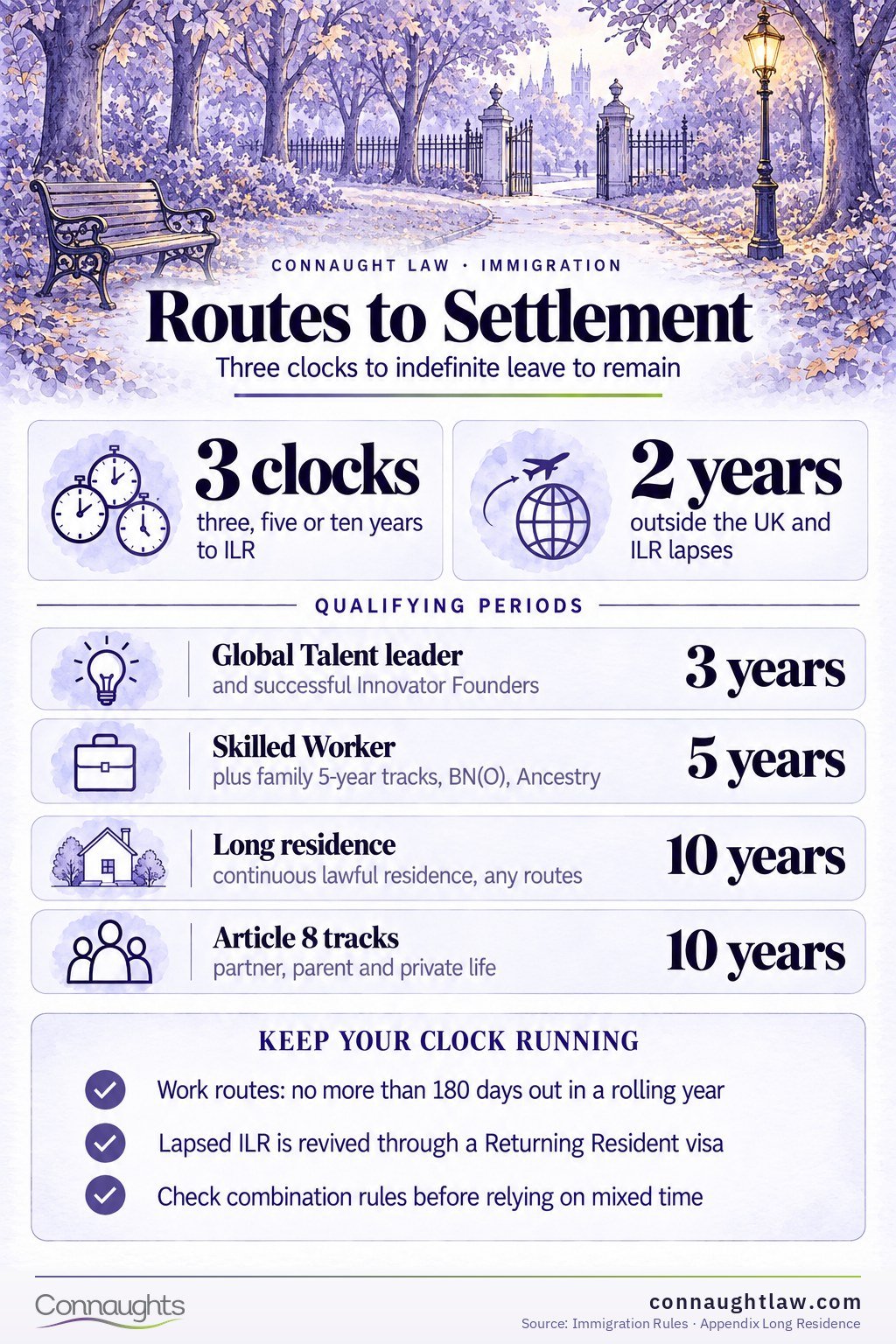
Every UK settlement journey runs on one of three clocks: accelerated three-year routes for talent and founders, the five-year mainstream — work, family, BN(O), Ancestry — and the ten-year long residence and private life tracks. All lead to the same £3,226 application. The earned settlement framework confirmed on 2 November 2026 will rework those clocks, but the Rules have not yet changed. This hub compares the routes, their qualifying periods and residence rules, and what the announced reforms will change.
On This Page

Three Clocks, One Destination
Indefinite leave to remain is the system's common endpoint — permanent residence, free of conditions, the base for citizenship — reached from routes with very different speeds and demands. Choosing between them, and switching wisely when circumstances change, is the settlement strategy question; the individual route guides linked below take each in depth, and this hub keeps the comparison current.
Three years: Global Talent leaders and successful Innovator Founders. Five years: Skilled Worker, family five-year tracks, BN(O), Ancestry. Ten years: long residence and the Article 8 tracks. All end at the same £3,226 application — and none has yet been changed: the earned settlement framework confirmed on 2 November 2026 still awaits the Immigration Rules that would bring it into force.
Fastest Routes
Global Talent: Three Years
Global Talent leaders — endorsed as exceptional talent rather than promise — settle after three years, the system's fastest mainstream clock, per the business and talent settlement rules. Promise-endorsed applicants take five; both enjoy the route's freedom from sponsorship throughout.
Innovator Founder: Three Years
Founders whose ventures meet the growth criteria settle after three years — the entrepreneurial fast track examined in our Innovator Founder guide — with endorsement checkpoints doing the quality control the old investor routes never managed.
Five-Year Routes
The Mainstream Clock
Qualifying Periods by Route
| Route | Years to ILR | Distinctive requirement |
|---|---|---|
| Global Talent (leader) · Innovator Founder | 3 | Endorsement quality |
| Skilled Worker · Health and Care Worker | 5 | Sponsorship + salary at settlement |
| Partner and parent (5-year track) | 5 | Financial + relationship continuity |
| BN(O) · UK Ancestry | 5 | Status / work intention |
| Long residence | 10 | Continuous lawful residence, any routes |
| Partner, parent, private life (10-year tracks) | 10 | Article 8 basis |
Family Routes
Partners and parents meeting the full requirements settle in five years under the framework mapped in our family settlement guide, with our family team handling the strategy where routes and switches interact. Sponsored workers — including the Health and Care Worker cohort — follow the requirements detailed in our Skilled Worker settlement guide.
BN(O) and Ancestry
The two status-based five-year routes carry the lightest ongoing requirements: the BN(O) route asks self-sufficiency and residence, the Ancestry visa a maintained work life — and both settle on the standard clock with the standard tests.
Ten-Year Routes
Long Residence
Ten continuous lawful years on almost any visa combination earns settlement under Appendix Long Residence — until earned settlement closes it — the accumulation route for students-turned-workers and everyone whose decade defies category, with its counting rules, case law and absence regimes in our long residence guide and the gap scenarios in our breaks in leave guide.
Private Life and Article 8 Tracks
The ten-year family and private life tracks serve those whose claim is the life built here rather than a category met — with children's provisions running faster, and protection-based routes alongside through our human rights team.
Earned Settlement
The Announced Framework
The white paper's ten-year standard is now government policy. The Home Secretary announced the outcome to Parliament on 2 November 2026, and the government response to the earned settlement consultation sets out the design. Ten years becomes the default. Five years is available for those earning at least £50,271 in three of the last five years, for eligible health and education occupations paid on national pay scales, and for a British connection — partners, parents and children of British citizens, and UK Ancestry. Three years is reserved for £125,141 earners and the high talent group. Specified immigration breaches, or use of specified public funds in the five years before applying, mean a 20-year path. Every applicant will also need a clean UK criminal record, no government debt, B2 English, the Life in the UK test and earnings of at least £12,571 in five of the last seven years, subject to exemptions; the Commons Library's briefings track the detail against current law.
What Is Law Today
None of the framework is in force. The response gives no commencement date, promising further guidance and a full impact assessment before implementation, and no statement of changes laid since contains it — every period in the table above remains the law until new Rules take effect. One element is already laid: under HC 1691, settlement applications made on or after 26 March 2027 on Skilled Worker and several other routes need B2 English. On transition, the government's position is that the Rules in force at the date of decision apply unless transitional provisions say otherwise. The announced protections are targeted: care workers who entered or switched into the route before the May 2025 white paper keep five years if they meet the £25,000 salary and route requirements, as do health and education workers below RQF 6 on national pay scales who arrived before then; BN(O) holders, the Armed Forces, bereaved partners and domestic abuse victims stay on existing arrangements. Long residence closes, and time on student, Graduate and other temporary routes will no longer count.
April 2026 Changes
The April 2026 fees round did land: settlement now costs £3,226 per applicant, continuing the pattern of annual increases, and applicants approaching eligibility have one more reason not to let a qualifying date pass unused while the earned settlement Rules are awaited.
ILR Costs
The Current Price
£3,226 per applicant, £50 for the Life in the UK test, English certification where needed — with exemptions covered in our exemptions guide — and priority services on top for those buying speed. Applications run through the UKVCAS process against a six-month standard.
Residence Rules
Work and points-based routes carry the 180-days-per-rolling-year absence limit; family routes assess whether the UK remained home; long residence runs its own two-regime history. And ILR itself keeps a residence rule after the grant — two years' absence lapses it (five for EUSS), reviving only through the Returning Resident visa. The counting mechanics for the 180-day test live in our absence rule guide; citizenship, twelve months after settlement, ends the arithmetic for good.
Frequently askedQuestions about settlement routes
What is the fastest route to ILR?
Three years — Global Talent for endorsed leaders, and Innovator Founder where the venture meets its growth criteria. The mainstream work, family, BN(O) and Ancestry routes run five years; long residence ten.
Which visas lead to settlement after 5 years?
Skilled Worker and Health and Care Worker, five-year partner and parent routes, BN(O), and Ancestry — each with its own continuing requirements at the settlement application, from salary thresholds to relationship continuity.
Has the qualifying period changed to 10 years?
Not yet. The government confirmed on 2 November 2026 that ten years will become the default, with shorter paths for higher earners, eligible public service roles and British connections, but no Immigration Rules implementing it have been laid. Current periods apply until they are, so qualified applicants should apply rather than wait.
How much does ILR cost in 2026?
£3,226 per applicant following the April 2026 fees round, plus £50 for the Life in the UK test — with no health surcharge on settlement, and £500/£1,000 priority services optional.
Can I combine time from different visas toward ILR?
Today, on the ten-year long residence route, yes — most lawful time combines, though the earned settlement framework will close that route once implemented. Five-year routes generally require the period in that route or defined combinations; the arithmetic is route-specific and worth checking before relying on it.
Does ILR ever expire?
It lapses after two continuous years outside the UK (five for EUSS settled status), and the Returning Resident visa is the way back. Citizenship removes the risk permanently — one reason most settled people take it.
Tell us your visa history and plans. We'll identify your fastest lawful route to settlement — and whether the earned settlement timetable argues for moving now.
Get Expert Advice